Drilling-Sky Poplar, a name in traditional Chinese medicine. It refers to the bark of Populus nigra var. italica (Moench) Koehne, a plant in the Salicaceae family. It is widely cultivated throughout the Yangtze and Yellow River basins in China. It has the effects of cooling the blood, detoxifying, dispelling wind, and removing dampness. It is commonly used to treat colds, hepatitis, dysentery, rheumatic pain, edema caused by beriberi, burns and scalds, as well as scabies, ringworm, and alopecia.

Drill-Sky Poplar
Drilling-Sky Poplar, a name in traditional Chinese medicine. It refers to the bark of Populus nigra var. italica (Moench) Koehne, a plant in the Salicaceae family. It is widely cultivated throughout the Yangtze and Yellow River basins in China. It has the effects of cooling the blood, detoxifying, dispelling wind, and removing dampness. It is commonly used to treat colds, hepatitis, dysentery, rheumatic pain, edema caused by beriberi, burns and scalds, as well as scabies, ringworm, and alopecia.
Chinese Name : 钻天杨
Authentic Producing Area : The Yangtze and Yellow River basins in China
Nature, Flavor & Meridian Tropism : Bitter in taste, cold in nature; enters the Liver and Heart meridians
Benefits & Efficacy
Benefits
Cools the blood and clears toxins; dispels wind and removes dampness.
Indications
Common cold, hepatitis, dysentery, rheumatic pain, edema caused by beriberi, burns and scalds, scabies, ringworm, and alopecia.
Usage and Dosage
Internal use: Decoct 10–30 g in water; or steep in alcohol. External use: Apply an appropriate amount—char the herb, grind into a powder, and apply as a paste; or boil into a paste and apply.
Precautions
Not yet established.
Relevant Discussions
*Compendium of Chinese Herbal Medicines*: “Cools the blood and detoxifies; dispels wind and removes dampness.”
Applications
Related Compatibility
1. For hepatitis, dysentery, and the common cold: 60–120 g of fresh Populus euphratica bark. Decoct in water and take orally. (*Compendium of Chinese Herbal Medicines*)
2. For rheumatic pain and edema caused by beriberi: Soak Populus euphratica bark in wine and take orally. (*Compendium of Chinese Herbal Medicines*)
3. For hypertension: 30 g of (Tall Poplar) bark. Decoct in water and take orally. (*Compendium of Chinese Herbal Medicines*)
4. For burns and scalds: An appropriate amount of (Tall Poplar) branches. Burn to ash, add a small amount of borneol, mix thoroughly with sesame oil, and apply to the affected area. (*Compendium of Chinese Herbal Medicines*)
5. For scabies, ringworm, and alopecia: Char the bark of *Populus davidiana* and mix with sesame oil; apply several times daily; or prepare a decoction from the bark and flowers and use as a paste. (*Compendium of Chinese Herbal Medicines*)
Processing & Preparation
Harvesting & Processing
Harvest in autumn or winter, or in conjunction with tree felling during cultivation. Use the peeled bark fresh or dry it in the sun.
Crude Drug Identification
Properties of Crude Drugs
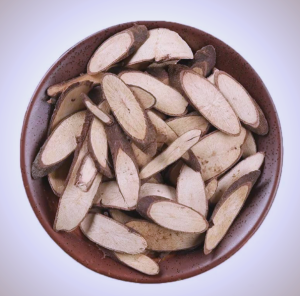
The bark is plate-like. The outer surface is dark grayish-brown or blackish-brown, rough, and grooved; after removing the outer layer, it appears yellowish-white or brownish-yellow and fibrous; the inner surface is relatively flat, yellowish-white or yellowish-brown, and light in texture. The fracture surface is plate-like and fibrous. It has a faint odor and a bland taste.
Botanical Information
Botanical Classification
Populus deltoides, a member of the Salicaceae family.
Morphological Characteristics
American Poplar, also known as American White Poplar or Pen Poplar. A tree reaching up to 30 m in height. The bark is dark grayish-brown and fissured with age; the crown is cylindrical. Buds are long-ovate, with a long, acuminate apex, pale red in color, and rich in mucilage.Leaves on long shoots are flattened-triangular, usually wider than long, about 7.5 cm long, with a short, gradually tapering apex, a truncate or broadly cuneate base, and margins bearing blunt, rounded teeth; leaves on short shoots are rhomboid-triangular or rhomboid-ovate, 5–10 cm long and 4–9 cm wide; petioles are slightly flattened toward the upper part, 2–4.5 cm long, with no glandular dots at the apex.Male inflorescences are 4–8 cm long, with 15–30 stamens; female inflorescences are 10–15 cm long. The capsule splits into two valves, with a pointed apex and a slender, elongated fruit stalk. Flowering occurs in April, and fruiting in May.
Distribution Area
Widely cultivated throughout the Yangtze and Yellow River basins in China.