
Emei Screen Grass, a name in traditional Chinese medicine. It refers to the whole plant of Tanakaea omeiensis, a member of the Saxifragaceae family. It is distributed in Sichuan. It has the therapeutic effects of clearing heat and subduing wind. It is commonly used to treat high fever with convulsions and epileptic seizures.
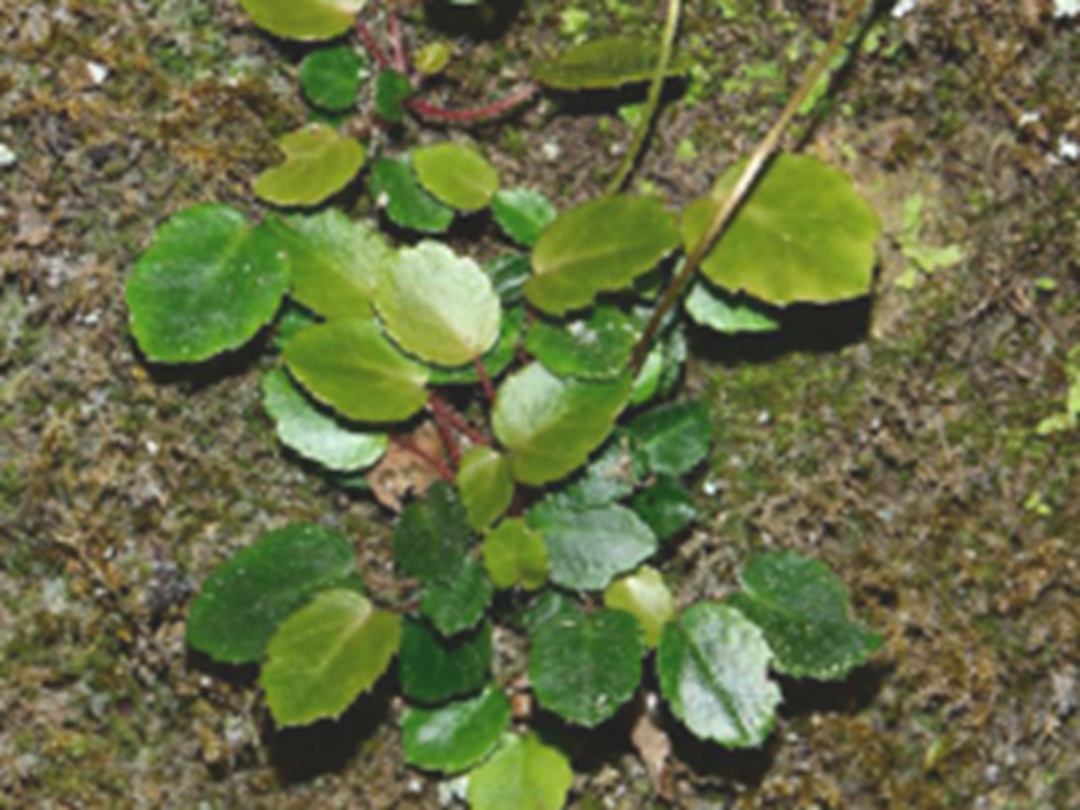
Emei Screen Grass
Emei Screen Grass, a name in traditional Chinese medicine. It refers to the whole plant of Tanakaea omeiensis, a member of the Saxifragaceae family. It is distributed in Sichuan. It has the therapeutic effects of clearing heat and subduing wind. It is commonly used to treat high fever with convulsions and epileptic seizures.
Chinese Name : 峨屏草
Aliases : Emei Rock Snow Under
Nature, Flavor & Meridian Tropism : Taste: bitter and salty; nature: cold. Enters the Liver meridian
Benefits & Efficacy
Benefits
Clears heat and subdues wind.
Indications
Febrile convulsions and epileptic seizures.
Usage and Dosage
Internal use: Decocted as a soup, 9–15 g; high doses may reach up to 30 g.
Relevant Discussions
*Xinhua Compendium of Materia Medica*: “The whole herb: has the effects of calming wind and relieving convulsions, and clearing heat.”
Applications
Processing & Preparation
Harvesting & Processing
Harvest from April to September; wash thoroughly and sun-dry.
Crude Drug Identification
Botanical Information
Botanical Classification
Emeipingcao, a plant of the Saxifragaceae family.
Morphological Characteristics
A perennial herb, 6.5–12.3 cm tall; rhizome creeping, approximately 2 mm in diameter.Leaves are all basal; leaf blades are elliptic, ovate to broadly ovate, 1.1–3 cm long, 0.8–2.9 cm wide, with an acute apex, coarsely serrate margins, and a rounded or slightly cordate base; both surfaces are covered with brown soft hairs (some bearing glandular tips); petioles are 1.1–6.5 cm long, covered with brown soft hairs(some bearing glandular tips). The flower stalk bears sparse glandular pubescence. The raceme is 2.8–3.5 cm long, covered with brown glandular pubescence; the sepals are narrowly ovate to lanceolate, 1.5–1.9 mm long, 0.4–0.6 mm wide, with an acute apex, glabrous on both surfaces, with very few glandular hairs along the margins, and unnerved;no petals; stamens 8–10, filaments 3.3–3.5 mm long; the lower parts of the two carpels fused, ca. 4 mm long, ovary nearly superior, styles 2. Capsule ca. 4 mm long, with two valves diverging. Flowering and fruiting period: April–October.
Distribution Area
Distributed in Sichuan.