Jinxianbiao, a name in traditional Chinese medicine. It refers to the roots and whole plant of Potentilla leuconota D. Don, a member of the Rosaceae family. It is distributed in southwestern China, as well as in Gansu, Taiwan, and Hubei. It has the effects of clearing heat, detoxifying, and promoting the elimination of dampness. It is commonly used to treat hoarseness caused by wind-heat, lung abscess, abdominal pain with diarrhea, and leukorrhea in women.

Jinxianbiao
Jinxianbiao, a name in traditional Chinese medicine. It refers to the roots and whole plant of Potentilla leuconota D. Don, a member of the Rosaceae family. It is distributed in southwestern China, as well as in Gansu, Taiwan, and Hubei. It has the effects of clearing heat, detoxifying, and promoting the elimination of dampness. It is commonly used to treat hoarseness caused by wind-heat, lung abscess, abdominal pain with diarrhea, and leukorrhea in women.
Chinese Name : 锦线镖
Aliases : Astringent Leaf, Brocade Flag Grass, Golden Thread Flag, Astringent Grass, Red Knotweed, White-Spotted Ginseng Fruit
Nature, Flavor & Meridian Tropism : Pungent and bitter in taste; cold in nature
Benefits & Efficacy
Benefits
Clears heat and detoxifies; promotes the elimination of dampness.
Indications
Used for hoarseness due to wind-heat, lung abscess, abdominal pain with diarrhea, and leukorrhea in women.
Usage and Dosage
Internal use: Decoct 15–30 g.
Relevant Discussions
*Compendium of Sichuan Chinese Materia Medica* (1960 edition): “Slightly cold in nature; astringent and sweet in taste; non-toxic.”
*Compendium of Chinese Herbal Medicines*: “Pungent and bitter; neutral in nature.”
*Compendium of Sichuan Chinese Materia Medica* (1960 edition): “Treats wind-heat-induced hoarseness, damp phlegm and wind-pathogen, abdominal pain with dysentery, and leukorrhea in women.”
*Compendium of Chinese Herbal Medicines*: “Clears heat and eliminates toxins. Primarily used to treat lung abscesses and dysentery.”
Applications
Related Compatibility
1. For wind-heat-induced hoarseness: 5 qian of Astringent Grass, 3 qian each of Ophiopogon tuber, Dendrobium, Chebulic myrobalan, and Sterculia seed; decoct in water and take orally. (*Medicinal Herbs of Wanxian*)
2. For dysentery: 1 liang of Shecao; 4 qian each of Shu Huanglian, Xianhecao, Purslane, and Radish root; decoct in water and take orally. (*Medicinal Herbs of Wanxian*)
3. For excessive leukorrhea: 8 qian of Shecao; 5 qian each of Golden Rosehip root and Cotton Seed; decoct in water and take orally. (*Medicinal Herbs of Wanxian*)
Processing & Preparation
Harvesting & Processing
Harvest in summer and fall; wash thoroughly and sun-dry.
Crude Drug Identification
Properties of Crude Drugs
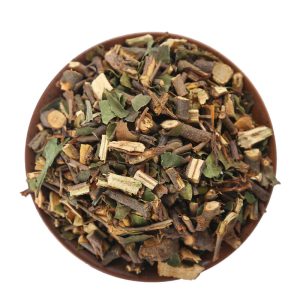
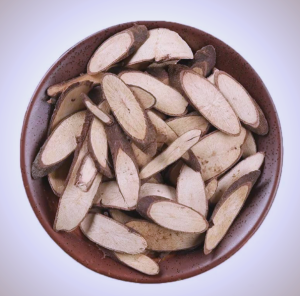
The root is cylindrical, over 10 cm long, and 1–1.5 cm in diameter; the outer surface is brownish-red, rough, fissured, and sometimes bears scars. It is hard and difficult to break. The cross-section of the woody core is also brownish-red, with wheel-like rings. It is odorless and has an astringent taste.
Botanical Information
Botanical Classification
Silver-leaved loosestrife, a plant of the Rosaceae family.
Morphological Characteristics
A perennial herb, 10–45 cm tall. The rhizome is thick. The flower stalk is erect or ascending, covered with appressed or slightly spreading long soft hairs.Basal leaves with petioles covered in appressed or slightly spreading long soft hairs; stipules membranous, brown, externally covered with white silky hairs; leaves discontinuously pinnately compound, rarely continuous, with 10–36 pairs of leaflets, opposite or alternate; the basal 2–3 pairs of leaflets extend downward to join the leaf rachis, while the remaining leaflets are sessile;leaflets oblong, elliptic, or elliptic-ovate, 0.5–3 cm long, 0.3–1.5 cm wide, gradually tapering downward, often appendage-like at the base, apex rounded-obtuse or acute, base rounded or broadly cuneate, margin with numerous acute or acuminate teeth, upper surface covered with appressed long soft hairs, rarely glabrous or nearly glabrous,the underside densely covered with silvery-white silky hairs, veins inconspicuous; cauline leaves 1–2, similar to basal leaves, with 3–7 pairs of leaflets; stipules herbaceous, margins deeply lacerate or deeply toothed.Flowers are bisexual; inflorescences are clustered at the apex of the flower stalk, forming a pseudo-umbel; flower stalks are covered with white, appressed soft hairs and bear a leaf-like involucre at the base; sepals are 5, triangular-ovate, with acute or acuminate tips; epicalyx segments are 5, lanceolate or oblong-lanceolate, slightly shorter than the sepals, entire, and externally covered with white, long soft hairs;Flowers 0.8–1 cm in diameter; petals 5, obovate, with rounded-obtuse apices, yellow; styles lateral. Achenes smooth and glabrous. Flowering and fruiting period: May–October.
Distribution Area
Southwest China, as well as Gansu, Taiwan, Hubei, and other areas.