Ma Diao’er, a name in traditional Chinese medicine. It refers to the tuberous root or the whole plant of Zehneria indica (Lour.) Keraudren, a member of the Cucurbitaceae family. It is distributed in Jiangsu, Zhejiang, Jiangxi, Fujian, Hubei, Hunan, Guangdong, Guangxi, Sichuan, Guizhou, and Yunnan. It has the effects of clearing heat and detoxifying, reducing swelling and dispersing nodules, resolving phlegm, and promoting urination.It is primarily used to treat boils, abscesses, and swellings; phlegm nodules and scrofula; sore throat; mumps; calculous urinary tract obstruction; difficulty urinating; skin eczema; red eyes and jaundice; hemorrhoids and fistulas; rectal prolapse; bleeding from external injuries; and venomous snake bites.

Ma Miao’er
Ma Diao’er, a name in traditional Chinese medicine. It refers to the tuberous root or the whole plant of Zehneria indica (Lour.) Keraudren, a member of the Cucurbitaceae family. It is distributed in Jiangsu, Zhejiang, Jiangxi, Fujian, Hubei, Hunan, Guangdong, Guangxi, Sichuan, Guizhou, and Yunnan. It has the effects of clearing heat and detoxifying, reducing swelling and dispersing nodules, resolving phlegm, and promoting urination.It is primarily used to treat boils, abscesses, and swellings; phlegm nodules and scrofula; sore throat; mumps; calculous urinary tract obstruction; difficulty urinating; skin eczema; red eyes and jaundice; hemorrhoids and fistulas; rectal prolapse; bleeding from external injuries; and venomous snake bites.
Chinese Name : 马瓞儿
Latin Name : Zehneria indica (Lour.) Keraudren
Aliases : Rat’s Tail Gourd, Wild Bitter Melon, Buttonweed, Jade Button
Authentic Producing Area : Jiangsu, Zhejiang, Jiangxi, Fujian, Hubei, Hunan, Guangdong, Guangxi, Sichuan, Guizhou, Yunnan
Nature, Flavor & Meridian Tropism : Sweet and bitter in taste; cool in nature; enters the Lung, Liver, and Spleen meridians
Benefits & Efficacy
Benefits
Clears heat and detoxifies; reduces swelling and disperses nodules; resolves phlegm and promotes urination.
Indications
Boils, abscesses, and swellings; phlegm nodules and scrofula; sore throat; mumps; calculi of the urinary tract; difficulty urinating; skin eczema; red eyes and jaundice; hemorrhoids and fistulas; rectal prolapse; bleeding from external injuries; venomous snake bites.
Usage and Dosage
Internal use: Decocted as a soup, 15–30 g; External use: Apply an appropriate amount, pounded and applied as a poultice; or decocted for washing.
Precautions
Not yet established.
Relevant Discussions
*Essentials of the Properties of Raw Herbs*: “Sweet in taste, cold in nature.”
*Guangdong Chinese Medicine*: “Sweet and bland in taste, cool in nature.”
*Guizhou Herbal Medicine*: “(Vine leaves) are neutral in nature, slightly bitter in taste.”
*Compendium of Chinese Herbal Medicine*: “Sweet and bitter, cool.”
*Essentials of the Properties of Raw Herbs*: “Treats hangovers, relieves small intestine colic, is applied to malignant sores, and treats locked jaw caused by snakebites.” “Treats paralysis and weakness of the limbs.”
*Illustrated Treatise on Plant Names and Realities*: “Treats anal abscesses caused by fish-mouth disease; used as a wash.”
*Guangdong Chinese Medicinal Herbs*: “Clears liver heat, removes dampness, and promotes diuresis; primarily treats bone pain caused by damp-heat, testicular swelling, and rat bites during pregnancy.”
Guangzhou Military Region *Manual of Common Chinese Herbal Medicines*: “Reduces swelling and draws out toxins; eliminates phlegm and disperses nodules. Treats boils, abscesses, and carbuncles; skin eczema; sore throat; mumps; urinary tract infections; stones; acute conjunctivitis; and malnutrition in children.”
*Compendium of Chinese Herbal Medicines*: “Clears heat and detoxifies; reduces swelling and disperses nodules. Used externally to treat lymph node tuberculosis.”
*Flora of Medicinal Plants of Zhejiang*: “Reduces swelling and drains pus. Primarily used to treat cellulitis.”
Applications
Related Compatibility
1. For treating boils, carbuncles, furuncles, and frostbite: Grind the dried roots of *Ma Miao’er* into a powder, mix with tea oil, and apply as a poultice. (*Quanzhou Materia Medica*)
2. For treating cellulitis: Use appropriate amounts of fresh *Ma Miao’er* whole plant, fresh *Huanliancao*, fresh *Jixuecao*, and fresh *Longkui*. Pound them into a paste and apply externally to the affected area.(*Flora of Medicinal Plants of Zhejiang*)
3. For treating multiple abscesses: Equal parts of Ma Miao’er root and ground ear grass. Pound into a paste and apply to the affected area. (*Fujian Materia Medica*)
4. For treating osteomyelitis: 9 g each of Ma Miao’er root, mountain sesame, and dandelion, plus one pig’s trotter. Simmer until tender, mix with a small amount of wine, and take before meals.(*Fujian Materia Medica*)
5. For lymph node tuberculosis: 15 g of Ma Miao’er root and 9 g of summer枯草. Decoct in water and take orally. (*Fujian Materia Medica*)
6. For hernias, bone pain caused by damp-heat, and skin eczema: 15–30 g of dried Ma Miao’er root; decoct in water and take orally; for external use, take an appropriate amount, pound into a paste and apply, or boil in water for external washing.(*Guangdong Chinese Herbal Medicine*)
7. For mumps, laryngitis, and acute conjunctivitis: 15–30 g of Ma Miao’er; decoct in water and take orally. (*Hubei Compendium of Chinese Herbal Medicine*)
8. For urinary tract infections, urinary stones, and malnutrition in children: 15–30 g of Ma Miao’er root; decoct in water and take orally. (*Hubei Compendium of Chinese Herbal Medicine*)
9. For the treatment of systemic lupus erythematosus: 15–18 g of Ma Miao’er root; decoct in slightly more than half a bowl of water for a short time; take 1–2 times daily. (*Compendium of Chinese Herbal Medicines*)
Processing & Preparation
Harvesting & Processing
Harvest in summer and fall; dig up the tuberous roots, remove soil and fine roots, wash thoroughly, and cut into thick slices; chop the stems and leaves finely, and use them fresh or sun-dry them.
Crude Drug Identification
Properties of Crude Drugs
The tuberous roots are potato-shaped, with a surface ranging from earthy yellow to brownish-yellow.The cross-section is powdery white to yellowish-white and starchy; the texture is firm and brittle, breaking easily. The stems are slender and twisted, dark green or grayish-white, with fine longitudinal ridges. The tendrils are fine and thread-like. The simple leaves are alternate, wrinkled, curled, and often fragmented; intact leaves are triangular-ovate or heart-shaped, with a green upper surface densely covered with small grayish-white raised dots, and a grayish-green lower surface with prominent veins. It has a faint odor and a slightly astringent taste.
Botanical Information
Botanical Classification
Ma Duan’er, a plant of the Cucurbitaceae family.
Morphological Characteristics
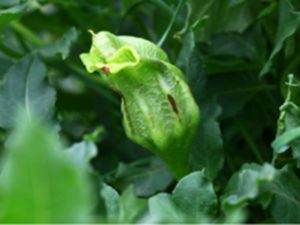
Ma Duan’er: A climbing or prostrate herb. The tuberous root is tuber-like. Stems and branches are slender, with ridges and grooves, and glabrous. Tendrils are unbranched. Petioles are slender, 2.5–3.5 cm long,with membranous leaf blades of various shapes—triangular-ovate, ovate-cordate, or lanceolate—that are either entire or shallowly lobed into 3–5 lobes, 3–5 cm long and 2–4 cm wide. The upper surface is dark green with very short soft hairs along the veins; the lower surface is pale green and glabrous. The apex is acuminate or, rarely, shortly acuminate; the base is semicircularly emarginate; the margin is slightly wavy or sparsely toothed; and the venation is palmate.Monoecious; male flowers solitary or, rarely, in clusters of 2–3 on short racemes; peduncle slender and extremely short; pedicel filiform; calyx broadly campanulate with 5 lobes; corolla 5-lobed, pale yellow, with extremely short soft hairs; stamens 3, 2 of which are 2-celled and 1 of which is 1-celled, though sometimes all are 2-celled;female flowers are solitary or in pairs in the same leaf axil as the male flowers; the ovary is narrowly ovate with wart-like protrusions; the style is short, and the stigma is 3-lobed; the staminodes are glandular. The fruit is oblong or narrowly ovate, blunt at both ends, glabrous externally, 1–1.5 cm long and 0.5–0.8 cm wide, turning orange-red or red when ripe.The seeds are grayish-white, ovate, slightly narrowed at the base, and with indistinct margins. Flowering occurs from April to July, and fruiting from July to October.
Distribution Area
Distributed in Jiangsu, Zhejiang, Jiangxi, Fujian, Hubei, Hunan, Guangdong, Guangxi, Sichuan, Guizhou, and Yunnan.