Mao Li Ye, a name in traditional Chinese medicine. It refers to the leaves of Castanea seguinii Dode, a plant in the Fagaceae family. It is distributed in East China, Central and South China, Southwest China, as well as Shanxi, Shaanxi, and Taiwan. It has the efficacy of aiding digestion and strengthening the stomach. It is primarily used to treat indigestion.
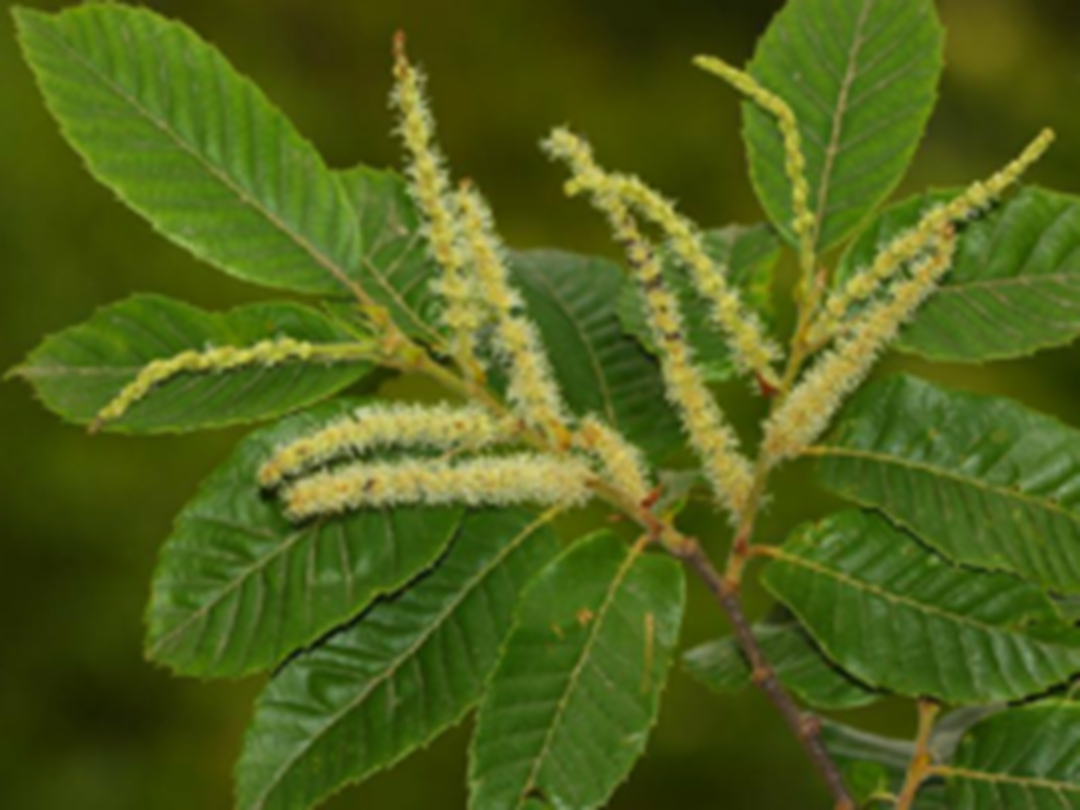
Maoli Leaf
Mao Li Ye, a name in traditional Chinese medicine. It refers to the leaves of Castanea seguinii Dode, a plant in the Fagaceae family. It is distributed in East China, Central and South China, Southwest China, as well as Shanxi, Shaanxi, and Taiwan. It has the efficacy of aiding digestion and strengthening the stomach. It is primarily used to treat indigestion.
Chinese Name : 茅栗叶
Benefits & Efficacy
Benefits
Promotes digestion and strengthens the stomach.
Indications
Primarily used to treat indigestion.
Usage and Dosage
Internal use: Decoct 15–30 g.
Precautions
Patients requiring treatment with Chinese herbal medicine should first consult a licensed Traditional Chinese Medicine (TCM) hospital, where a TCM practitioner will conduct a professional pattern differentiation and issue a herbal prescription.
Applications
Processing & Preparation
Harvesting & Processing
Harvested in summer and fall; used fresh or sun-dried.
Crude Drug Identification
Botanical Information
Botanical Classification
A plant of the Fagaceae family, known as "Mao Li."
Morphological Characteristics
Maoli, also known as Shu, Shu Li, Jin Li, Ye Maoli, or Mao Li. A deciduous shrub or small tree. Young branches are covered with soft hairs; buds are ovate, 2–3 mm long. Leaves are alternate; petioles are 0.6–1 cm long and bear short hairs;leaf blades are thin and leathery, oblong or obovate-oblong, 6–14 cm long and 3–7 cm wide, with an acuminate apex, a wedge-shaped, rounded, or slightly cordate base, often asymmetrical, margins bearing short, spiny-like serrations, and 12–17 pairs of pinnate lateral veins;glossy on the upper surface, with hairs along the veins, and brownish-yellow on the lower surface, bearing scaly glandular dots. Flowers are unisexual, with male and female flowers on the same plant; male inflorescences are spicate, solitary in the axils of new branches, erect, 6–7 cm long, bearing a single flower, with 10–14 stamens; female flowers are borne below the male inflorescences, usually in clusters of three, with an inferior, 6-chambered ovary.The involucre is nearly spherical, 3–4 cm in diameter, with slender, pointed spines on the outer surface; the spines are 4–5.5 mm long and densely arranged. Each cupule contains 3–7 nuts, usually 3; the nuts are flattened-spherical, 1–1.5 cm in diameter, and brown. Flowering occurs in May, and fruiting in September–October.
Distribution Area
Distributed in East China, Central and South China, Southwest China, as well as Shanxi, Shaanxi, and Taiwan.