Red Blood Vine, a name in traditional Chinese medicine. It refers to the stems and vines of the legume Spatholobus sinensis Chun et T. Chen. It is distributed in Guangdong, Hainan, and Guangxi. It has the effects of nourishing the blood and promoting blood circulation. It is commonly used to treat anemia, amenorrhea, irregular menstruation, and joint and bone pain.

Red Blood Vine
Red Blood Vine, a name in traditional Chinese medicine. It refers to the stems and vines of the legume Spatholobus sinensis Chun et T. Chen. It is distributed in Guangdong, Hainan, and Guangxi. It has the effects of nourishing the blood and promoting blood circulation. It is commonly used to treat anemia, amenorrhea, irregular menstruation, and joint and bone pain.
Chinese Name : 红血藤
Nature, Flavor & Meridian Tropism : Sweet in taste, warm in nature. Enters the Liver Meridian
Benefits & Efficacy
Benefits
Nourishes the blood and promotes blood circulation.
Indications
Anemia, amenorrhea, irregular menstruation, and joint and bone pain.
Usage and Dosage
Internal use: Decoct 9–15 g.
Precautions
Use with caution during pregnancy.
Pharmacological Actions
A decoction of red blood vine significantly prolongs blood clotting time. Its ethanol extract inhibits red blood cell aggregation at high concentrations but promotes aggregation at low concentrations.
Relevant Discussions
*Xinhua Compendium of Materia Medica*: “The stems and vines are used as a substitute for chicken-blood vine.”
Applications
Processing & Preparation
Harvesting & Processing
Harvest throughout the year or in fall and winter; wash, slice, and sun-dry.
Crude Drug Identification
Properties of Crude Drugs
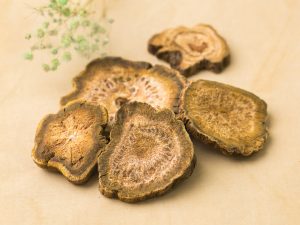
The stem is cylindrical, slightly curved, 3.3–4.0 cm in diameter, with a grayish-brown surface featuring distinct longitudinal grooves and fine, dense transverse rings.lenticels are wart-like protrusions, round or oval in shape, small; the stem is hard and difficult to break; the fracture surface is irregularly fissured; in cross-section, the bark exudes a blackish-brown secretion, the wood is reddish-brown, the woody parenchyma is darker in color and arranged in wavy layers, the vessels are pitted and irregularly arranged, the pith is minute; it has a faint odor and a bland taste.
Botanical Information
Botanical Classification
A legume plant, known as red blood vine.
Morphological Characteristics
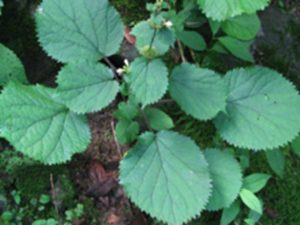
A climbing shrub. The branches are initially purplish-brown and slightly pubescent, later turning gray and glabrous, with dense linear striations. The leaves are trifoliate and leathery; the petioles are 2–5 cm long, slender, swollen at the base, and pubescent; the stipules are awl-shaped, 3 mm long, and persistent;leaflets are oblong-elliptic; the terminal leaflet is 5–8 cm long and 2–3 cm wide, while the lateral leaflets are slightly smaller, with the apex abruptly narrowed to a blunt point and the base rounded or broadly obtuse; the upper surface is glabrous and glossy when mature, while the lower surface is covered with rough, appressed hairs.Panicles are axillary, densely covered with brown, rough, appressed hairs, 8–10 cm long; bracteoles are 2, awl-shaped, 1 mm long; flowers are 7–8 mm long, somewhat densely arranged; pedicels are 3–4 mm long, hairy; the calyx is campanulate, externally pubescent, 5-lobed, with ovate lobes;the corolla is purplish-red, with each petal bearing a slender claw; the standard is flattened-rounded with a concave apex; the wings are obovate-lanceolate with downward-pointing lobes; the keel is lanceolate and lacks lobes; the ovary is linear-lanceolate, covered with rough, appressed hairs, and the style is glabrous.The pod is sessile, oblong-oblique, 7–9 cm long, 2–2.3 cm wide from the middle downward, and narrower toward the apex; the fruit valves are thin with fine reticulate veins, covered with brown, long, soft hairs, and the dorsal suture is densely tomentose; the seeds are oblong-elliptic, flattened, about 3 cm long, with a black seed coat.
Distribution Area
Guangdong, Hainan, Guangxi.