Mulberry leaves are a type of traditional Chinese medicinal herb used to disperse wind-heat. First recorded in the *Shennong Bencao Jing*, they are the dried leaves of the mulberry plant (Morus alba L.) of the Moraceae family and are produced in most regions of the country.Mulberry leaves have the effects of dispersing wind-heat, clearing the lungs and moistening dryness, subduing liver yang, and clearing the liver to improve vision. They are primarily used to treat conditions such as wind-heat colds, the early stages of warm diseases, lung-heat coughs, dry-heat coughs, hyperactive liver yang, and rising liver fire. In addition, mulberry leaves can cool the blood and stop bleeding, and they are also effective in improving conditions such as hemoptysis and hematemesis caused by uncontrolled blood heat.Mulberry leaves of a yellow-green color are considered the best; they can be used raw or after being honey-roasted.

Mulberry Leaves
Mulberry leaves are a type of traditional Chinese medicinal herb used to disperse wind-heat. First recorded in the *Shennong Bencao Jing*, they are the dried leaves of the mulberry plant (Morus alba L.) of the Moraceae family and are produced in most regions of the country.Mulberry leaves have the effects of dispersing wind-heat, clearing the lungs and moistening dryness, subduing liver yang, and clearing the liver to improve vision. They are primarily used to treat conditions such as wind-heat colds, the early stages of warm diseases, lung-heat coughs, dry-heat coughs, hyperactive liver yang, and rising liver fire. In addition, mulberry leaves can cool the blood and stop bleeding, and they are also effective in improving conditions such as hemoptysis and hematemesis caused by uncontrolled blood heat.Mulberry leaves of a yellow-green color are considered the best; they can be used raw or after being honey-roasted.
Chinese Name : 桑叶
Latin Name : Folium Mori
Aliases : Common Mulberry, Yellow Mulberry, Chinese Mulberry, Iron Fan Tree, Winter Mulberry Leaves
Authentic Producing Area : Zhejiang, etc.
Nature, Flavor & Meridian Tropism : Cold in nature; sweet and bitter in taste; enters the Lung and Liver meridians
Benefits & Efficacy
Benefits
Mulberry leaves are cold in nature, sweet and bitter in taste, and enter the Lung and Liver meridians. They have the effects of dispersing wind-heat, clearing the lungs and moistening dryness, subduing liver yang, clearing the liver and improving vision, and cooling the blood to stop bleeding.
Indications
1. Mulberry leaves are primarily used to treat wind-heat common cold, the early stages of warm diseases, lung-heat cough, dry-heat cough, headaches and dizziness caused by hyperactive liver yang, as well as red, swollen, and painful eyes and blurred vision resulting from wind-heat ascending or liver fire flaring upward. 2. Mulberry leaves can also be used in combination with other herbs that cool the blood and stop bleeding to treat hemoptysis, hematemesis, and epistaxis caused by uncontrolled blood flow due to blood heat.
Usage and Dosage
1. Decoct and take orally, 5–10 g; or incorporate into pills or powders. 2. For external use, decoct in water and use as an eye wash.
Precautions
1. Patients with psoriasis should use mulberry leaves and their products with caution. 2. Use with caution in individuals with spleen-stomach deficiency-cold or yang deficiency constitution.
Chemical Constituents
Mulberry leaves primarily contain flavonoids (rutin, quercetin, isoquercetin, morin, etc.), steroidal compounds (such as achyranthes sterone, hydroxyecdysterone, rapeseed sterone, daidzein, etc.),coumarin compounds (umbelliferone, scopolin, scopolin glycoside, etc.), as well as essential oils, alkaloids, and terpenoids.
Pharmacological Actions
Mulberry leaves possess anti-inflammatory, anticoagulant, hypoglycemic, antihypertensive, antioxidant, anti-stress, and anti-fatigue effects.
Applications
Related Compatibility
1. Mulberry leaves combined with chrysanthemum flowers. When used together, these two herbs enhance the effects of dispersing wind-heat, calming the liver, and clearing the liver to improve vision. This combination is commonly used to treat wind-heat exterior syndromes or the early stages of warm diseases; headaches and dizziness caused by hyperactive liver yang; and red, swollen, and painful eyes resulting from wind-heat ascending or liver fire flaring up.
2. Mulberry leaves combined with mulberry twigs. Mulberry leaves are light in nature and cold in property, capable of clearing and draining liver fire;Mulberry twigs are bitter and neutral in nature, capable of dispelling wind-dampness to relieve pain and promoting joint mobility to treat numbness. When used together, these two herbs provide a light, clearing, and dispersing action that reaches the limbs, clears the liver and purges fire, dispels wind, and relieves pain. This combination is commonly used to treat symptoms such as dizziness, headaches, and limb numbness caused by the stagnation of liver wind and liver fire in the meridians; it can also alleviate headaches and joint pain resulting from exogenous wind-heat.
3. Mulberry leaves combined with black sesame seeds. Mulberry leaves clear liver heat and improve vision to address the symptoms, while black sesame seeds tonify the essence and blood of the liver and kidneys to address the root cause. When used together, this combination nourishes yin and improves vision, and is commonly used to treat dizziness, vertigo, and blurred vision caused by deficiency of the liver and kidneys.
4. Mulberry leaves combined with perilla seeds. Mulberry leaves disperse wind, clear heat, cool the blood, and unblock the meridians; perilla seeds descend qi, transform phlegm, relieve cough, and alleviate wheezing. When used together, this combination dispels wind, clears heat, descends qi, relieves cough, and alleviates wheezing. It is commonly used to treat symptoms such as coughing with shortness of breath, thick phlegm, wheezing, and thirst caused by lung heat complicated by wind.
5. Mulberry Leaf combined with Loquat Leaf. Mulberry Leaf has the effects of dispersing wind-heat, clearing the lungs and moistening dryness, and promoting lung function to relieve cough; Loquat Leaf has the effects of descending qi, regulating the lungs, resolving phlegm, and relieving cough. When used together, they can promote the descent of lung qi, resolve phlegm, and relieve cough. This combination is commonly used to treat symptoms such as coughing and wheezing, as well as difficult expectoration, caused by wind-heat and dry-fire invading the lungs and impaired lung function.
6. Mulberry leaves combined with mulberry bark. Mulberry leaves disperse wind, clear heat, promote lung function, and relieve cough; mulberry bark clears and drains lung heat, descends qi, and alleviates wheezing. When used together, these two herbs promote the descent of lung qi, clear heat, relieve cough, and alleviate wheezing. This combination is commonly used to treat wind-heat stagnating in the lungs, cough with shortness of breath, and yellow or white, viscous phlegm.
Medicinal Identification
Honey-fried mulberry leaves enhance their ability to moisten the lungs and relieve coughs; therefore, honey-fried mulberry leaves are often used for dry-lung coughs. However, for dispersing wind-heat, clearing lung heat and moistening dryness, subduing liver yang, clearing the liver and improving vision, and cooling the blood to stop bleeding, regular mulberry leaves are more commonly used.
Related Medicines
Mulberry and Ginger Cold Tablets, Wind-Heat Cough Capsules, Autumn Dryness Cold Granules, Mulberry and Hemp Pills, and Gastrodia and Polygonum Multiflorum Tablets, among others.
Related Prescriptions
Mulberry and Chrysanthemum Decoction, Mulberry and Apricot Decoction, Decoction for Clearing Dryness and Rescuing the Lungs, Antelope Horn and Uncaria Decoction, and Fusan Pills, etc.
Notes
Patients requiring treatment with traditional Chinese medicine should first consult a licensed TCM hospital, where a TCM practitioner will conduct a professional diagnosis and prescribe the appropriate herbal formula.
Processing & Preparation
Harvesting & Processing
Harvest after the first frost, remove impurities, and sun-dry.
Processing Methods
1. To process mulberry leaves, take the raw herb, remove impurities, crumble it, remove the stems, and sift out any dust or debris.
2. To prepare honey-processed mulberry leaves, first dilute refined honey with an appropriate amount of boiling water, then pour it over the clean, crushed mulberry leaves and mix thoroughly. After allowing the mixture to stand until moistened, place it in a frying pan and heat over low heat. Stir-fry until the surface turns a deep yellow color, becomes slightly glossy, and no longer sticks to the hands. Remove from heat and allow to cool.
Storage Methods
Store in a dry place to prevent mold, insect infestation, and discoloration.
Crude Drug Identification
Properties of Crude Drugs
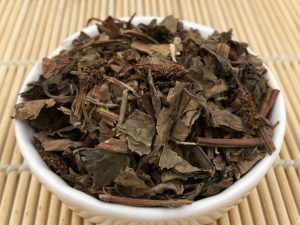
Mulberry leaves are often shriveled and fragmented. Intact leaves have petioles; when flattened, the leaf blade is ovate or broadly ovate, 8–15 cm long and 7–13 cm wide.The apex is acuminate; the base is truncate, rounded, or cordate; the margin is serrate or bluntly serrate, and some are irregularly lobed. The upper surface is yellowish-green or pale yellowish-brown, sometimes with small wart-like protrusions; the lower surface is slightly paler, with prominent veins and a reticulate network of minor veins; the veins are sparsely hairy, and the vein bases bear tufts of hairs. The texture is brittle. The odor is faint; the taste is bland, with a slight bitterness and astringency.
Properties of Processed Slices
This product consists of irregularly broken leaf fragments. The margins of the leaf fragments show serrations or blunt serrations, while some are irregularly lobed. The upper surface is yellowish-green or pale yellowish-brown; the lower surface is slightly paler in color. The main veins are prominent, the secondary veins form a reticulate pattern, and the veins are sparsely hairy, with tufts of hairs at their bases. The texture is brittle. The odor is faint; the taste is bland with a slight bitterness and astringency.
Botanical Information
Botanical Classification
A plant of the genus Morus in the family Moraceae.
Morphological Characteristics
A deciduous shrub or small tree, 3–15 meters tall. The root bark is yellowish-brown or reddish-yellow and highly fibrous. Simple leaves are alternate, ovate to broadly ovate; the upper surface is glabrous and glossy, while the lower surface is green, with sparse hairs along the veins and hairs in the axils of the veins; mature leaves are yellowish-green, while young leaves are dark green; the leaves are brittle and easily broken, with a slightly bitter and astringent taste.Flowering period: April–May; fruiting period: June–July.
Distribution Area
It is cultivated throughout the country, with higher yields in the silkworm-rearing regions of the southern provinces.
Growth Habits
Mulberry leaves thrive in warm, humid climates and prefer full sun; they are tolerant of poor soil, cold, drought, wind, smoke and dust, and toxic gases, demonstrating strong adaptability to various climates and soil conditions. They prefer deep, loose, fertile soil and can tolerate mild salinity and alkalinity. The plant has a well-developed root system, grows rapidly, has strong regrowth capacity, is highly disease-resistant, and has a long lifespan—generally reaching several hundred years, with some individuals living for thousands of years.