Heishun Slices, also known as Black Aconite, are a type of Aconite used in traditional Chinese medicine. They are the lateral roots of Aconitum carmichaelii Debx. (a plant in the Ranunculaceae family), processed through cleaning, boiling in a bile-based solution, rinsing with water, slicing, and steaming.This product is primarily produced in Sichuan. It has the effects of restoring yang to reverse collapse, tonifying fire to assist yang, and dispelling cold to relieve pain. It is commonly used to treat conditions such as cold limbs and a faint pulse due to yang collapse and deficiency; chest pain (xianbi) caused by insufficient heart yang; impotence and uterine cold due to kidney yang deficiency; vomiting and diarrhea caused by deficiency-cold; cold pain in the epigastrium and abdomen; cold-damp edema; yang deficiency with external pathogenic factors; and cold-damp arthralgia.

Heishun Pian
Heishun Slices, also known as Black Aconite, are a type of Aconite used in traditional Chinese medicine. They are the lateral roots of Aconitum carmichaelii Debx. (a plant in the Ranunculaceae family), processed through cleaning, boiling in a bile-based solution, rinsing with water, slicing, and steaming.This product is primarily produced in Sichuan. It has the effects of restoring yang to reverse collapse, tonifying fire to assist yang, and dispelling cold to relieve pain. It is commonly used to treat conditions such as cold limbs and a faint pulse due to yang collapse and deficiency; chest pain (xianbi) caused by insufficient heart yang; impotence and uterine cold due to kidney yang deficiency; vomiting and diarrhea caused by deficiency-cold; cold pain in the epigastrium and abdomen; cold-damp edema; yang deficiency with external pathogenic factors; and cold-damp arthralgia.
Chinese Name : 黑顺片
Aliases : Black Aconite
Nature, Flavor & Meridian Tropism : Pungent and sweet in taste; extremely hot in nature; enters the Heart, Kidney, and Spleen meridians
Benefits & Efficacy
Benefits
Black Shun Pian has a pungent and sweet taste, is extremely hot in nature, and enters the Heart, Kidney, and Spleen meridians. It has the effects of restoring yang to reverse collapse, tonifying fire to assist yang, and dispelling cold to relieve pain.
Indications
Black Sliced Aconite is primarily used to treat conditions such as cold limbs and a faint pulse due to yang collapse and deficiency; chest pain (xianbi) caused by insufficient heart yang; impotence and uterine coldness due to kidney yang deficiency; vomiting and diarrhea caused by deficiency-cold; cold pain in the epigastrium and abdomen; cold-damp edema; yang deficiency with external pathogenic factors; and cold-damp arthralgia.
Usage and Dosage
Decoct 3–15 g; it should be boiled first and simmered for a long time until the numbing and spicy sensation is no longer detectable when tasted; or it may be incorporated into pills or powders.
Precautions
1. This product is pungent, hot, and intensely drying; therefore, pregnant women should use it with caution. 2. Use with caution in the elderly and children. 3. Use with caution in patients with cardiac dysfunction, abnormal blood pressure, or impaired liver or kidney function. 4. This product should not be used in combination with Pinellia, Trichosanthes, Trichosanthes seeds, Trichosanthes peel, Tianhuafen, Sichuan fritillary bulb, Zhejiang fritillary bulb, Ping fritillary bulb, Yi fritillary bulb, Hubei fritillary bulb, Bailing, or Baiji. 5. This product should not be used in combination with Evodia or Wilfordia. 6. This product should not be used in combination with cardiac glycosides, quinidine, or procaine. 7. During treatment, monitor changes in blood pressure, heart rate, body temperature, and respiration, and watch for adverse reactions such as tongue numbness or palpitations. 8. Avoid alcohol consumption during treatment; do not consume coffee; and avoid spicy, raw, or cold foods.
Chemical Constituents
This product primarily contains diester-type alkaloids (such as aconitine, neoaconitine, subaconitine, noraconitine, norpachyrine, taraaconitine,isopapaverine, neopapaverine, etc.) and monoester alkaloids (such as benzyl neoprotonine, benzyl aconitine, benzyl subaconitine, etc.).
Pharmacological Actions
Modern pharmacological studies have found that this product has cardiotonic, blood pressure-raising, vasodilatory, cardioprotective, energy metabolism-promoting, anti-inflammatory, and analgesic effects.
Applications
Related Compatibility
1. Heishun Pian combined with Danggui: Heishun Pian is pungent, hot, and intensely drying, excelling at warming and tonifying yang qi; Danggui is sweet, warm, and moisturizing, excelling at nourishing liver blood.When used in combination, Heishun Pian, when paired with Danggui, penetrates the blood level, while Danggui, when combined with Heishun Pian, gains enhanced warming and circulatory power. This combination offers the subtle benefit of balancing both yin and yang and is commonly used to treat bloody stools caused by spleen-stomach deficiency-cold, as well as dysmenorrhea and amenorrhea resulting from yang deficiency with cold stagnation complicated by blood stasis.
2. Hei Shun Pian Combined with Guizhi: Hei Shun Pian is pungent, hot, and highly mobile, circulating through the Twelve Meridians; it can warm yang, dispel cold, expel dampness, and relieve pain. Guizhi, with its pungent nature, dispels wind pathogens and warms and unblocks the meridians. When used together, these two herbs work to warm and unblock the yang qi of the Heart and Kidney, dispel cold, unblock the collaterals, and eliminate bi syndrome. They are commonly used to treat palpitations and shortness of breath caused by deficient Heart yang, chest bi pain, and severe cold-bi pain.Furthermore, since Guizhi can warm and unblock Wei Yang, relieve muscle tension, and induce sweating, and Heishun Pian excels at replenishing fire and assisting Yang, the combination of the two aids in supporting Yang and resolving exterior syndromes, making it suitable for treating wind-cold exogenous pathogens in cases of Yang deficiency.
3. Heishun Pian combined with Ren Shen: Heishun Pian is pungent, sweet, and extremely hot, excelling at restoring Yang to reverse collapse and replenishing fire to assist Yang; Ren Shen is sweet and warm, capable of greatly replenishing original Qi, restoring the pulse, and consolidating collapse.When used together, they can tonify qi, consolidate collapse, restore yang, and reverse collapse. This combination is commonly used to treat sudden yang collapse characterized by cold extremities, profuse cold sweat, and a faint, nearly imperceptible pulse.
4. Heishun Pian combined with White Peony Root (Bai Shao): Heishun Pian is pungent and hot, warming the kidneys and strengthening yang; White Peony Root is sweet and sour, astringing yin and alleviating urgency.When combined, one is warming and the other cooling; one disperses with pungency and the other astringes with sourness. This pairing allows White Peony Root’s ability to tonify deficiency and harmonize the Nutritive Blood to mitigate Hei Shun Pian’s tendency to deplete Nutritive Yin, while simultaneously harnessing Hei Shun Pian’s potent ability to break through blockages and overcome obstacles, thereby circumventing White Peony Root’s astringent nature. Through this complementary interplay of opposites, the effect of unblocking stagnation and relieving pain is particularly pronounced; this combination is frequently used to treat bi syndrome characterized by a predominance of cold pathogens.
5. Hei Shun Pian combined with Huang Lian: Hei Shun Pian is pungent and hot, warming Yang to treat deficiency-cold; Huang Lian is bitter and cold, clearing the Heart to treat excess heat. The bitter-cold nature of Huang Lian and the pungent-hot nature of Hei Shun Pian mutually counteract each other, achieving a dual effect of clearing and warming. This combination is commonly used to treat conditions characterized by heat above and cold below, as well as patterns of mutual resistance between cold and heat.
Medicinal Identification
Salted Aconite, Black Shun Pian, White Aconite Slices, Processed Aconite Slices, and Mild Aconite Slices are different processed forms of Aconite, each with distinct therapeutic focuses. Among these, soaking Aconite in a salt solution and then sun-drying it prevents the herb from rotting and facilitates storage;whereas Black Shun Slices and White Aconite Slices have reduced toxicity and can be used directly in formulas; Roasted Aconite Slices primarily warm the kidneys and spleen, and are commonly used to treat cold pain in the chest and abdomen, as well as vomiting and diarrhea due to deficiency-cold; Light Aconite Slices excel at restoring yang to reverse collapse, dispelling cold, and relieving pain, and are frequently used to treat yang-collapse with deficiency, cold limbs with a faint pulse, yin-cold edema, yang-deficiency with external pathogenic factors, and cold-damp arthralgia.
Related Medicines
Formulas such as Kidney-Fortifying and Asthma-Relieving Pills, Heart-Nourishing Pills, and Gastrodia Pills.
Notes
Patients requiring treatment with Heishun Pian should first consult a licensed Traditional Chinese Medicine (TCM) hospital, where a TCM practitioner will conduct a professional pattern differentiation and issue a TCM prescription.
Processing & Preparation
Harvesting & Processing
Harvest from late June to early August; remove the mother root, fibrous roots, and soil.
Processing Methods
Take the raw medicinal materials, wash them according to size, soak them in an aqueous solution of edible bile for several days, then boil them together with the soaking liquid until thoroughly cooked through. Remove them, rinse with water, cut lengthwise into slices approximately 0.5 cm thick, and rinse again with water. Use a coloring solution to dye the slices a dark tea color. Remove them, steam until the surface becomes glossy, then oven-dry until half-dry, and finally sun-dry or continue oven-drying.
Storage Methods
Store in a dry, airtight container in a well-ventilated, dry place. Protect from moisture.
Crude Drug Identification
Properties of Crude Drugs
Conical in shape, varying in size, with a yellowish-brown surface; the apex (plump) bears a bud scar, surrounded by tuberous lateral roots or lateral root scars. The cross-section is off-white. Odor is faint; taste is numbing and prickly on the tongue.
Properties of Processed Slices
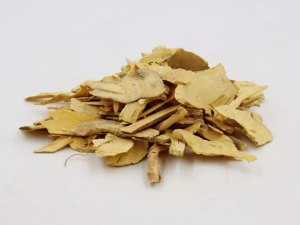
Hei Shun Pian consists of thick, longitudinally sliced pieces that are wider at the top and narrower at the bottom. The outer skin is blackish-brown; the cross-section is dark yellow, oily, glossy, and translucent, with longitudinal vascular bundles. The texture is hard and brittle, and the fracture surface is horn-like. It has a faint odor and a bland taste.
Botanical Information
Botanical Classification
A plant of the genus Aconitum in the Ranunculaceae family.
Morphological Characteristics
A perennial herb, 60–150 cm tall. The taproot is spindle-shaped to obovate; the central portion is the mother root, surrounded by several lateral roots (Fuzi). The leaves are pentagonal, deeply trilobed; the central lobe is rhomboid, and the lateral lobes are further deeply bifid.The racemose panicle is elongated and densely covered with recurved, fine pubescence; there are 5 sepals, bluish-purple (petal-like), with the upper sepal high and helmet-shaped, and the lateral sepals nearly circular;The petals are reduced, with two of them transformed into nectaries; they are closely attached to the lower part of the helmet-shaped lobe and bear a long claw, with the spur twisted; the stamens are numerous and free; the carpels number 3–5 and are usually covered with fine soft hairs. The fruit is a capsule; the seeds have membranous wings. Flowering occurs from September to October, and fruiting from October to November.
Distribution Area
Distributed in Sichuan, Hubei, Hunan, and other areas.
Growth Habits
It prefers a warm and humid environment, is sun-loving, drought-tolerant, and cold-hardy, but cannot tolerate waterlogging. It is highly adaptable and resilient, capable of growing in most types of soil.