Jiaoshu is a name used in traditional Chinese medicine. It refers to the tuberous root of Pachyrhizus erosus (L.) Urban, a plant in the genus Pachyrhizus of the Fabaceae family. It has the effects of clearing lung heat, promoting fluid production, promoting urination, stimulating lactation, and alleviating alcohol toxicity. It is primarily used to treat coughs caused by lung heat, lung abscesses, heatstroke with restlessness and thirst, diabetes insipidus, insufficient lactation, and difficulty urinating.

Jicama
Jiaoshu is a name used in traditional Chinese medicine. It refers to the tuberous root of Pachyrhizus erosus (L.) Urban, a plant in the genus Pachyrhizus of the Fabaceae family. It has the effects of clearing lung heat, promoting fluid production, promoting urination, stimulating lactation, and alleviating alcohol toxicity. It is primarily used to treat coughs caused by lung heat, lung abscesses, heatstroke with restlessness and thirst, diabetes insipidus, insufficient lactation, and difficulty urinating.
Chinese Name : 凉薯
Latin Name : Radix Pachyrhizi Erosi
Aliases : Earth Melon, Sweet Potato, Bitter Melon, Kudzu Melon, Kudzu Yam, Earth Radish, Grass Melon Root, Sand Melon, Ground Radish
Authentic Producing Area : Guangdong, Hainan, Guangxi, Yunnan, Sichuan, Hubei
Nature, Flavor & Meridian Tropism : Sweet in taste, cool in nature; enters the Lung and Kidney meridians
Benefits & Efficacy
Benefits
Clears the lungs and promotes fluid production; promotes urination and lactation; alleviates alcohol toxicity.
Indications
Cough due to lung heat, lung abscess, heatstroke with restlessness and thirst, diabetes insipidus, insufficient breast milk, and difficulty urinating.
Usage and Dosage
Internal use: Eat raw, 120–250 g; or cook and eat; or extract the juice.
Precautions
Those with spleen and stomach deficiency-cold should not consume large amounts.
Chemical Constituents
Contains protein, fat, carbohydrates, and birido glycosides.
Pharmacological Actions
This product has effects such as lowering blood pressure and reducing blood lipids.
Relevant Discussions
1. *Selected Compendium of Guangxi Materia Medica*: “Quenches thirst and detoxifies.”
2. *Edible Chinese Herbs and Simple Formulas*: “Promotes fluid production, quenches thirst, alleviates alcohol toxicity, and lowers blood pressure.”
3. *Chronicle of Sichuan Chinese Medicinal Herbs* (1979 edition): “Promotes fluid production and alleviates alcohol toxicity. Used for thirst with insufficient saliva and chronic alcohol poisoning.”
4. *Fujian Materia Medica*: “Promotes the production of body fluids to quench thirst, acts as a diuretic, and helps sober up. Mainly used to treat heat-induced thirst and heatstroke.”
Applications
Clinical Applications
1. For treating common cold with fever, headache, intense thirst, and diarrhea: Decoct sweet potatoes and take 9–15 g daily (60–120 g of fresh sweet potatoes). Alternatively, combine with an equal amount of kudzu root and decoct for oral administration.
2. For treating hypertension, dizziness, red eyes, facial flushing, and constipation:Peel the sweet potato, mash it into a paste, and strain the juice; mix with cool boiled water and drink. Take one wine glass per dose, 2–3 times daily. (Formulas 1 and 2 are from *Food, Chinese Herbs, and Simple Remedies*)
3. For chronic alcohol poisoning: Mix 250 g of fresh sweet potato (peeled) with white sugar and eat raw. (*Chronicle of Sichuan Chinese Medicinal Herbs*, 1979 edition)
Notes
Patients requiring treatment with Chinese herbal medicine should first consult a licensed Traditional Chinese Medicine (TCM) hospital to receive a prescription following a professional TCM differential diagnosis.
Processing & Preparation
Harvesting & Processing
Harvested in the fall; typically used fresh or sun-dried.
Crude Drug Identification
Properties of Crude Drugs
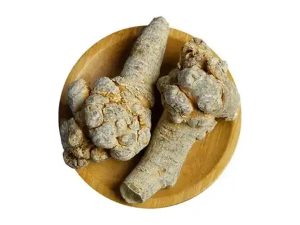
The tuber is spindle-shaped or flattened spherical, sometimes indented into lobes, 5–20 cm long, with a diameter of up to 20 cm. The surface is yellowish-white or brownish-yellow; the flesh is thick and fleshy. When fresh, the outer skin peels off easily; the interior is white and contains a high moisture content. When dried, it is powdery white with a high starch content. It has a faint odor and a sweet taste.
Botanical Information
Botanical Classification
A plant of the genus Pueraria in the family Fabaceae.
Morphological Characteristics
An annual herbaceous vine. The tuber is fleshy and enlarged, conical or spindle-shaped, with white flesh that is sweet and juicy. The stem is twining, 5–6 m long. The leaves are trifoliate and alternate;petioles 7–8 cm long; the terminal leaflet is rhombic, 5–7 cm long (or longer, up to 16 cm), 5.5–18 cm wide; the lateral leaflets are ovate or rhombic, 3.5–14 cm long, 3–14 cm wide, with an acute apex, shallowly lobed toward the upper part, entire below the middle, broadly cuneate at the base, and hairy on both surfaces.Racemes are borne at the branch tips; the peduncle is 20–30 cm long and bears about 10 flowers; bracts are small and ovate;the calyx is bell-shaped, green and hairy, 5-lobed at the apex; the papilionaceous corolla is bluish-purple or pale purplish-red, with a nearly circular standard, slightly concave at the apex and bearing lateral lobes at the base; the wings are slightly obovate, with two claws at the base; the keel is free; the stamens number 10 and are in two groups; the ovary is long-cylindrical and flattened, hairy, with an inwardly curved style and a rounded stigma.The pod is flattened, about 9 cm long, with a velvety surface, brown, and dehiscent. There are 5–10 seeds, nearly square and flattened, about 8 mm long, brownish-brown, smooth, and glossy. Flowering occurs from July to September; fruiting occurs from October to November.
Distribution Area
Distributed in Jiangsu, Anhui, Zhejiang, Jiangxi, Fujian, Taiwan, Hubei, Hunan, Guangdong, Hainan, Guangxi, Sichuan, Guizhou, Yunnan, and other regions.