Eleusine, a name in traditional Chinese medicine. It refers to the dried whole plant of Eleusine indica (L.) Gaertn., a member of the Poaceae family. It has the effects of clearing heat, draining dampness, cooling the blood, and detoxifying. It is primarily used to treat heatstroke-induced fever, infantile convulsions, Japanese encephalitis, meningococcal meningitis, jaundice, dysuria, difficulty urinating, dysentery, bloody stools, swollen and painful sores, and trauma.

Eleusine
Eleusine, a name in traditional Chinese medicine. It refers to the dried whole plant of Eleusine indica (L.) Gaertn., a member of the Poaceae family. It has the effects of clearing heat, draining dampness, cooling the blood, and detoxifying. It is primarily used to treat heatstroke-induced fever, infantile convulsions, Japanese encephalitis, meningococcal meningitis, jaundice, dysuria, difficulty urinating, dysentery, bloody stools, swollen and painful sores, and trauma.
Chinese Name : 牛筋草
Aliases : Qianjincao, Qianqiantā, Tianzaicao, Qianrenba, Niuduncao, Yajiaocao, Suzi Yue, Yejiaozhua,Suniuqiecao, Cricket Grass, Flat Grass, Shuigu Grass, Oil Gourd Grass, Qianjincao, Chibencao, Roadside Grass, Jizi Grass, Goose Palm Grass, Wild Duck Foot Millet, Old Donkey Grass, Baiye Grass
Authentic Producing Area : Mainly produced in Fujian, Zhejiang, Jiangsu, Jiangxi, Hunan, Guangxi, and other provinces and regions
Nature, Flavor & Meridian Tropism : Taste: sweet and bland; nature: cool; enters the Liver meridian
Benefits & Efficacy
Benefits
It has the effects of clearing heat, draining dampness, cooling the blood, and detoxifying.
Indications
It is primarily used to treat heatstroke-induced fever, infantile convulsions, Japanese encephalitis, meningococcal meningitis, jaundice, dysuria, difficulty urinating, dysentery, bloody stools, swollen and painful sores, and trauma.
Usage and Dosage
Internal use: Decoct 9–15 g of dried herb or 30–90 g of fresh herb.
Precautions
Pregnant and lactating women, children, and the elderly or frail should use this herb under the guidance of a physician.
Chemical Constituents
This herb contains flavonoids such as isohuperzine, luteolin-7-O-rutinoside, and wheat flavone.
Pharmacological Actions
Modern research indicates that cowhage has an inhibitory effect on the Japanese encephalitis virus.
Relevant Discussions
1. *Mirror of a Hundred Herbs*: “Enters the Liver Meridian.”
2. *Commonly Used Chinese Herbs of Shanghai*: “Sweet, neutral.”
3. *Qingdao Handbook of Chinese Herbs*: “Clears heat and dispels wind; removes dampness and promotes diuresis. Mainly used to treat hepatitis, indigestion, traumatic bleeding, rheumatoid arthritis, and to prevent epidemic Japanese encephalitis and urticaria.”
Applications
Clinical Applications
1. For high fever, convulsions, and loss of consciousness: 120 g of fresh cowhage. Simmer 3 bowls of water until reduced to 1 bowl; add a pinch of salt; consume the entire decoction within 12 hours. (*Herbal Medicine of Eastern Fujian*)
2. For Japanese encephalitis: 30 g of cowhage, 9 g of Isatis leaf, and 15 g of fresh reed root.Decoct in water to extract the juice; take once daily for 3–5 consecutive days as one course of treatment. (*Chronicle of Hubei Herbal Medicine*)
3. For damp-heat jaundice: 60 g of fresh cow-tendon grass and 30 g of mountain sesame. Decoct in water and take orally. (*Jiangxi Herbal Medicine Manual*)
4. For cloudy urine: 15 g each of cow-tendon grass, golden thread grass, and foxtail grass.Decoct in water and take orally.
5. For dysentery: 60–90 g of fresh cowhage, 45 g of three-leaved devil’s-claw. Decoct in water and take orally. (Formulas 4–5 are from *Compendium of Fujian Medicinal Herbs*)
6. For rheumatoid arthritis: 30 g of cowhage, 9 g of Chinese angelica, 9 g of Chinese clematis. Decoct in water and take orally.
Notes
Patients requiring treatment with Chinese herbal medicine should first consult a licensed Traditional Chinese Medicine (TCM) hospital to receive a prescription following a professional TCM differential diagnosis.
Processing & Preparation
Harvesting & Processing
Harvest in August–September; stems and leaves may be removed or left intact; wash thoroughly; use fresh or sun-dry.
Processing Methods
Take the raw herb, remove impurities, wash thoroughly, dry, and cut into long sections.
Storage Methods
Store in a dry place.
Crude Drug Identification
Properties of Crude Drugs
The roots are fibrous, yellowish-brown, and 0.5–1 mm in diameter. The stems are flattened-cylindrical, pale gray-green, with longitudinal ridges and distinct nodes; internodes are 4–8 mm long and 1–4 mm in diameter. The leaves are linear, up to 15 cm long, with parallel, striate veins. Several spike-like inflorescences are arranged in a finger-like pattern at the stem apex, usually three in number. It has a faint odor and a bland taste.
Properties of Processed Slices
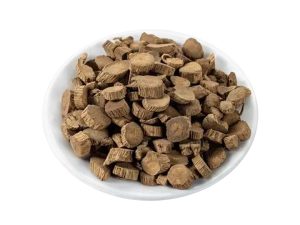
A mixed segment consisting of roots, stems, leaves, and flowers. The fibrous roots are fine and dense; the stems are flattened; the leaves are flat and dark green. The spikelets have mostly fallen off. It has a faint odor and a sweet, bland taste.
Botanical Information
Botanical Classification
Poaceae plant: Cowhage.
Morphological Characteristics
An annual herb. The root system is extremely well-developed. Stems grow in clumps, with the base slanting, and reach a height of 15–90 cm.Leaf sheaths are flattened, ridged, glabrous or sparsely covered with warty hairs, and the sheath mouth is pubescent; the ligule is about 1 mm long; leaf blades are spreading, linear, 10–15 cm long, 3–5 mm wide, glabrous or often with pubescence with wart-like bases on the upper surface.There are 2–7 spikelike inflorescences, finger-like and borne at the top of the culm, 3–10 cm long and 3–5 mm wide; spikelets contain 3–6 florets, 4–7 mm long and 2–3 mm wide; glumes are lanceolate, ridged, and rough along the ridges; the first glume is 1.5–2 mm long, and the second glume is 2–3 mm long;the first lemma is 3–4 mm long, ovate, membranous, and ridged, with narrow wings along the ridge; the palea is shorter than the lemma, with two ridges bearing narrow wings. The capsule is ovate, approximately 1.5 mm long, concave at the base, with distinct wavy wrinkles; the pericarp consists of two folded scales with five veins. Flowering and fruiting occur from June to October.
Distribution Area
Distributed throughout China.
Propagation Methods
Propagated by seed.