Fried Cashews, a name in traditional Chinese medicine. It refers to the whole plant of Grewia falcata C.Y. Wu, a species of the Tiliaceae family. Grewia falcata is distributed in Yunnan and other regions of China. It possesses astringent and hemostatic properties. It is primarily used to treat traumatic bleeding and wounds caused by knives or guns.

Fried Cashew
Fried Cashews, a name in traditional Chinese medicine. It refers to the whole plant of Grewia falcata C.Y. Wu, a species of the Tiliaceae family. Grewia falcata is distributed in Yunnan and other regions of China. It possesses astringent and hemostatic properties. It is primarily used to treat traumatic bleeding and wounds caused by knives or guns.
Chinese Name : 炸腰果
Aliases : Sickle-leaved Jiebao Leaf, *Compendium of Chinese Herbal Medicines*
Nature, Flavor & Meridian Tropism : Bitter and astringent in taste; cold in nature
Benefits & Efficacy
Benefits
Astringent and hemostatic.
Indications
Bleeding from external injuries, cuts, and gunshot wounds.
Usage and Dosage
External use: Apply an appropriate amount, ground into a powder and sprinkled on the affected area.
Precautions
Use with caution in patients with spleen-stomach deficiency-cold.
Relevant Discussions
*Medicinal Herbs of Yunnan*: “Stops bleeding. Used for knife and gunshot wounds, and bleeding from external injuries.”
Applications
Processing & Preparation
Processing Methods
Harvesting and Processing: Can be harvested year-round; cut into sections and sun-dried.
Crude Drug Identification
Botanical Information
Botanical Classification
Scythe-leaved Polygonum (Polygonum scypharicum) of the Tiliaceae family.
Morphological Characteristics
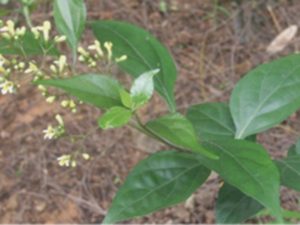
Shrub or small tree. Young branches are covered with yellowish-brown soft downy hairs.Leaves are alternate; petioles are 3–5 mm long and covered with soft downy hairs; leaf blades are leathery, strap-shaped, slightly curved or straight, 13–18 cm long and 2–3 cm wide, with a gradually tapering apex and a blunt base; the upper surface is glabrous except for hairs along the veins, while the lower surface is covered with yellowish-brown soft downy hairs, and the margin has fine serrations;The lateral veins on either side of the ternate venation are faint, less than one-quarter the length of the leaf blade, and 1–3 mm from the margin; the midrib bears 6–7 pairs of lateral veins, and the reticulate venation is distinct.1–3 flowers are axillary, on a peduncle 3–5 mm long; the pedicels are 3–4 mm long and bear yellowish-brown tomentum; the sepals are lanceolate, 8–9 mm long and 2–2.5 mm wide, tomentose on the outer surface and glabrous on the inner surface;petals are oblong, 3–4 mm long; stamens are 5–6 mm long; the ovary is densely covered with yellowish-brown long tomentum; the style is longer than the stamens, and the stigma is 4-lobed. The drupe is quadrangular, hairy, and glossy.
Distribution Area
Found in Yunnan and other regions of China.