Qinghuazi is a medicinal herb used to clear heat; it consists of the dried, mature seeds of Celosia argentea L. (family Amaranthaceae). It is produced in most regions of China. It has the effects of clearing liver heat, purging fire, improving vision, and removing corneal opacities. It is primarily used for red eyes due to liver heat, corneal opacities, blurred vision, and dizziness caused by liver fire.

Celosia Seeds
Qinghuazi is a medicinal herb used to clear heat; it consists of the dried, mature seeds of Celosia argentea L. (family Amaranthaceae). It is produced in most regions of China. It has the effects of clearing liver heat, purging fire, improving vision, and removing corneal opacities. It is primarily used for red eyes due to liver heat, corneal opacities, blurred vision, and dizziness caused by liver fire.
Chinese Name : 青葙子
Latin Name : Celosiae Semen
Aliases : Wild Cockscomb, Dog’s-tail Flower, Dog’s-tail Amaranth
Nature, Flavor & Meridian Tropism : Bitter in taste, slightly cold in nature; enters the Liver meridian
Benefits & Efficacy
Benefits
Clears liver heat, improves vision, and removes corneal opacities.
Indications
Indicated for red eyes due to liver heat, corneal opacities, blurred vision, and dizziness caused by liver fire.
Usage and Dosage
Decoct and take 9–15 g.
Precautions
Celosia seeds should be used under the guidance of a TCM practitioner based on syndrome differentiation; do not use them blindly on your own to avoid adverse effects. If you experience any discomfort during use, seek medical attention promptly.
Chemical Constituents
It primarily contains fatty acids such as palmitic acid, stearic acid, oleic acid, and linoleic acid; triterpene saponins such as Cnidium saponins A and B; and various amino acids.
Pharmacological Actions
This product has a hepatoprotective effect.
Relevant Discussions
1. *Treatise on the Nature of Medicinal Substances*: “Treats liver heat toxins affecting the eyes, red opacities, loss of vision, and corneal opacities.”
2. *Original Source of the Classic of Herbs*: “Treats wind-heat eye diseases; its efficacy is similar to that of Cassia seeds.”
3. *Justification of the Materia Medica*: “Its seeds are bitter, cold, and slippery; they are excellent at clearing stagnant heat, and thus are used to treat all eye conditions caused by wind-heat and liver fire.”
Applications
Clinical Applications
1. To treat redness, swelling, and pain in the eyes, as well as the formation of opacities and blurred vision caused by ascending liver fire, it can be combined with Cassia seeds, Leonurus seeds, and antelope horn, as in the Qinghuo Pills (from *Zhengzhi Zhunsheng*); to treat blurred vision due to liver deficiency with blood heat, it can be combined with raw Rehmannia root, Scrophularia root, and Plantain seeds, as in the Qinghuo Pills (from *Yizong Jinjian*);To treat liver and kidney deficiency manifesting as blurred vision and dry, gritty eyes, it is combined with Cuscuta seed, Cistanche, and Chinese yam, as in the Green Wind Restoring Vision Pills (from *Medical Canon of the Golden Mirror*).
2. To treat headaches, dizziness, restlessness, and insomnia caused by liver yang transforming into fire, it is often combined with Oyster Shell, Gardenia, and Summer Deadgrass.
Related Compatibility
Combination of Qinghuo Seeds and Jue Ming Seeds: Qinghuo Seeds clear liver fire and dispel heat, improving vision and removing opacities; Jue Ming Seeds clear liver fire and improve vision, while also nourishing liver yin. When used together, their effects in clearing liver fire, dispelling heat, and improving vision are enhanced, and they combine clearing with dispersing, and draining with tonifying. This combination is suitable for red, swollen, and painful eyes caused by ascending liver fire, as well as opacities in the eyes and blurred vision.
Medicinal Identification
1. Qinghuazi and Gujingcao: Both enter the Liver Meridian and can clear the liver and improve vision. They are used for redness, swelling, and pain in the eyes caused by liver fire or wind-heat in the Liver Meridian, as well as photophobia, excessive tearing, and opacities in the eyes.However, Qinghuazi is bitter and slightly cold in nature; its functions include clearing and draining liver fire, improving vision, and removing opacities. It is primarily used to treat redness, swelling, and pain in the eyes caused by ascending liver fire, as well as opacities leading to dim vision. It can also clear and drain liver fire to treat headaches and dizziness caused by liver yang transforming into fire.Gujingcao is light in nature and has an ascending and floating action; it excels at dispersing wind-heat, improving vision, and removing opacities. It is primarily used to treat redness and opacities in the eyes caused by ascending wind-heat, accompanied by headaches and toothaches.
2. Qinghuazi and Mimenghua: Both are herbs that clear heat and purge fire; they enter the Liver Meridian and can clear the Liver and improve vision. They are used to treat redness, swelling, and pain in the eyes caused by Liver fire or wind-heat in the Liver Meridian, as well as photophobia, excessive tearing, and corneal opacities.However, Qinghuazi is bitter and slightly cold in nature; it clears and drains liver fire, improves vision, and removes opacities. It is primarily used to treat redness, swelling, and pain in the eyes caused by ascending liver fire, as well as opacities and blurred vision. Furthermore, it can clear liver fire and subdue liver yang, making it effective for treating headaches and dizziness caused by liver yang transforming into fire.Mimenghua is sweet and slightly cold in nature; it excels at clearing the liver, nourishing the blood, improving vision, and removing opacities. It is primarily used to treat redness, swelling, and pain in the eyes caused by liver heat, as well as blurred vision resulting from deficiency of liver blood.
Related Medicines
Zhangyi San, Dendrobium Nightlight Granules (Pills), and Amber Eye-Restoring Pills.
Related Prescriptions
Qingxiu Pills (from *The Golden Mirror of Medical Orthodoxy*).
Notes
Patients requiring treatment with Chinese herbal medicine should first consult a licensed Traditional Chinese Medicine (TCM) hospital, where a TCM practitioner will conduct a professional pattern differentiation and issue a herbal prescription.
Processing & Preparation
Harvesting & Processing
Harvest the plant or pick the fruit clusters when the fruits ripen in the fall, dry them, collect the seeds, and remove impurities.
Processing Methods
1. Qinghuo Seeds: Take the raw herbal material, remove impurities, and sift out ash and debris.
2. Roasted Qinghuo Seeds: Take the cleaned Qinghuo seeds, place them in a preheated roasting vessel, and heat over low heat. Roast until they crackle, turn light yellow inside, and release a fragrant aroma; then remove and allow to cool.
Storage Methods
Store in a well-ventilated, dry place.
Crude Drug Identification
Properties of Crude Drugs
This product is flattened and round, with a few being round-kidney-shaped, measuring 1–1.5 mm in diameter. The surface is black or reddish-black and glossy, with a slightly raised center and a seed scar in the slightly concave side. The seed coat is thin and brittle; it has a faint odor and a bland taste.
Properties of Processed Slices
1. Qinghuazi: See the “Identification of Medicinal Materials” section.
2. Roasted Qinghuazi: The surface is charred black and has a fragrant aroma.
Botanical Information
Botanical Classification
Amaranthus, a plant of the genus Amaranthus in the Amaranthaceae family.
Morphological Characteristics
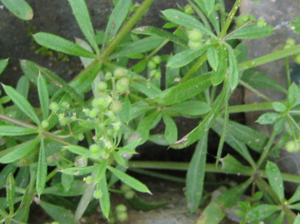
An annual herb, 0.3–1 m tall, glabrous throughout; the stem is erect, branched, green or red, with distinct striations. Leaves are oblong-lanceolate, lanceolate, or lanceolate-linear, with a few ovate-oblong; 5–8 cm long, 1–3 cm wide, green and often tinged with red; the apex is acute or acuminate, with a small awn, and the base is gradually narrowing;petioles 2–15 mm long, or absent. Flowers numerous, densely arranged, forming a single, unbranched, pyramidal or cylindrical spike at the stem or branch tips, 3–10 cm long;Bracts and bracteoles are lanceolate, 3–4 mm long, white, glossy, with an acuminate apex extending into a slender awn, bearing a single midvein that is raised on the adaxial surface; perianth segments are oblong-lanceolate, 6–10 mm long, initially white with a reddish apex or entirely pink, later turning white, with an acuminate apex, bearing a single midvein that is raised on the adaxial surface;Filaments 5–6 mm long, with the free portion approximately 2.5–3 mm long; anthers purple; ovary short-stalked; style purple, 3–5 mm long. Capsule ovate, 3–3.5 mm long, enclosed within the persistent perianth segments. Seeds convex-lenticular and reniform, approximately 1.5 mm in diameter. Flowering period: May–August; fruiting period: June–October.
Distribution Area
It is found in most regions of China.
Growth Habits
It prefers a warm and humid climate. It is not particular about soil type, but is best grown in fertile, well-drained sandy loam. It does not tolerate waterlogging and should not be planted in low-lying areas.
Propagation Methods
Propagated by seed.
Cultivation Techniques
Seed Propagation: Select plants with long spikes, numerous branches, and high yields for seed collection. Cockscomb is prone to hybridization with celosia, which significantly reduces yield; therefore, when saving seeds, ensure isolation from celosia to maintain purity. Seed germination rates range from 70% to 80%, with an optimal germination temperature of 25°C; seeds germinate well within a temperature range of 20–30°C.For spring sowing in March–April, prepare 1.3-meter-wide raised beds. Sow in rows by opening shallow furrows 30 cm apart. Scatter the seeds evenly in the furrows, cover with 0.5 cm of soil, lightly firm the soil, and water.Seed rate: 4.5–6.0 kg per hectare. For hole sowing, dig holes approximately 25 cm apart in both rows and plants, 5–6 cm deep, ensuring the holes are shallow and level at the bottom. After applying manure or livestock slurry, mix in a small amount of wood ash to create a seed-coating ash mixture, sprinkle it evenly into the holes, and then cover with another layer of wood ash. Seed rate: 3.75 kg per hectare.