Eranthemum pulchellum, a name in traditional Chinese medicine. Refers to the roots and leaves of Eranthemum pulchellum Andrews., a plant in the Acanthaceae family. It is distributed in Guangdong, Hainan, Guangxi, Guizhou, and Yunnan. It has the efficacy of dispersing blood stasis and reducing swelling. It is primarily used to treat swelling and pain caused by trauma.

Eranthemum pulchellum
Eranthemum pulchellum, a name in traditional Chinese medicine. Refers to the roots and leaves of Eranthemum pulchellum Andrews., a plant in the Acanthaceae family. It is distributed in Guangdong, Hainan, Guangxi, Guizhou, and Yunnan. It has the efficacy of dispersing blood stasis and reducing swelling. It is primarily used to treat swelling and pain caused by trauma.
Chinese Name : 可爱花
Aliases : Duijie Cai, Niuqi
Authentic Producing Area : Yunnan, Guangdong
Nature, Flavor & Meridian Tropism : Pungent in taste, neutral in nature
Benefits & Efficacy
Benefits
Dispels blood stasis and reduces swelling.
Indications
Mainly used to treat swelling and pain caused by trauma.
Usage and Dosage
1. External use: Apply an appropriate amount as a pounded poultice or use the decoction for washing. 2. Internal use: Decoct 6–15 g.
Precautions
Patients requiring treatment with Chinese herbal medicine should first consult a licensed Traditional Chinese Medicine (TCM) hospital, where a TCM practitioner will conduct a professional pattern differentiation and issue a herbal prescription.
Chemical Constituents
Contains betaine, xihuaoside, and tritostanol.
Applications
Notes
References: [1] Editorial Committee of *Chinese Materia Medica*, State Administration of Traditional Chinese Medicine. *Chinese Materia Medica* 7 [M]. Shanghai: Shanghai Science and Technology Press, 1999: 459.
Processing & Preparation
Harvesting & Processing
Harvest in summer or fall; wash thoroughly; sun-dry or use fresh.
Crude Drug Identification
Properties of Crude Drugs
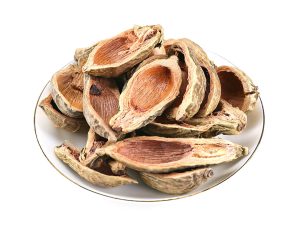
Leaves are wrinkled; intact leaves are elliptical to oblong, 5–10 cm long, with a sharp to short acuminate apex, a wedge-shaped base that extends downward, and margins that are slightly wavy or have minute rounded teeth; leaf veins are prominent, with secondary veins arranged in an orderly, nearly parallel pattern. Slight odor; bland taste.
Botanical Information
Botanical Classification
A plant of the Acanthaceae family, commonly known as “flowering herb.”
Morphological Characteristics
A shrub, 70–150 cm tall. Glabrous or nearly glabrous. Leaves opposite; petioles short; leaf blades ovate to elliptic, 10–20 cm long, 5–8 cm wide, apex long acuminate, base gradually narrowing into the petiole, margins with indistinct blunt teeth; lateral veins about 10 on each side, prominent on both surfaces.Spike-like inflorescences are terminal or axillary; bracts are obovate, 1–1.5 cm long, with an acute apex, veined, and pubescent; bracteoles are linear-lanceolate, about 5 mm long; the calyx is small, nearly white, concealed within the bracts, and deeply 5-lobed;Corolla blue, ca. 3 cm long; corolla tube slender, throat short and slightly expanded, corolla lobes spreading, 5-lobed, lobes of equal length, usually obovate; stamens exserted, 2 developed, attached at the throat; ovary with 2 ovules per locule, stigma single. Capsule club-shaped, ca. 1 cm long.There are two seeds, flattened on both sides and covered with close-lying white hairs that extend when the hairs absorb water. Flowering occurs in spring.
Distribution Area
Distributed in Guangdong, Hainan, Guangxi, Guizhou, and Yunnan.