Thyrocarpus, a name in traditional Chinese medicine. It refers to the whole plant of Thyrocarpus sampsonii Hance, a member of the Boraginaceae family. It is distributed in Shaanxi, Gansu, Jiangsu, Anhui, Zhejiang, Jiangxi, Fujian, Taiwan, Hubei, Hunan, Guangdong, Guangxi, Sichuan, Guizhou, Yunnan, and other regions. It has the effects of clearing heat, detoxifying, and reducing swelling. It is commonly used to treat boils, carbuncles, sore throat, diarrhea, and dysentery.

Thyrocarpus
Thyrocarpus, a name in traditional Chinese medicine. It refers to the whole plant of Thyrocarpus sampsonii Hance, a member of the Boraginaceae family. It is distributed in Shaanxi, Gansu, Jiangsu, Anhui, Zhejiang, Jiangxi, Fujian, Taiwan, Hubei, Hunan, Guangdong, Guangxi, Sichuan, Guizhou, Yunnan, and other regions. It has the effects of clearing heat, detoxifying, and reducing swelling. It is commonly used to treat boils, carbuncles, sore throat, diarrhea, and dysentery.
Chinese Name : 盾果草
Aliases : Shield-shaped Herb, Wild Rehmannia, Dried Cat’s Tail, Black Bone Wind, Wall-Climbing Herb
Nature, Flavor & Meridian Tropism : Bitter in taste, cool in nature. Enters the Heart and Large Intestine meridians
Benefits & Efficacy
Benefits
Clears heat, detoxifies, and reduces swelling.
Indications
Boils, carbuncles, sore throat, diarrhea, and dysentery.
Usage and Dosage
Internal use: Decoction, 9–15 g; 30 g of fresh herb. External use: Apply an appropriate amount of fresh herb, pounded into a paste, as a poultice.
Precautions
Not suitable for individuals with spleen and stomach deficiency-cold.
Relevant Discussions
1. *Compendium of Chinese Herbal Medicines*: “Clears heat, detoxifies, and reduces swelling. Primarily used to treat boils, carbuncles, furuncles, bacterial dysentery, and enteritis.”
2. *Hunan Materia Medica*: “Relieves sore throat and quenches thirst.”
Applications
Related Compatibility
1. For treating carbuncles and boils: Decoct 30 g of fresh Shield-fruit Grass in water; take one dose daily, and apply the residue externally to the affected area. Alternatively, pound the fresh whole plant into a paste and apply it externally to the affected area. (*Compendium of Chinese Herbal Medicines*)
2. For treating bacterial dysentery and enteritis: 15 g of Shield-fruit Grass. Decoct and take twice daily. (*Compendium of Chinese Herbal Medicines*)
Processing & Preparation
Harvesting & Processing
Harvest from April to June; use fresh or sun-dry.
Crude Drug Identification
Properties of Crude Drugs
Stems are relatively slender, ranging from 1 to several, cylindrical, 10–30 cm long, with a withered green surface covered in grayish-white rough hairs; they are brittle and break easily, with a white cross-section.Basal leaves grow in clusters; they are shriveled and curled. When moistened and unfolded, they are spoon-shaped with petioles, 3.5–19 cm long and 1–5 cm wide, withered green or dark green in color, and covered with grayish-white coarse hairs on both surfaces. Cauline leaves are smaller and sessile.The leaf blades are slightly thick. Small blue or purple flowers are sometimes visible. May bear two layers of bowl-shaped, protruding nutlets; the outer layer at the base and apex has erect, cog-like projections, while the inner layer lies close to the margin. Slight odor; slightly bitter taste.
Botanical Information
Botanical Classification
A plant of the Boraginaceae family, Shield-fruited Grass.
Morphological Characteristics
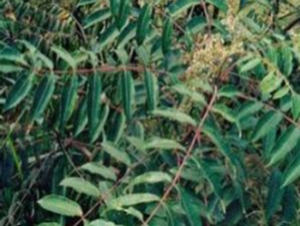
Stems number from one to several, erect or ascending, 20–45 cm tall, often branching from the lower part, bearing spreading long stiff hairs and short rough hairs. Basal leaves are clustered, short-petiolate, spatulate, 3.5–19 cm long, 1–5 cm wide, entire or sparsely and finely serrate, with long stiff hairs and short rough hairs bearing basal discs on both surfaces;Cauline leaves are smaller, sessile, and narrowly oblong or oblanceolate. Inflorescences are 7–20 cm long; bracts are narrowly ovate to lanceolate, borne in the axils of bracts or outside the axils; pedicels are 1.5–3 mm long; the calyx is about 3 mm long, with narrowly elliptic lobes bearing spreading, long, stiff hairs on the back and margins, and slightly shorter, appressed hairs on the front;Corolla pale blue or white, markedly longer than the calyx; tube 2.5 times shorter than the lobe; lobe 5–6 mm in diameter; lobes nearly circular, spreading; throat appendages linear, ca. 0.7 mm long, thickened, with papillate projections, apex slightly notched;There are 5 stamens, attached to the middle of the corolla tube; the filaments are about 0.3 mm long, and the anthers are ovate-oblong, about 0.5 mm long.There are 4 nutlets, each about 2 mm long, dark brown; the outer margin of the cup-shaped protrusion is paler in color; the teeth are about half the height of the cup, straight, and not swollen at the apex; the inner layer of the cup-shaped protrusion does not contract inward. Flowering and fruiting occur from May to July.
Distribution Area
Distributed in Shaanxi, Gansu, Jiangsu, Anhui, Zhejiang, Jiangxi, Fujian, Taiwan, Hubei, Hunan, Guangdong, Guangxi, Sichuan, Guizhou, Yunnan, and other regions.