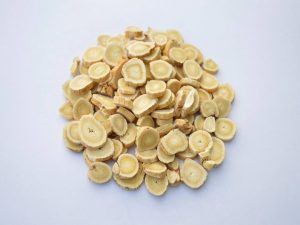
Yunnan Artemisia, a name in traditional Chinese medicine. It refers to the whole plant of Artemisia mairei Lévl., a member of the Asteraceae family. It is distributed in Yunnan. It has the effects of clearing damp-heat, dispelling wind and relieving depression, and promoting diaphoresis and draining dampness. It is commonly used for conditions involving damp-heat stagnation in the spleen, exogenous wind-heat syndromes, and cases where there are exterior symptoms externally and retained water and dampness internally.

Dongchuan Wormwood
Yunnan Artemisia, a name in traditional Chinese medicine. It refers to the whole plant of Artemisia mairei Lévl., a member of the Asteraceae family. It is distributed in Yunnan. It has the effects of clearing damp-heat, dispelling wind and relieving depression, and promoting diaphoresis and draining dampness. It is commonly used for conditions involving damp-heat stagnation in the spleen, exogenous wind-heat syndromes, and cases where there are exterior symptoms externally and retained water and dampness internally.
Chinese Name : 东川蒿
Aliases : Dongchuan Artemisia, Small-spiked Artemisia
Nature, Flavor & Meridian Tropism : Taste: sweet and bland; nature: cold. Enters the Spleen, Liver, and Bladder meridians
Benefits & Efficacy
Benefits
Clears damp-heat, dispels wind and relieves depression, induces sweating, and promotes diuresis.
Indications
Syndrome of damp-heat stagnation in the spleen; syndrome of exogenous wind-heat; external syndrome with internal retention of water and dampness.
Usage and Dosage
6–9 g. For external use, apply as needed.
Relevant Discussions
*Xinhua Compendium of Materia Medica*: “It has the effects of eliminating damp-heat, dispelling wind and relieving depression, inducing sweating, and promoting diuresis.”
Applications
Processing & Preparation
Crude Drug Identification
Botanical Information
Botanical Classification
Dongchuan Artemisia (a plant of the Asteraceae family).
Morphological Characteristics
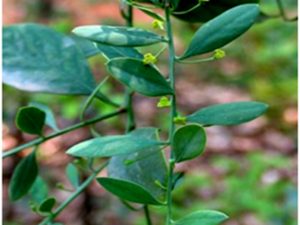
Perennial herb. The principal root is slightly prominent; the rhizome is somewhat thick, with a few vegetative branches. Several stems, 40–60 cm tall, with the lower part semi-woody and marked by distinct longitudinal ridges; the upper part branches, with branches 5–7 cm long; both surfaces of the branches and leaves are densely covered with grayish-yellow soft hairs.Leaves are papery; those on the lower and middle parts of the stem are ovate, 1.5–3 cm long and 1–2 cm wide, pinnately deeply lobed, with two lobes on each side; the lobes are awl-shaped or narrowly linear-awl-shaped, 1–1.5 cm long and 1 mm wide, with acute tips; upper leaves and bract-like leaves are either deeply lobed into three parts or entire, while the bract-like leaves—whether lobed or entire—are awl-shaped.Flowering occurs in summer and fall; the capitula are small, nearly spherical, 1.5–2 mm in diameter, sessile, arranged in spike-like inflorescences on branches or branched twigs, and forming narrow or moderately spreading panicles on the stem;The involucral bracts are arranged in 3–4 layers; the outer involucral bracts are elliptical with membranous margins, while the middle and inner involucral bracts are long-ovate with broad membranous margins or entirely semimembranous; there are 2–3 female flowers, with a narrow tubular corolla bearing a 2-lobed lobe at the apex; the style extends beyond the corolla and is bifid at the tip, with the forks ending in sharp points;3–7 hermaphroditic flowers, sterile; corolla tubular; anthers linear; apical appendages acute, long-triangular, with a blunt base; style short, apically 2-lobed. Achenes small. Flowering and fruiting period: August–November.
Distribution Area
Mainly distributed in Yunnan.