Eriacorneri, a name in traditional Chinese medicine. It refers to the whole plant of *Eriacorneri Rchb.f.*, a species of the genus *Eriacornis* in the Orchidaceae family.The plant Eriacorneri Rchb.f. is distributed in Fujian, Taiwan, Guangdong, Hainan, Guangxi, Yunnan, and Guizhou. It has the effects of nourishing yin, clearing heat, promoting fluid production, and quenching thirst. It is primarily used to treat heat-related illnesses causing fluid depletion, restlessness and thirst, night sweats, pulmonary tuberculosis, scrofula, and swollen, toxic sores.
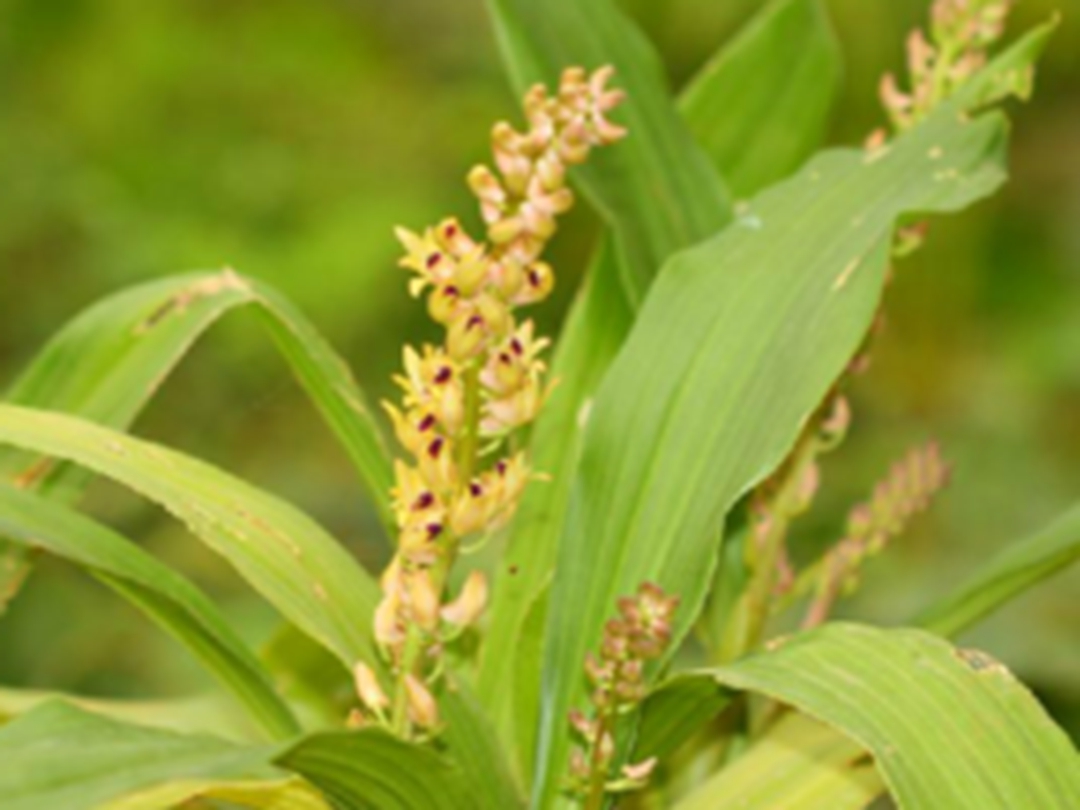
Eriacorneri
Eriacorneri, a name in traditional Chinese medicine. It refers to the whole plant of *Eriacorneri Rchb.f.*, a species of the genus *Eriacornis* in the Orchidaceae family.The plant Eriacorneri Rchb.f. is distributed in Fujian, Taiwan, Guangdong, Hainan, Guangxi, Yunnan, and Guizhou. It has the effects of nourishing yin, clearing heat, promoting fluid production, and quenching thirst. It is primarily used to treat heat-related illnesses causing fluid depletion, restlessness and thirst, night sweats, pulmonary tuberculosis, scrofula, and swollen, toxic sores.
Chinese Name : 蜢臂兰
Aliases : Chicken-Leg Lotus, Beyond the Horizon, Foot of the Mountain, Mountain Areca, Stone Shrimp (from *Catalog of Medicinal Plants of Guangxi*); Stone-Wall Wind, Tiger’s Tooth (Guangxi)
Nature, Flavor & Meridian Tropism : Sweet in taste, neutral in nature
Benefits & Efficacy
Benefits
Nourishes yin and clears heat; promotes fluid production and quenches thirst.
Indications
Fever-induced fluid depletion, restlessness and thirst, night sweats, pulmonary tuberculosis, scrofula, and swollen, toxic sores.
Usage and Dosage
Internal use: Decoct 6–15 g.
Applications
Processing & Preparation
Harvesting & Processing
Harvested in summer and fall; wash, steam, and sun-dry.
Crude Drug Identification
Botanical Information
Botanical Classification
*Hemipodium pilosum*, a plant of the genus *Hemipodium* in the orchid family.
Morphological Characteristics
Hemipodium, also known as Huangronglan (Taiwan) and Fangtoulan (Hong Kong). An epiphytic plant, growing to a height of over 20 cm. The entire plant is glabrous. Pseudobulbs are densely clustered, ovate or oblong, 2–6 cm long and 1–3 cm thick, with sheath-like leaves at the base. There are two apical leaves; the leaf blades are oblong or lanceolate, with an acute apex and a base that gradually narrows into a petiole.The inflorescence is solitary, arising laterally from the apex of the pseudobulb, and shorter than the leaves. The base is sheathed; the raceme is pendulous; the bracts are minute;flowers are yellowish-green; the labellum is pale white with purple spots; the median sepal is ovate-triangular, about 1 cm long and 2 mm wide, with an acuminate apex; the lateral sepals are falcate-triangular, wider than the median sepal; the sepal sacs are short and obtuse; the petals are narrowly lanceolate, nearly as long as the sepals, and 1.2 mm wide;the labellum is 3-lobed, 7 mm long; the lateral lobes are semicircular, about 2 mm wide; the median lobe is ovate-triangular, longer than the lateral lobes; the upper surface of the labellum disc bears three longitudinal folds extending from the base to the apex of the median lobe.
Distribution Area
Distributed in Fujian, Taiwan, Guangdong, Hainan, Guangxi, Yunnan, and Guizhou.