Platycarya fruit, a name in traditional Chinese medicine. It is the fruit of Platycarya strobilacea Sieb. et Zucc., a plant in the family Juglandaceae.It is distributed in East China, southern Shaanxi, Taiwan, Henan, Hubei, Hunan, Sichuan, Guizhou, and Yunnan. It has the effects of promoting blood circulation, regulating qi, relieving pain, and killing parasites and relieving itching. It is used to treat internal injuries causing chest and abdominal distension and pain, trauma, pain in tendons and bones, boils and swellings, damp sores, and scabies and ringworm.

Fruit of Platycarya
Platycarya fruit, a name in traditional Chinese medicine. It is the fruit of Platycarya strobilacea Sieb. et Zucc., a plant in the family Juglandaceae.It is distributed in East China, southern Shaanxi, Taiwan, Henan, Hubei, Hunan, Sichuan, Guizhou, and Yunnan. It has the effects of promoting blood circulation, regulating qi, relieving pain, and killing parasites and relieving itching. It is used to treat internal injuries causing chest and abdominal distension and pain, trauma, pain in tendons and bones, boils and swellings, damp sores, and scabies and ringworm.
Chinese Name : 化香树果
Latin Name : Platycarya strobilacea Sieb. et Zucc.
Aliases : Fragrant Tree Cones, Fragrant Tree Fruits
Authentic Producing Area : East China, Shaanxi, Taiwan, Henan, Hubei, Hunan, Sichuan, Guizhou, Yunnan
Nature, Flavor & Meridian Tropism : Pungent in taste, warm in nature; enters the Lung, Spleen, and Large Intestine meridians
Benefits & Efficacy
Benefits
Promotes blood circulation and the flow of qi; relieves pain; kills parasites and alleviates itching.
Indications
Used for internal injuries causing chest and abdominal distension and pain, trauma from falls or blows, pain in tendons and bones, abscesses and swellings, damp sores, and scabies and ringworm.
Usage and Dosage
Internal use: Decocted as a soup, 10–20 g. External use: Decocted in water for washing; or ground into a powder and applied as a poultice.
Precautions
Not yet established.
Relevant Discussions
*Illustrated Compendium of Plant Names and Realities*: “Regulates qi and dispels phlegm.”
Applications
Related Compatibility
1. For treating chest distension, abdominal pain, and joint and bone pain caused by internal injury: 15–18 g of dried *Hua Xiang Shu* fruit, combined with an equal amount of hawthorn root. Decoct to extract the juice, mix with rice wine, and take on an empty stomach in the morning and evening.
2. For treating toothache: Decoct several *Hua Xiang Shu* fruits in water and hold the decoction in the mouth. (Recipes 1 and 2 are from the Jiangxi *Manual of Herbal Medicine*)
Processing & Preparation
Harvesting & Processing
Harvest the fruits in autumn when nearly ripe, then sun-dry them.
Crude Drug Identification
Properties of Crude Drugs
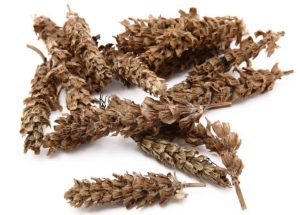
The fruit spikes are erect, ovate to oblong, 3.5–4 cm long, approximately 2 cm in diameter, and dark brown. The fruit bracts are ovate-lanceolate, with a spiny apex; they are hard and persistent. Each bract contains one nut. The nut is nearly round, flattened, with a slight central bulge on both sides and rounded edges; it is 2.6–4.5 mm long,with a base 1.4–2.9 mm wide, an apex 3.1–6.1 mm wide, and a thickness of 1.4–1.6 mm; it is brownish with dark brown spots, bearing one lanceolate rib on each surface, with relatively broad, wing-like margins, and a knife-like transverse fissure near the apex of the nut.The apex is centrally concave; the notch corresponds to a persistent style or style remnant. The base has a single depression, with one side opening low, forming a “U” shape. The seed coat is yellowish-brown and triangular. There is one cotyledon, which is wrinkled. The seed is solitary.
Botanical Information
Botanical Classification
The Chinese fragrant tree (a member of the walnut family).
Morphological Characteristics
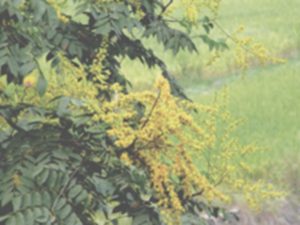
Huaxiangshu, also known as Huaxiangliu, Huamuxiang, Kaoxiang, Kaohuashu, Kaoguosh, Huanxiangshu, Pigantiao, Maliu, Huaguo’er Shu, Hualongshu, Huai Shu, Huai Pi Shu, Kaopu, Fangxiangshu, Banxiangshu, Fanxiang, Huanxiangshu, and Shanmaliu. A deciduous small tree, 2–6 m tall.The bark is grayish-brown and irregularly fissured longitudinally; the branches are dark brown with small lenticels; they are covered with bud scales in winter, and the pith is solid. The leaves are odd-pinnate, alternate, 15–30 cm long,with 7–23 leaflets, sessile, ovate-lanceolate to long-elliptic-lanceolate, thin and leathery, 4–11 cm long, 1.5–3.5 cm wide, unequal in size, slightly sickle-shaped, with a nearly rounded base that is slightly asymmetrical on one side, a long acuminate apex, and doubly serrate margins.Flowers are unisexual or bisexual, with the plant being monoecious; bisexual and male inflorescences are borne at the tips of twigs or in leaf axils, arranged in corymbose clusters, with the central one typically being a bisexual inflorescence, the male inflorescences above, and the female inflorescences below; surrounding the bisexual inflorescence are male inflorescences, usually 3–8 in number;Male floral bracts are broadly ovate, gradually tapering to a point at the apex, curving outward; they lack small bracts and perianth segments, and bear 6–8 stamens with filaments of varying lengths;The female inflorescences are globose-ovate or oblong; the female bracts are ovate-lanceolate, with a long, acuminate apex, rigid but not outwardly curved; they lack small bracts and bear two perianth segments that are adnate to both sides of the ovary and enlarge together with it.The fruit cluster is cone-like, ovoid-elliptic to oblong-cylindrical, 2.5–5 cm long and 2–3 cm in diameter; the involucral bracts are persistent, membranous, and brown; the nutlets are flattened, with narrow wings on both sides. The seeds are ovoid, with a membranous seed coat. Flowering occurs from May to June; fruiting occurs from July to October.
Distribution Area
It is distributed in East China, southern Shaanxi, Taiwan, Henan, Hubei, Hunan, Sichuan, Guizhou, Yunnan, and other areas.