Leimogu is a name used in traditional Chinese medicine. It refers to the fruiting bodies of the fungi Leucopaxillus giganteus (Sow. ex Fr.) Sing. and Leucopaxillus candidus (Bres.) Sing., both belonging to the family Leucopaxillaceae.Leucopaxillus giganteus is distributed in Northeast China, as well as Inner Mongolia, Hebei, Xinjiang, Qinghai, Zhejiang, Fujian, Guangxi, Yunnan, and Tibet. Leucopaxillus candidus is distributed in Heilongjiang, Shanxi, Qinghai, and other regions. It has the therapeutic effects of relieving exterior syndromes, clearing heat, promoting the eruption of rashes, aiding digestion, and combating tuberculosis. It is commonly used for the treatment of colds and coughs, measles with incomplete eruption, food stagnation, epigastric and abdominal distension, and pulmonary tuberculosis.

Leimog
Leimogu is a name used in traditional Chinese medicine. It refers to the fruiting bodies of the fungi Leucopaxillus giganteus (Sow. ex Fr.) Sing. and Leucopaxillus candidus (Bres.) Sing., both belonging to the family Leucopaxillaceae.Leucopaxillus giganteus is distributed in Northeast China, as well as Inner Mongolia, Hebei, Xinjiang, Qinghai, Zhejiang, Fujian, Guangxi, Yunnan, and Tibet. Leucopaxillus candidus is distributed in Heilongjiang, Shanxi, Qinghai, and other regions. It has the therapeutic effects of relieving exterior syndromes, clearing heat, promoting the eruption of rashes, aiding digestion, and combating tuberculosis. It is commonly used for the treatment of colds and coughs, measles with incomplete eruption, food stagnation, epigastric and abdominal distension, and pulmonary tuberculosis.
Chinese Name : 雷蘑
Latin Name : Leucopaxillus giganteus (Sow. ex Fr.) Sing., Leucopaxillus candidus (Bres.) Sing.
Aliases : Thunder Mushroom, Mouth Mushroom, Green-Legged Mushroom, Giant-Cap Mushroom, Large Blue Mushroom
Authentic Producing Area : Northeast China, Inner Mongolia, Hebei, Xinjiang, Shanxi, Qinghai, Zhejiang, Fujian, Guangxi, Yunnan, Tibet
Nature, Flavor & Meridian Tropism : Sweet in taste, neutral in nature; enters the Lung meridian
Benefits & Efficacy
Benefits
Dispels exterior pathogens, clears heat, promotes the eruption of rashes, aids digestion, and combats tuberculosis.
Indications
Common cold and cough; measles with incomplete eruption; food stagnation; epigastric and abdominal distension; pulmonary tuberculosis.
Usage and Dosage
Internal use: Decoct 9–15 g.
Precautions
Not yet established.
Pharmacological Actions
1. Antitubercular effects. 2. Anticancer effects. 3. Antioxidant effects.
Relevant Discussions
1. Liu Bo, *Medicinal Fungi of China*: “It promotes bowel movement, tonifies qi, dispels blood heat, and relieves exterior syndromes. It is primarily used to treat measles in children where the rash is about to break out but has not yet done so, accompanied by restlessness and irritability.”
2. *Compendium of Natural Medicines from the Qinling and Bashan Mountains*: “It strengthens the spleen, tonifies qi, and eliminates food stagnation. It treats indigestion and abdominal pain caused by malnutrition.”
Applications
Related Compatibility
1. For the common cold: Appropriate amounts of Lei Mushroom and fresh ginger. Slice them, decoct in water, and drink the decoction. (*Illustrated Compendium of Chinese Medicinal Fungi*)
2. For measles in children that are about to erupt but have not yet done so, accompanied by restlessness and irritability: 9 g of Kou Mushroom (dried). Soak in water until softened, then chop finely, decoct in water, and drink the decoction twice daily. (Liu Bo, *Medicinal Fungi of China*)
Processing & Preparation
Harvesting & Processing
Harvest in summer or fall when the fruiting bodies are young, then sun-dry.
Crude Drug Identification
Properties of Crude Drugs
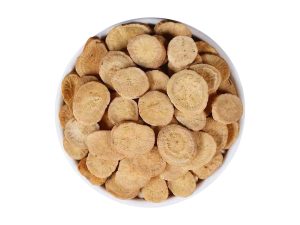
1. Large White Stalk Mushroom: The cap is flat and hemispherical, or funnel-shaped with a central depression, 7–36 cm in diameter, off-white, bluish-white, or slightly grayish-yellow in color, with a smooth surface and an inrolled or flat margin. The flesh is white. The gills are dense, of varying lengths, and white, dull off-white, or bluish-brown. The stem is cylindrical with a swollen base.It is 5–13 cm long and 2–6 cm in diameter, white or bluish-white. It has a faint odor and a mild taste.
2. White Stump Mushroom: The cap is 7–15 cm in diameter, off-white, with a smooth surface and an inwardly curled margin. The flesh is white. The gills are white. The stem is 5–7 cm long and 2–3 cm in diameter, off-white, and solid. It has a faint odor and a mild taste.
Botanical Information
Botanical Classification
Fungi of the Agaricaceae family: Large White Stalk Mushroom and White Stalk Mushroom.
Morphological Characteristics
1. Large White Stalk Mushroom: The fruiting body is large, with a cap 7–36 cm wide. The cap is flattened hemispherical to nearly flat, concave in the center to funnel-shaped, off-white, bluish-white, or slightly grayish-yellow, smooth, with margins that are initially inrolled and gradually become extended. The flesh is white and thick. The gills are white to off-white, turning bluish-brown with age; they are decurrent, dense, narrow, and of unequal length.The stem is relatively thick, 5–13 cm long and 2–6 cm in diameter, swollen at the base and tapering upward. It is white to bluish-white, smooth, and fleshy. The spore print is white. Spores are colorless, smooth, elliptical, (6–8) μm × (4–6) μm.The sac-like structures at the gill margins are club-shaped, (30–33) μm × (5.6–7) μm.
2. White-stalked Mushroom: Also known as White Thunder Mushroom. The fruiting body is relatively large. The cap is 7–15 cm wide, flattened hemispherical, with a depressed center when spread flat; it is white, smooth, and has a smooth, inwardly curled margin.The flesh is white and relatively thick. The gills are white, dense, narrow, nearly adnate, and of unequal length. The stem is nearly cylindrical, white, 5–7 cm long, 2–3 cm thick, smooth, and solid. The spores are colorless, smooth, elliptical, (5–6.3) μm × (3–4) μm.
Distribution Area
1. Large White Stalk Mushroom: Found in Northeast China, as well as Inner Mongolia, Hebei, Xinjiang, Qinghai, Zhejiang, Fujian, Guangxi, Yunnan, and Tibet. 2. White Stalk Mushroom: Found in Heilongjiang, Shanxi, Qinghai, and other areas.