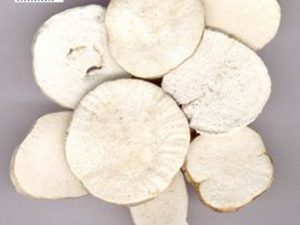
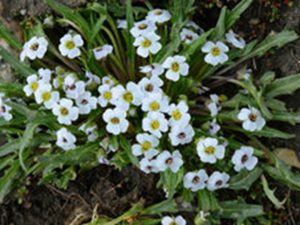
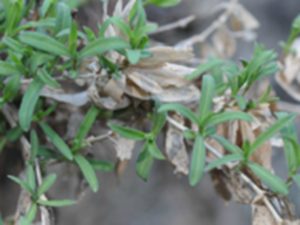
Amaranth Stems, a name in traditional Chinese medicine. It refers to the mature stems of Chenopodium album L., a plant of the Amaranthaceae family. It is distributed throughout China. It has the efficacy of eroding and removing verrucas. It is commonly used to treat common warts.

Quinoa Stem
Amaranth Stems, a name in traditional Chinese medicine. It refers to the mature stems of Chenopodium album L., a plant of the Amaranthaceae family. It is distributed throughout China. It has the efficacy of eroding and removing verrucas. It is commonly used to treat common warts.
Chinese Name : 藜茎
Latin Name : Chenopodium album L.
Authentic Producing Area : Nationwide
Nature, Flavor & Meridian Tropism : Sweet in taste, neutral in nature; enters the Lung meridian
Benefits & Efficacy
Benefits
Erosion of verrucas.
Indications
Common warts.
Usage and Dosage
External use: Burn to ash or extract the juice to make a decoction, then apply to the affected area.
Precautions
Not yet established.
Relevant Discussions
*Compendium of Materia Medica*: “Burn the stems of Chenopodium album to ash, mix with equal parts of reed ash and mugwort ash, add water and steam to extract the juice, then boil it down to a paste and apply it to warts and moles.”
Applications
Processing & Preparation
Harvesting & Processing
Harvest the lower, mature stems from September to November and sun-dry them.
Crude Drug Identification
Botanical Information
Botanical Classification
Amaranthus, a plant of the Amaranthaceae family.
Morphological Characteristics
An annual herb, 30–150 cm tall. The stem is erect, stout, ridged, with green or purplish-red stripes, and highly branched.Leaves are alternate; petioles are nearly as long as the leaf blades, or half the length of the leaf blades; lower leaf blades are rhombo-ovate or ovate-triangular, 3–6 cm long and 2.5–5 cm wide, with an acute or slightly obtuse apex, a cuneate base, and the upper surface usually glabrous, though young leaves may have a purplish-red powdery coating on the upper surface; margins are toothed or irregularly shallowly lobed;upper leaves are lanceolate; the underside is often powdery. Flowers are small, bisexual, and yellowish-green, clustered in groups of 8–15; many such clusters form large or small panicles, arising from leaf axils and branch tips; perianth segments are 5, with longitudinal ridges on the back, powdery, slightly concave at the apex, and with membranous margins;There are 5 stamens, protruding beyond the perianth; the ovary is flattened-globose, the style is short, and the stigma is bifid. The capsule is slightly flattened, nearly circular; the pericarp adheres to the seeds and is enclosed within the perianth. The seeds are transverse, biconvex and mirror-like, black, glossy, with shallow grooves on the surface. Flowering occurs from August to September, and fruiting from September to October.
Distribution Area
Found throughout the country.