Tianhuafen is the name of a traditional Chinese medicine. It consists of the dried roots of Trichosanthes kirilowii Maxim. or Trichosanthes rosthornii Harms, plants belonging to the genus Trichosanthes in the Cucurbitaceae family. It has the effects of clearing heat and reducing fire, promoting fluid production to quench thirst, and reducing swelling and draining pus.It is primarily used to treat feverish conditions with restlessness and thirst, dry cough due to lung heat, diabetes caused by internal heat, and swollen, toxic sores.

Tianhuafen
Tianhuafen is the name of a traditional Chinese medicine. It consists of the dried roots of Trichosanthes kirilowii Maxim. or Trichosanthes rosthornii Harms, plants belonging to the genus Trichosanthes in the Cucurbitaceae family. It has the effects of clearing heat and reducing fire, promoting fluid production to quench thirst, and reducing swelling and draining pus.It is primarily used to treat feverish conditions with restlessness and thirst, dry cough due to lung heat, diabetes caused by internal heat, and swollen, toxic sores.
Chinese Name : 天花粉
Latin Name : Trichosanthis Radix
Aliases : Trichosanthes root, Lo root, Baiyao, Ruixue, Tianguapin, Huafen, Trichosanthes powder, Lo powder
Authentic Producing Area : Shandong, Henan, Anhui, Sichuan
Nature, Flavor & Meridian Tropism : Sweet and slightly bitter in taste; slightly cold in nature; enters the Lung and Stomach meridians
Benefits & Efficacy
Benefits
Clears heat and purges fire; generates body fluids and quenches thirst; reduces swelling and expels pus.
Indications
Feverish conditions with restlessness and thirst, lung heat with dry cough, internal heat with excessive thirst, and swollen, toxic sores.
Usage and Dosage
1. Internal use: Decocted as a soup, 9–15 g; or incorporated into pills or powders. 2. External use: Apply as a powder or as a paste.
Precautions
1. Use with caution in pregnant women. 2. Should not be used in combination with Chuanwu, processed Chuanwu, Caowu, processed Caowu, or Fuzi.
Chemical Constituents
It primarily contains protein components (Trichosanthin), amino acids and peptides (α-hydroxymethylserin, aspartic acid), carbohydrates (ribose, xylose, arabinose),steroids (7-stigmast-3-β-ol), and fatty acids (cholic acid), as well as α- and β-cucurbitacins and cucurbitacin.
Pharmacological Actions
This product possesses antiviral, antitumor, and labor-inducing effects.
Relevant Discussions
1. *Shennong Bencao Jing*: “Treats thirst, fever, restlessness and fullness, and severe heat; tonifies deficiency and harmonizes the middle jiao; heals severe injuries.”
2. *Rihua Zi Bencao*: “Promotes the function of the small intestine, expels pus, alleviates swelling and toxicity, promotes tissue regeneration and muscle growth, and dissipates blood stasis from contusions and injuries.It treats fever-induced mania and acute diseases, mastitis, back abscesses, hemorrhoids, fistulas, sores, and boils.”
3. *Bencao Huiyan*: “It dispels stagnant heat in the five viscera, such as excessive heart fire causing a dry tongue and mouth, excessive lung fire causing a swollen throat and laryngeal obstruction,excessive spleen fire causing swelling of the mouth, tongue, and teeth; excessive phlegm-fire causing persistent, restless coughing; or conditions such as liver fire causing distension and pain in the flanks, kidney fire causing bone-steaming fever and restlessness; or abscesses and boils—whether already ruptured or not—where heat toxins have not dissipated; or the five types of jaundice where the body and eyes are yellow and urination is scanty, painful, or difficult—all of these are caused by stagnant heat and fire. Only this formula can resolve stagnation, subdue phlegm-fire, and treat these conditions.Furthermore, with its sweet and cold nature, it is highly effective in treating thirst: when combined with tonic herbs, it treats thirst due to deficiency; when combined with cooling herbs, it treats thirst due to fire; when combined with qi-regulating herbs, it treats thirst due to stagnation; and when combined with blood-nourishing herbs, it treats thirst accompanied by restlessness. It is thus an essential herb for treating thirst.”
Applications
Clinical Applications
1. To treat thirst associated with febrile diseases, it may be combined with Phragmites Rhizome (Lugen) and Ophiopogon Tuber (Maimendong); or with Raw Rehmannia Root (Shidihuang) and Schisandra Berry (Wuweizi), as in the Smallpox Powder (Tianhua San, from *Ren Zhai Zhi Zhi Fang*). To treat dryness injuring the lung and stomach, resulting in a dry throat and thirst, it may be combined with Glehnia Root (Shashen), Ophiopogon Tuber (Maimendong), and Polygonatum Rhizome (Yuzhu), as in the Glehnia and Ophiopogon Decoction (Shashen Maidong Tang, from *Treatise on the Differentiation of Warm Diseases*).
2. To treat lung heat and dryness, manifested as dry cough with scant phlegm or blood-streaked sputum, it can be combined with Tianmendong, Ophiopogon, and Raw Rehmannia, as in the Zizao Decoction (*Source and Course of Miscellaneous Diseases: A Rational Analysis*); when combined with Ginseng, it treats cough, wheezing, and hemoptysis resulting from lung damage by dry heat and heat, which depletes both qi and yin, as in the Shenhua Powder (*Revival of Ten Thousand Diseases*).
3. To treat xiaoke (thirst and wasting syndrome) caused by internal accumulation of heat that generates dryness and depletes body fluids, it is commonly combined with Ophiopogon japonicus, Phragmites root, and White茅根 (from *Qianjin Fang*); to treat xiaoke due to internal heat with concurrent deficiency of both qi and yin, it is combined with Ginseng, as in the *Yuhu Pill* (from *Ren Zhai Zhizhi Fang*).
4. For the initial stage of skin ulcers and sores, where heat-toxin is intense but pus has not yet formed, it can help disperse the condition; for cases where pus has already formed, it can promote ulcer rupture and pus discharge. It is often used in combination with Honeysuckle, White Angelica, and Manchurian Pangolin Scale, as in the Immortal Formula for Preserving Life Decoction (*Effective Formulas for Women*);To treat wind-heat ascending to the head, causing swelling and pain in the throat, it can be ground into a powder with an equal amount of mint and taken with watermelon juice, as in the “Silver Lock Key” formula (*Comprehensive Book of One Hundred Effective Surgical Formulas*).
Related Compatibility
1. Tianhuafen combined with Trichosanthes peel: Tianhuafen excels at clearing heat, purging fire, promoting fluid production, and quenching thirst; Trichosanthes peel excels at regulating qi, relieving chest congestion, and clearing and transforming heat-induced phlegm. When used together, the effects of clearing heat, transforming phlegm, regulating qi, and relieving chest congestion are enhanced. Suitable for conditions such as dry cough due to lung heat and chest tightness with counterflow of qi.
2. Tianhuafen Combined with Tian冬: Tianhuafen excels at clearing heat, purging fire, generating body fluids, and quenching thirst; Tian冬 excels at clearing lung heat, generating body fluids, nourishing yin, and moistening dryness. When used together, these two herbs enhance the ability to clear lung heat and moisten lung dryness. This combination is suitable for conditions such as dry heat injuring the lungs, dry cough with scant phlegm, and blood-streaked sputum.
3. Tianhuafen combined with Jin Yin Hua: Tianhuafen clears heat, purges fire, reduces swelling, and expels pus; Jin Yin Hua clears heat, detoxifies, and dissipates abscesses and swellings. When used together, their effects in clearing heat, dispersing nodules, reducing swelling, and relieving pain are enhanced. This combination is suitable for the early stages of abscesses, boils, and toxic swellings characterized by redness, swelling, and severe pain.
Medicinal Identification
1. Tianhuafen and Zhimu: Both herbs belong to the category of heat-clearing and fire-purging agents, both enter the Lung and Stomach meridians, and both can clear heat, generate body fluids, and quench thirst. They can be used for feverish conditions with restlessness and thirst, dry cough due to lung heat, and thirst caused by internal heat.However, Tianhuafen is sweet, slightly bitter, and slightly cold in nature; it excels at clearing heat and generating body fluids, while also clearing lung heat and moistening dryness. It is suitable for conditions such as dry heat injuring the lungs, dry cough with scant sputum, and cough with blood-streaked sputum—all manifestations of lung heat and dry cough. It can also reduce swelling and expel pus, making it effective for treating abscesses and swellings caused by toxic heat; in cases where pus has not yet formed, it helps disperse the swelling, and in cases where pus has already formed, it promotes ulceration and the expulsion of pus.Zhimu, on the other hand, is sweet, cold, and moist in nature, and enters the Kidney meridian. It clears lung heat and purges fire in the upper burner, purges stomach fire and quenches thirst in the middle burner, and moistens kidney dryness and nourishes yin in the lower burner. It can clear heat and purge fire to treat exogenous febrile diseases and excess heat patterns characterized by high fever and restlessness with thirst, and it can also nourish yin and subdue fire to treat deficiency heat patterns characterized by yin deficiency with excessive fire, bone-steaming fever, and tidal fever;Because it has the effect of moistening the intestines and promoting bowel movements, it can also be used for constipation due to intestinal dryness.
2. Tianhuafen and Lugen: Both herbs belong to the category of heat-clearing and fire-purging agents, and both enter the Lung and Stomach meridians. They can clear heat, generate body fluids, and quench thirst, and can be used to treat heat-related illnesses with fluid depletion and thirst.However, Tianhuafen is sweet, slightly bitter, and slightly cold in nature; it has a stronger ability to clear heat and generate body fluids, and can also clear lung heat and moisten dryness, making it suitable for treating dry cough due to lung heat and cough with bloody sputum caused by phlegm-heat; furthermore, it can reduce swelling and expel pus, and is used to treat abscesses, swellings, and toxic sores.Reed Root (Lugen), on the other hand, is sweet and cold in nature. It excels at clearing heat from the Lung and Stomach meridians while also promoting dispersion, making it suitable for treating the early stage of exogenous febrile diseases accompanied by exterior syndrome, the middle stage characterized by high fever and restlessness with thirst, and the late stage marked by heat subsiding but fluid depletion leading to thirst. It can also clear heat and promote urination for treating painful and scanty urination due to heat; clear heat and stop vomiting for treating vomiting caused by stomach heat; and clear and disperse lung heat for treating coughs due to lung heat and lung abscesses with pus discharge.
3. Tianhuafen and Gegen: Both herbs can clear heat, generate body fluids, and quench thirst, and are used for thirst caused by fluid depletion in febrile diseases as well as for xiaoke syndrome. However, Tianhuafen is sweet, slightly cold, and moist in nature; it belongs to the category of herbs that clear heat and purge fire. It excels at clearing heat, nourishing yin, generating body fluids, and quenching thirst, while also clearing lung heat, moistening dryness, reducing swelling, and expelling pus. It treats both dry coughs due to lung heat and abscesses, swellings, and skin infections.Kudzu Root (Ge Gen) has a light, ascending, and dispersing nature and belongs to the category of herbs that disperse wind-heat. It excels at relieving muscle tension and reducing fever, as well as promoting the eruption of measles. It is the primary herb for treating exterior syndrome characterized by fever without sweating, headache, and stiffness of the neck, and can also be used when the eruption of measles is incomplete. Furthermore, it can lift and promote the ascension of clear yang, stimulating the ascending movement of the spleen and stomach’s clear yang qi to stop diarrhea and dysentery; thus, it treats both spleen-deficiency diarrhea and heat-induced diarrhea and dysentery.
Related Medicines
Qingfei Yihuo Wan, Qingyin Wan, Yuquan Wan, and Ruyi Jinhuang San.
Related Prescriptions
Shen Shen Mai Dong Decoction (*Treatise on the Differentiation of Warm Diseases*), Zi Zao Decoction (*A Rational Analysis of the Origins and Course of Miscellaneous Diseases*), and Xian Fang Huo Ming Decoction (*Effective Formulas for Women*).
Medicinal Diet Therapy
Tianhuafen and Chrysanthemum Tea
1. Benefits: Nourishes yin, clears heat, generates body fluids, and purges fire.
2. Ingredients: 30 grams of chrysanthemum flowers, 30 grams of Tianhuafen, 6 grams of raw licorice, and rock sugar to taste.
3. Preparation: Lightly rinse the Tianhuafen and licorice; add an appropriate amount of water and simmer for half an hour, then strain to remove the residue and retain the liquid; add the chrysanthemum flowers and steep for 10 minutes; add rock sugar to taste.
4. Usage: Drink three times daily, using the decoction as a substitute for tea.
Notes
Patients requiring treatment with Chinese herbal medicine should first consult a licensed Traditional Chinese Medicine (TCM) hospital, where a TCM practitioner will conduct a professional pattern differentiation and prescribe an herbal formula.
Processing & Preparation
Harvesting & Processing
Harvest in the fall and winter seasons; wash thoroughly, remove the outer skin, cut into sections or split lengthwise into segments, and dry.
Processing Methods
Take the raw herbal material, remove impurities, sort by size, soak separately until 40–50% softened, remove from water, moisten thoroughly, cut into thick slices, and dry.
Storage Methods
Store in a dry container in a cool, well-ventilated, dry place.
Crude Drug Identification
Identification
1. The powder of this product is off-white. Starch granules are very numerous; single granules are subglobose, semicircular, or helmet-shaped, with a diameter of 6–48 μm; the hilum is punctate, short-fissured, or chevron-shaped, and the lamellar structure is faintly visible; compound granules consist of 2–14 subgranules, often composed of one large subgranule and several small subgranules.Vessels with marginal pores are large and often fragmented; some have marginal pores that are hexagonal or square in shape and are densely arranged. Stone cells are yellowish-green, rectangular, elliptical, square-like, polygonal, or spindle-shaped, with a diameter of 27–72 μm; their walls are relatively thick, and their pores are fine and dense.
2. Take 2 g of the powdered sample, add 20 mL of dilute ethanol, subject to ultrasonic treatment for 30 minutes, filter, and use the filtrate as the test solution. Separately, take 2 g of Tianhuafen reference herbal material and prepare a reference herbal material solution using the same method.Next, take a reference standard of citrulline, dissolve it in dilute ethanol to prepare a solution containing 1 mg per mL, and use this as the reference standard solution. Perform the test according to the thin-layer chromatography method (General Chapter 0502). Pipette 2 μL each of the test solution and the reference herbal material solution, and 1 μL of the reference standard solution, and apply them separately onto the same silica gel G thin-layer plate. Develop the plate using n-butanol–anhydrous ethanol- glacial acetic acid-water (8:2:2:3) as the developing agent, remove the plate, allow it to air-dry, spray with indanone reagent, and heat at 105°C until the spots become clearly visible. In the test sample chromatogram, spots of the same color appear at positions corresponding to those in the reference herbal material chromatogram and the reference standard chromatogram.
Properties of Crude Drugs
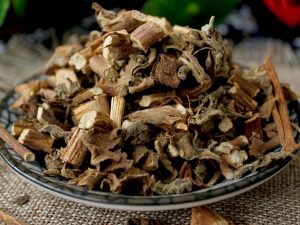
This product is irregularly cylindrical, spindle-shaped, or lobed, 8–16 cm long and 1.5–5.5 cm in diameter. The surface is yellowish-white or pale brownish-yellow, with longitudinal wrinkles, fine root scars, and slightly sunken, elongated transverse lenticels; some specimens retain remnants of yellowish-brown outer bark.The texture is firm; the fracture surface is white or pale yellow and powdery. The transverse section reveals yellow xylem arranged in a slightly radial pattern, while the longitudinal section shows yellow, striated xylem. It has a faint odor and a slightly bitter taste.
Properties of Processed Slices
The prepared slices are thick, circular, semicircular, or irregular in shape. The outer surface is yellowish-white or pale brownish-yellow. The cross-section reveals small yellow xylem pores arranged in a slightly radial pattern. It has a faint odor and a slightly bitter taste.
Botanical Information
Botanical Classification
Plants of the genus Trichosanthes in the Cucurbitaceae family, specifically Trichosanthes kirilowii and Trichosanthes bilateralis.
Morphological Characteristics
1. Trichosanthes: A climbing vine that can reach up to 10 m in length. The tuberous root is cylindrical, thick, and rich in starch. The stem is relatively thick, highly branched, with longitudinal ridges and grooves, and covered with white, spreading soft hairs. Leaves are alternate; petioles are 3–10 cm long, with longitudinal striations and covered with long soft hairs; tendrils are 3–7-branched and covered with soft hairs;the leaf blade is papery, with a nearly circular or nearly cordate outline, approximately 5–20 cm in both length and width; it is often 3–7-lobed with shallow to moderate lobes, rarely deeply lobed or unlobed with only unequal, coarse teeth; the lobes are rhomboid-obovate or oblong, with a blunt or acute apex, margins often further shallowly lobed; the base is cordate, with a deep notch 3–4 cm deep; the upper surface is dark green and rough,the underside is pale green; both surfaces are covered with long, soft, bristly hairs along the veins; there are 5 basal palmate veins, with a reticulate network of fine veins.Dioecious; male racemes solitary or paired with a single flower, or solitary on the upper parts of the branches; racemes 10–20 cm long, stout, with longitudinal ridges and grooves, covered with fine soft hairs, bearing 5–8 flowers at the apex; pedicels of solitary flowers approximately 15 cm long, pedicelules approximately 3 mm long,the bracteoles are obovate or broadly ovate, 1.5–3 cm long and 1–2 cm wide, coarsely toothed in the middle to upper part, with a stalk at the base, and covered with short soft hairs; the calyx tube is cylindrical, 2–4 cm long.The apex is expanded, with a diameter of about 10 mm; the middle and lower parts have a diameter of about 5 mm and are covered with short soft hairs; the lobes are lanceolate, 10–15 mm long and 3–5 mm wide, with entire margins; the corolla is white, with obovate lobes approximately 20 mm long and 18 mm wide, bearing a green tip at the central apex and filamentous fringes on both sides, and covered with soft hairs;The anthers are connate, approximately 6 mm long and 4 mm in diameter; the filaments are free, stout, and covered with long soft hairs; the female flower is solitary, with a 7.5 cm long pedicel covered with soft hairs; the calyx is cylindrical, 2.5 cm long and 1.2 cm in diameter, with lobes similar to those of the male flower’s corolla; the ovary is elliptical, green, 2 cm long; the style is 2 cm long, with three stigmas.The fruit is elliptical or round, 7–10.5 cm long, and yellowish-brown or orange-yellow when ripe. The seeds are ovoid-elliptical, flattened, 11–16 mm long, 7–12 mm wide, pale yellowish-brown, and ridged near the margins. Flowering occurs from May to August, and fruiting from August to October.
2. Bilateral Trichosanthes: This species closely resembles Trichosanthes, except that its plants are smaller;the leaves are usually deeply lobed 3–7 times, almost reaching the base, with linear-lanceolate or oblanceolate lobes and, very rarely, small sublobes; the small bracts of the male flowers are smaller, typically 5–16 mm long and 5–11 mm wide; the calyx lobes are linear; and the ridges on the seeds are set farther from the margins.
Distribution Area
1. Trichosanthes: Distributed in North China, Central and South China, East China, as well as the provinces and regions of Liaoning, Shaanxi, Gansu, Sichuan, Guizhou, and Yunnan. 2. Bilobed Trichosanthes: Distributed in the provinces and regions of Gansu, Shaanxi, Jiangxi, Hubei, Sichuan, Guizhou, and Yunnan.
Growth Habits
It prefers a warm and humid climate. It is relatively cold-tolerant but not drought-tolerant. It is best cultivated in sunny locations with deep, loose, and fertile sandy loam soil; it is not suitable for cultivation in low-lying areas or saline-alkali soils.
Propagation Methods
Propagation is carried out using seeds, root division, and layering; in commercial production, root division is the primary method.
Cultivation Techniques
1. Direct Seeding: In September–October, select mature fruits with short stems and an orange-yellow color. The following spring, between March and April, soak the seeds in warm water at 40–50°C for one day and one night. Remove and air-dry them, then use moist sand to promote germination. Sow seeds at 2-meter intervals between holes, covering them with 3–4 cm of soil. Seedlings emerge 5–20 days after sowing.
2. Root Division: In northern regions during March–April and in southern regions during October–December, dig up the entire tuber and crown, selecting fresh, disease- and pest-free sections for propagation. Divide them into 7–10 cm segments, ensuring an appropriate mix of roots from female and male plants to facilitate pollination. Plant in holes dug at a row spacing of 2 m and a plant spacing of 0.3 m; seedlings will emerge in about one month.
3. Layering Propagation: In summer and fall, lay vigorous vines on the ground and cover the base of the leaves with soil. Once roots have developed, cut the stem; new stems will grow, forming new plants. These can be transplanted the following year.
Pest and Disease Control
1. Yellow Melon Beetle: Adult beetles begin feeding on leaves in May, while larvae bore into the roots. During the larval stage, apply a 30-fold dilution of nicotine solution as a root drench.
2. Trichoptera Melon Moth: Starting in July, this moth’s larvae bore into stems and vines, causing entire branches to wither and die.
3. Melon Aphids: These aphids damage tender young leaves; other pests include the black-legged aphid and the black melon aphid.