Vinegar-processed Cyperus is a processed form of the traditional Chinese medicinal herb Cyperus. It is the dried rhizome of Cyperus rotundus L. (a plant of the Cyperaceae family), prepared through cleaning, slicing, and either vinegar-roasting or vinegar-boiling and steaming.This product is produced in Shandong, Zhejiang, Fujian, Hunan, and other regions. It primarily serves to soothe the liver and relieve pain, as well as eliminate food stagnation and resolve digestive blockages. It is commonly used to treat qi stagnation in the blood, abdominal pain caused by indigestion, and epigastric pain resulting from cold-induced qi stagnation.
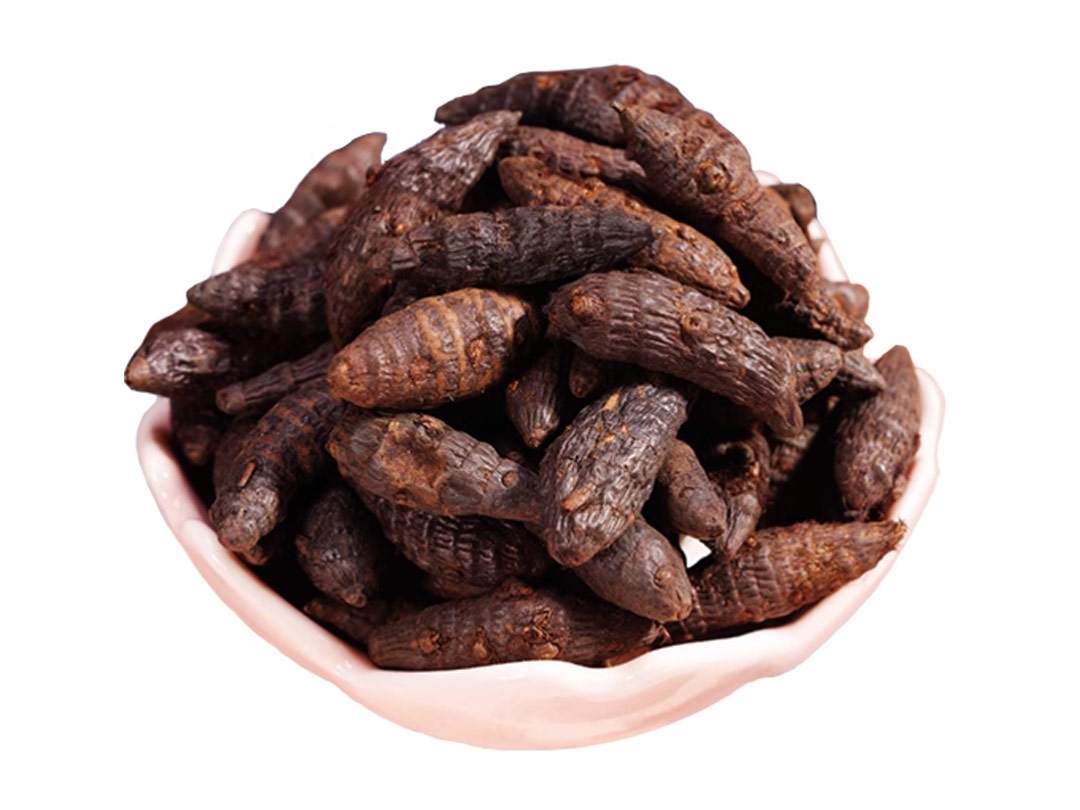
Vinegar-Processed Cyperus
Vinegar-processed Cyperus is a processed form of the traditional Chinese medicinal herb Cyperus. It is the dried rhizome of Cyperus rotundus L. (a plant of the Cyperaceae family), prepared through cleaning, slicing, and either vinegar-roasting or vinegar-boiling and steaming.This product is produced in Shandong, Zhejiang, Fujian, Hunan, and other regions. It primarily serves to soothe the liver and relieve pain, as well as eliminate food stagnation and resolve digestive blockages. It is commonly used to treat qi stagnation in the blood, abdominal pain caused by indigestion, and epigastric pain resulting from cold-induced qi stagnation.
Chinese Name : 醋香附
Nature, Flavor & Meridian Tropism : Pungent, slightly bitter, and slightly sweet in taste; neutral in nature; enters the Liver, Spleen, and Triple Energizer meridians
Benefits & Efficacy
Benefits
Vinegar-processed Cyperus rhizome has a pungent, slightly bitter, and slightly sweet taste; it is neutral in nature and enters the Liver, Spleen, and Triple Energizer meridians. Its primary functions are to soothe the liver and relieve pain, as well as to eliminate food stagnation and resolve digestive blockages. It is commonly used to treat qi stagnation in the blood, abdominal pain caused by indigestion, and epigastric pain resulting from cold-induced qi stagnation.
Indications
Vinegar-processed Cyperus is primarily used to treat qi stagnation in the blood, abdominal pain caused by indigestion, and epigastric pain due to cold-induced qi stagnation.
Usage and Dosage
Take 6–10 g as a decoction; or incorporate into pills or powders.
Precautions
1. This herb has a pungent and bitter nature and a drying, dispersing action; it carries the risk of depleting blood and injuring yin. Therefore, it should be used with caution in patients with yin deficiency, blood deficiency, or blood heat. 2. This herb has a blood-pressure-lowering effect; therefore, patients with hypotension should use it with caution. 3. Monitor for allergic reactions during treatment. 4. This herb should not be decocted for an extended period to avoid destroying the volatile oil components and reducing its efficacy. 5. Avoid contact with iron utensils during decoction and administration. 6. Avoid raw, cold, spicy, irritating, and greasy foods while taking this herb.
Chemical Constituents
This product contains volatile oils, flavonoids, alkaloids, and triterpenes, among other components.
Pharmacological Actions
Modern pharmacological research has found that this product possesses antispasmodic, analgesic, and antioxidant effects.
Applications
Related Compatibility
1. Vinegar-processed Cyperus can be used in combination with Bupleurum, Ligusticum, and Fructus Aurantii to treat distending pain in the flanks caused by liver qi stagnation.
2. Vinegar-processed Cyperus can be used in combination with Alpinia to treat epigastric pain caused by cold stagnation and qi stagnation, or liver qi invading the stomach.
Medicinal Identification
Raw Xiangfu, vinegar-processed Xiangfu, four-processed Xiangfu, wine-processed Xiangfu, and charred Xiangfu: These are different processed forms of Xiangfu, each with slightly different therapeutic focuses.Among these, raw Xiangfu excels at regulating qi, relieving epigastric fullness, regulating menstruation, and alleviating pain; it is commonly used to treat distending pain in the flanks caused by liver qi stagnation, epigastric fullness and distension caused by spleen-stomach qi stagnation, irregular menstruation, and dysmenorrhea. Vinegar-processed Xiangfu tends to soothe the liver and relieve pain, while also eliminating food stagnation and resolving stagnation; it is commonly used to treat abdominal pain caused by indigestion, epigastric pain caused by qi stagnation in the blood, and epigastric pain caused by cold-induced qi stagnation.The primary effects of Four-Processed Xiangfu are to regulate qi and relieve depression, as well as regulate menstruation and disperse masses; it is frequently used to treat flank pain, dysmenorrhea, and irregular menstruation; Wine-Processed Xiangfu can unblock meridians and disperse masses and stagnation, and is often used to treat abdominal pain caused by cold hernia; Charred Xiangfu has a bitter and astringent taste and a warm nature, and is frequently used to treat uncontrollable uterine bleeding in women.
Related Medicines
Gynecological Ten-Ingredient Tablets, Mu Xiang Shun Qi Pills, and Shu Jin Huo Xue Ding Tong Powder, among others.
Related Prescriptions
Xiang Sha Ping Wei San (from *Yi Zong Jin Jian*), Xiang Fu Xiong Gui Tang (from *Shen Shi Zun Sheng Fang*), Liang Fu Wan (from *Liang Fang Ji Ye*), etc.
Notes
Patients requiring treatment with Vinegar-Processed Cyperus should first consult a licensed Traditional Chinese Medicine (TCM) hospital to receive a TCM prescription following a professional TCM differential diagnosis.
Processing & Preparation
Harvesting & Processing
Harvest in the fall; singe off the hairs and filaments; briefly boil in boiling water or steam thoroughly before sun-drying, or sun-dry directly after singeing. Cut into thick slices or grind into granules.
Processing Methods
Take clean Cyperus rhizome granules or slices, mix with a measured amount of rice vinegar, and let stand until the vinegar is fully absorbed. Place the mixture in a roasting pan, roast over low heat until dry, remove and let cool, then sift out any debris.Alternatively, add a specified amount of rice vinegar, followed by an equal amount of water; boil until the vinegar is completely absorbed, then steam for 5 hours, let stand briefly, remove and allow to cool slightly, cut into thin slices, dry, and sift out any debris; or remove, dry, and then grind into powder. Use 20 kg of rice vinegar per 100 kg of Cyperus rhizome granules or slices.
Storage Methods
Store in a dry container, keep tightly sealed, and place in a cool, dry location; take care to prevent insect infestation.
Crude Drug Identification
Properties of Crude Drugs
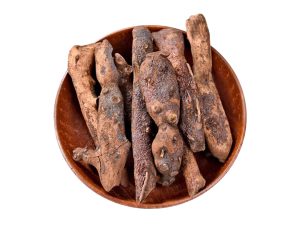
Cyperus rhizomes are mostly spindle-shaped, some slightly curved, 2–3.5 cm long, and 0.5–1 cm in diameter. The surface is brownish or dark brown, with longitudinal wrinkles and 6–10 slightly raised nodes; the nodes bear remnants of brown hairs and traces of root hairs that have not been completely removed. Those with all hairs removed are relatively smooth, and the nodes are less distinct.The texture is hard; when steamed or boiled, the cross-section is yellowish-brown or reddish-brown and horn-like; when sun-dried, the cross-section is white and powdery, with a distinct inner pericycle ring, a darker central column, and scattered dot-like vascular bundles. It has a fragrant aroma and a slightly bitter taste.
Properties of Processed Slices
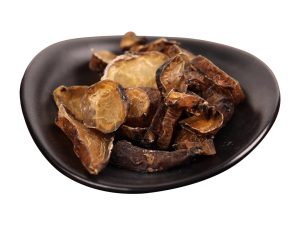
Vinegar-processed Cyperus rhizome appears as irregular thick slices or granules. The surface is dark brown. It has a faint vinegar-like aroma and a slightly bitter taste.
Botanical Information
Botanical Classification
A plant of the genus Cyperus in the family Cyperaceae.
Morphological Characteristics
Cyperus is a perennial herb. The rhizome is creeping; the tuber is elliptical; the stem is triangular in cross-section and smooth.Leaves are clustered, with closed leaf sheaths that clasp the stem. Leaf blades are long and linear. The inflorescence is a compound spike, terminal, with 3–10 flowers arranged in an umbel-like cluster; the flowers are dark tea-brown, with 2–3 leaf-like bracts and two rows of closely packed scales, each scale bearing one flower; there are three stamens, and the stigma is three-lobed and filiform.The nutlets are oblong-obovate with three ridges. Flowering occurs from May to August, and fruiting from July to November.
Distribution Area
It is distributed in Guangdong, Henan, Sichuan, Zhejiang, Shandong, Fujian, Hunan, and other areas.
Growth Habits
It is highly adaptable and undemanding in terms of soil.