Vinegar-processed Turtle Carapace is a processed form of the traditional Chinese medicinal material “turtle carapace.” It consists of the dorsal and ventral shells of the turtle Chinemys reevesii (Gray) from the family Testudines, which have been cleaned, selected, stir-fried with sand, and quenched in vinegar.This product is produced in Hubei, Hunan, Jiangsu, Zhejiang, Anhui, and other regions. It primarily has the effects of tonifying the kidneys and strengthening the bones, as well as nourishing yin and stopping bleeding. It is commonly used to treat fever due to overwork accompanied by hemoptysis, weakness and atrophy of tendons and bones, night sweats, and swollen, painful hemorrhoids.

Vinegar-Processed Turtle Carapace
Vinegar-processed Turtle Carapace is a processed form of the traditional Chinese medicinal material “turtle carapace.” It consists of the dorsal and ventral shells of the turtle Chinemys reevesii (Gray) from the family Testudines, which have been cleaned, selected, stir-fried with sand, and quenched in vinegar.This product is produced in Hubei, Hunan, Jiangsu, Zhejiang, Anhui, and other regions. It primarily has the effects of tonifying the kidneys and strengthening the bones, as well as nourishing yin and stopping bleeding. It is commonly used to treat fever due to overwork accompanied by hemoptysis, weakness and atrophy of tendons and bones, night sweats, and swollen, painful hemorrhoids.
Chinese Name : 醋龟甲
Authentic Producing Area : Hubei, etc.
Nature, Flavor & Meridian Tropism : Slightly cold in nature, salty and sweet in taste; enters the Liver, Kidney, and Heart meridians
Benefits & Efficacy
Benefits
Vinegar-processed Turtle Shell is slightly cold in nature, salty and sweet in taste, and enters the Liver, Kidney, and Heart meridians. It primarily has the effects of tonifying the kidneys and strengthening the bones, as well as nourishing yin and stopping bleeding.
Indications
Vinegar-treated Turtle Shell is primarily used to treat fever due to overwork accompanied by hemoptysis, weakness and atrophy of tendons and bones, night sweats, and swollen, painful hemorrhoids.
Usage and Dosage
1. Internal use: Decoct 9–24 g; it is recommended to crush the material and decoct it first; alternatively, it can be boiled into a paste or incorporated into pills or powders. 2. External use: Apply an appropriate amount of the ash, ground into a fine powder, as a poultice.
Precautions
1. Use with caution in cases of spleen-stomach deficiency-cold or internal cold-dampness. 2. Use with caution during pregnancy. 3. Patients with kidney disease should avoid long-term use in large doses. 4. This product should not be used in combination with tetracycline-class drugs. 5. Avoid spicy and hot foods and alcohol while taking this medication.
Chemical Constituents
This product primarily contains keratin, collagen, cholesterol-related compounds (such as cholesterol, cholesterol-4-ene-3-one, and cholesterol esters of docosenoic acid), and amino acids (such as aspartic acid, threonine, and arginine).
Pharmacological Actions
Modern pharmacological research has found that this product promotes growth and development, stimulates the uterus, prevents osteoporosis, protects against nerve and liver damage, enhances immune function, prevents blood clotting, increases coronary blood flow and improves tolerance to hypoxia, reduces fever, nourishes the blood, and has a sedative effect.
Applications
Related Compatibility
1. Vinegar-processed Turtle Carapace combined with Prepared Rehmannia Root: Vinegar-processed Turtle Carapace excels at nourishing kidney yin and strengthening tendons and bones; Prepared Rehmannia Root excels at replenishing blood, nourishing yin, replenishing essence, and nourishing the marrow.When used in combination, they enhance the effects of nourishing yin, tonifying the kidneys, and strengthening tendons and bones. This combination is suitable for conditions caused by deficiency of yin and essence, such as soreness and weakness in the lower back and knees, atrophy of tendons and bones, numbness and stiffness in the feet and knees, and even complete inability to walk, progressive wasting of body tissue, as well as the “Five Delays and Five Weaknesses” in children.
2. Vinegar-processed Turtle Shell Combined with Dragon Bone: Vinegar-processed Turtle Shell nourishes yin and subdues yang; Dragon Bone excels at calming the liver and subduing yang. When these two herbs are combined, they enhance the effect of calming the liver and subduing yang, making this combination suitable for conditions such as dizziness and headaches caused by hyperactive liver yang.
Medicinal Identification
Vinegar-processed turtle shell and raw turtle shell are different processed forms of turtle shell, and their therapeutic focuses differ. Raw turtle shell is hard in texture and has a fishy odor; it excels at nourishing yin and subduing yang, primarily treating conditions such as internal liver wind and hyperactivity of liver yang;Vinegar-processed turtle shell not only facilitates the extraction of active ingredients and eliminates the fishy odor and astringent taste but also enhances the effects of tonifying the kidneys, strengthening the bones, nourishing yin, and stopping bleeding. It is suitable for conditions such as fever due to overwork with hemoptysis, weakness and atrophy of tendons and bones, night sweats, and swollen, painful hemorrhoids.
Related Medicines
There are many medicinal formulations containing vinegar-treated turtle shell, including common ones such as Jianbu Qiangsheng Pills and Dabu Yin Pills.
1. Jianbu Qiangsheng Pills: This formulation consists of vinegar-treated turtle shell, white peony root, Phellodendron bark, Anemarrhena rhizome, Achyranthes root,leopard bone, dodder seed, eucommia bark, psoralea fruit (salt-roasted), cistanche, aconite root (processed), goji berries,续断, notopterygium root, angelica root, qinjiao, saposhnikovia root, papaya, astragalus root (honey-roasted), ginseng, white atractylodes (wheat bran-fried), poria, prepared rehmannia root, and angelica sinensis.It has the effects of tonifying the kidneys and strengthening the bones, as well as dispelling obstruction and relieving pain. It is used to treat weakness and atrophy of the tendons and bones, soreness in the lower back and legs, weakness in the feet and knees, and difficulty walking caused by deficiency of the liver and kidneys and obstruction of the meridians by wind-dampness.
2. Da Bu Yin Wan: This formula consists of Rehmannia glutinosa (prepared), vinegar-treated turtle shell, salt-processed Anemarrhena asphodeloides, salt-processed Phellodendron amurense, and porcine spinal cord. It has the effects of nourishing yin and reducing internal heat. It is used to treat night sweats, coughing, hemoptysis, tinnitus, and nocturnal emissions caused by yin deficiency with excessive internal heat.
Related Prescriptions
There are many formulas that include vinegar-treated turtle shell; common examples include Da Bu Yin Wan (from *Danxi’s Heart Method*) and Hu Qian Wan (from *Danxi’s Heart Method*).
1. Da Bu Yin Wan (*Danxi’s Heart Method*): Composed of prepared rehmannia root, vinegar-treated turtle shell, phellodendron bark, and anemarrhena rhizome. It has the efficacy of nourishing yin and reducing fire.It is indicated for conditions of yin deficiency with excessive fire, manifested by bone-steaming fever, night sweats, nocturnal emission, coughing with hemoptysis, irritability and short temper, pain and heat in the feet and knees, and a red tongue with little coating.
2. Huqian Pills (*Danxi’s Heart Method*): Composed of Phellodendron bark, vinegar-treated turtle shell, Anemarrhena rhizome, prepared Rehmannia root, tangerine peel, white peony root, Cistanche, and dried ginger.It has the effects of nourishing yin, reducing fire, and strengthening tendons and bones. It is indicated for atrophy syndromes caused by liver and kidney deficiency and yin deficiency with internal heat, with symptoms such as soreness and weakness in the lower back and knees, atrophy and weakness of tendons and bones, emaciation of the legs and feet, weakness when walking, or dizziness, tinnitus, nocturnal emission, and enuresis, accompanied by a red tongue with little coating and a fine, weak pulse.
Notes
Patients requiring treatment with traditional Chinese medicine should first consult a licensed TCM hospital, where a TCM practitioner will conduct a professional pattern differentiation and issue a prescription.
Processing & Preparation
Harvesting & Processing
Turtles can be captured year-round, though they are most commonly caught in the fall and winter. After capture, they are killed either by slaughter or by scalding with boiling water. The carapace and plastron are then removed, any remaining flesh is scraped off, and the shells are sun-dried.
Processing Methods
Place clean sand in a roasting pan and heat over high heat until it becomes smooth and easy to stir. When the sand is ready, add the cleaned turtle shells, sorted by size, and roast until the surface turns pale yellow and the shells become crisp. Remove them, sift out the sand, and immediately quench them in vinegar. Remove them from the vinegar, dry them, and crush them when ready for use. Use 20 kg of vinegar for every 100 kg of cleaned turtle shells.
Storage Methods
Store in a sealed or airtight container in a dry place, taking care to prevent insect infestation.
Crude Drug Identification
Properties of Crude Drugs
The carapace and plastron are connected by a carapacial bridge; the carapace is slightly longer than the plastron and is often separated from it. The carapace is long, elliptical, and arched, measuring 7.5–22 cm in length and 6–18 cm in width;the outer surface is brownish or blackish-brown, with three ridges; there is one nuchal scute, narrower at the front and wider at the back; there are five vertebral scutes, with the first vertebral scute being longer than or nearly equal in width to its length, and the second through fourth vertebral scutes being wider than they are long; the costal scutes are symmetrical on both sides, with four on each side; there are 11 marginal scutes on each side; and there are two anal scutes.The plastron is plate-like, nearly oblong-elliptical, 6.4–21 cm long and 5.5–17 cm wide; the outer surface is pale yellowish-brown to brownish-black, with 12 scutes, each often bearing purplish-brown radial patterns; the mid-sutures of the ventral, pectoral, and femoral scutes are long, those of the gular and anal scutes are next longest, and those of the humeral scutes are the shortest;The inner surface is yellowish-white to grayish-white; some specimens may have slight traces of blood or residual flesh. After cleaning, nine bony plates can be seen, interlocked in a sawtooth pattern; the front end is bluntly rounded or flat-cut, the rear end has a triangular notch, and on both sides, remnants of wing-like carapacial bridges curved diagonally upward remain. The texture is hard. It has a faint fishy odor and a slightly salty taste.
Properties of Processed Slices
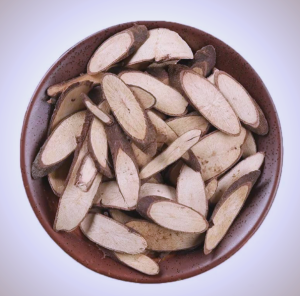
Vinegar-treated turtle shell appears in irregular chunks. The carapace scutes are slightly arched, while the plastron scutes are flat and vary in size. The surface is yellow or brownish-yellow; some may have dark brownish-yellow spots and irregular patterns.The inner surface is brownish-yellow or brownish-black; some edges are serrated. The cross-section is uneven, and some specimens have small honeycomb-like pores; the texture is brittle. It has a faint fishy odor, a slightly salty taste, and a faint aroma of vinegar.
Botanical Information
Distribution Area
It is primarily produced in Hubei, Hunan, Jiangsu, Zhejiang, Anhui, and other regions.