Jasmine is a name used in traditional Chinese medicine. It refers to the flowers of the plant Jasminum sambac (L.) Ait., belonging to the Oleaceae family. It has the effects of regulating qi, relieving pain, dispelling foul odors, and alleviating depression. It is primarily used to treat dampness and turbidity obstructing the middle burner, chest and diaphragm discomfort, abdominal pain from diarrhea or dysentery, dizziness and headaches, red eyes, and toxic sores.
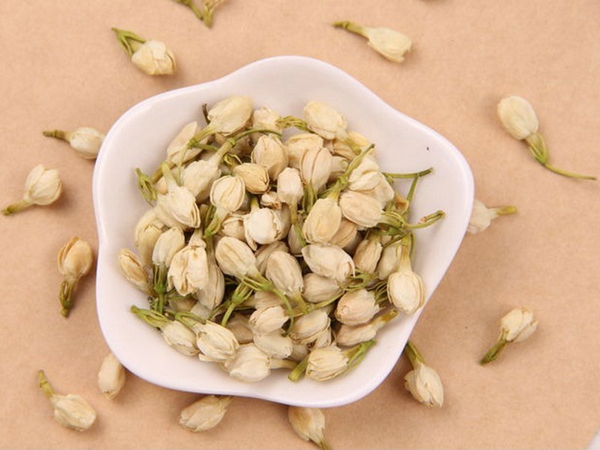
Jasmine
Jasmine is a name used in traditional Chinese medicine. It refers to the flowers of the plant Jasminum sambac (L.) Ait., belonging to the Oleaceae family. It has the effects of regulating qi, relieving pain, dispelling foul odors, and alleviating depression. It is primarily used to treat dampness and turbidity obstructing the middle burner, chest and diaphragm discomfort, abdominal pain from diarrhea or dysentery, dizziness and headaches, red eyes, and toxic sores.
Chinese Name : 茉莉花
Latin Name : Flos Jasmini Sambac
Aliases : Jasmine, Mo Li, Bai Mo Li, Mo Li Hua, Xiao Nan Qiang, Man Hua
Authentic Producing Area : Mainly produced in Jiangsu, Sichuan, and Guangdong
Nature, Flavor & Meridian Tropism : Pungent and slightly sweet in taste; warm in nature; enters the Spleen, Stomach, and Liver meridians
Benefits & Efficacy
Benefits
Regulates qi and relieves pain; dispels foul odors and alleviates depression.
Indications
Mainly used to treat dampness and turbidity obstructing the middle burner, chest and diaphragm discomfort, abdominal pain from diarrhea or dysentery, dizziness and headache, red eyes, and toxic sores.
Usage and Dosage
Internal use: Decoct 3–10 g in water; or drink as a tea substitute. External use: Use an appropriate amount; decoct in water to wash the eyes, or soak in vegetable oil and instill into the ears.
Precautions
Pregnant women and children should use this herb in moderation under a physician’s guidance to ensure safety.
Chemical Constituents
Jasmine flowers contain various chemical components, including essential oils, flavonoids, phenylpropanoids, and organic acids. Among these, essential oils are the primary active components of jasmine flowers, mainly comprising methyl benzoate, jasmone, and jasmonic acid.Flavonoid compounds mainly include flavonoids, flavanols, and flavanones. Coumarin compounds mainly include coumarin and umbelliferone. Organic acids mainly include benzoic acid, acetic acid, and propionic acid.
Pharmacological Actions
This product has effects such as promoting gastrointestinal motility, antibacterial, anti-inflammatory, sedative, and antioxidant properties.
Relevant Discussions
1. Yao Kecheng, *Food Materia Medica*: “Primarily warms the spleen and stomach and relieves chest and diaphragm congestion.”
2. *Practical Applications of Medicinal Properties*: “Specializes in eliminating foul odors and treating dysentery; suitable for those with deficiency.”
3. *Ben Cao Zai Xin*: “It clears deficient fire and dispels accumulated cold. It also treats toxic sores and eliminates abscesses and tumors.”
4. *Sui Xi Ju Dietary Spectrum*: “It harmonizes the middle burner, descends qi, and dispels foulness and turbidity. It treats dysentery and abdominal pain.”
5. *New Reference on Herbal Slices*: “It calms the liver and relieves depression; it regulates qi and alleviates pain.”
6. *Modern Practical Chinese Herbal Medicine*: “Used as an eye wash to treat conjunctivitis.”
7. *Chronicle of Sichuan Chinese Herbal Medicine* (1960 edition): “It wards off epidemics and clears the mind. It treats redness, swelling, and pain in the eyes, as well as ear and chest pain.”
8. *Chronicle of Fujian Medicinal Herbs*: “It calms the mind. It treats headaches and dizziness.”
Applications
Clinical Applications
1. For dampness and turbidity obstructing the middle burner, epigastric and abdominal distension, and diarrhea with abdominal pain: 6 g of jasmine flowers (added later), 10 g of green tea, and 6 g of Acorus tatarinowii. Decoct in water and take while warm. (*Chronicle of Sichuan Traditional Chinese Medicine*, 1979)
2. For abdominal distension and diarrhea: 6 g each of jasmine flowers and Magnolia officinalis, 9 g of Aquilaria agallocha, and 30 g of hawthorn. Decoct in water and take orally. (*Qingdao Manual of Chinese Herbal Medicine*)
3. For dizziness and headache: 15 g of jasmine flowers and 1 silver carp head. Simmer in water and consume. (*Fujian Compendium of Medicinal Materials*)
4. For red, swollen, and painful eyes: 6 g of jasmine flowers, 10 g each of Clethra and wild chrysanthemum. Decoct in water; use the decoction for steam baths and internal consumption. (*Compendium of Sichuan Chinese Materia Medica*, 1979)
5. For red, swollen, and painful eyes with tearing in the wind: 6 g each of jasmine flowers and chrysanthemum flowers, 9 g of honeysuckle. Decoct in water and drink. (*Medicinal Flowers of China*)
6. For earache: Soak jasmine flowers in vegetable oil and instill a few drops into the ear. (*Compendium of Sichuan Traditional Chinese Medicine*, 1960)
7. For difficult childbirth in women: Steep 7 jasmine flowers in hot water; swallow the liquid along with the flowers, and labor will proceed immediately. (Chai Yi, *Dietary Guide to Materia Medica*)
Notes
Patients requiring treatment with traditional Chinese medicine should first consult a licensed TCM hospital, where a TCM practitioner will conduct a professional diagnosis and prescribe the appropriate herbal formula.
Processing & Preparation
Harvesting & Processing
Harvest when the flowers first bloom in summer, then dry immediately in the sun or by artificial means.
Processing Methods
Take the raw herbal material, remove impurities, and sift out dust and debris.
Storage Methods
Store in a dry container, tightly sealed, in a cool, dry place.
Crude Drug Identification
Properties of Crude Drugs
The flowers are mostly flat, shriveled, and clustered, 1.5–2 cm long and approximately 1 cm in diameter. The calyx is tubular, with 8–10 slender, serrated lobes. When flattened, the petals are elliptical, approximately 1 cm long and 5 mm wide, yellowish-brown to brownish-black in color, with a smooth, hairless surface; their bases are fused into a tube. They are brittle in texture. They have a fragrant aroma and a astringent taste.
Properties of Processed Slices
See “Characteristics of Medicinal Materials.”
Botanical Information
Botanical Classification
Jasminum, genus Jasminum, family Oleaceae.
Morphological Characteristics
An erect or climbing shrub, up to 3 m tall. Young branches are cylindrical or slightly flattened, sometimes hollow and sparsely pubescent.Leaves are opposite and simple; petioles are 2–6 mm long, covered with short soft hairs, and jointed. Leaf blades are papery, round, ovate-elliptic, or obovate, 4–12.5 cm long and 2–7.5 cm wide, with rounded or blunt tips and bases that are sometimes slightly cordate; they are glabrous except for tufts of hairs often present in the axils of the veins on the underside.The corymb is terminal, usually bearing 3 flowers, though sometimes a single flower or as many as 5; the inflorescence peduncle is 1–4.5 cm long, covered with short soft hairs, with minute, conical bracts; the flower pedicels are 0.3–2 cm long;flowers are highly fragrant; the calyx is glabrous or sparsely pubescent, with linear lobes; the corolla is white, with a tube 0.7–1.5 cm long and oblong to nearly circular lobes. The fruit is spherical, about 1 cm in diameter, and purplish-black. Flowering occurs from May to August, and fruiting from July to September.
Distribution Area
Widely cultivated throughout southern China. Native to India.
Growth Habits
It thrives in a warm, humid climate but is susceptible to frost in winter and direct intense sunlight in summer. Well-drained, humus-rich sandy loam is the preferred soil type.
Propagation Methods
Propagated by cuttings and layering.
Cultivation Techniques
1. Propagation by Cuttings: From April to June, select two-year-old branches and cut them into 5–6-inch cuttings, each with 2–3 buds. Leave one pair of leaves at the top and remove all others.Prepare the soil and create raised beds. Plant the cuttings at a 7-inch row spacing and 3-inch plant spacing, inserting them diagonally into the soil and firming the soil around them. Set up a shade structure over the beds; roots will form in about one month. Once rooted, provide proper care and apply fertilizer as needed. Transplant in March of the following year, spacing rows 1.5 feet apart and plants 2 feet apart, with one plant per hole.
2. Layering Propagation: Select 2- to 3-year-old branches and bury them in the soil, leaving 5–6 nodes exposed above ground. Keep the soil moist; roots will form in about 40 days, after which the cuttings should be severed and transplanted. During the growing season, apply supplemental fertilizer based on soil fertility, primarily using human urine and compost. Provide shade in summer and protect the plants from cold in winter.