Tongcao is the name of a traditional Chinese medicine. It is the dried stem pith of Tetrapanax papyrifer (Hook.) K.Koch, a plant in the Araliaceae family, primarily produced in Guangxi and Sichuan. This product has the effects of clearing heat, promoting urination, regulating qi, and stimulating lactation. It is primarily used to treat damp-heat dysuria, edema with scant urination, and insufficient lactation.

Tongcao
Tongcao is the name of a traditional Chinese medicine. It is the dried stem pith of Tetrapanax papyrifer (Hook.) K.Koch, a plant in the Araliaceae family, primarily produced in Guangxi and Sichuan. This product has the effects of clearing heat, promoting urination, regulating qi, and stimulating lactation. It is primarily used to treat damp-heat dysuria, edema with scant urination, and insufficient lactation.
Chinese Name : 通草
Latin Name : Tetrapanacis Medulla
Aliases : White Akebia, Tonghua, Huacao, Daitongcao, Tongdahai, Paotong, Wujiafeng, Kuanchang, Datongta, Damutong, Wujiaopi
Authentic Producing Area : Guangxi, Sichuan
Nature, Flavor & Meridian Tropism : Sweet and bland in taste; slightly cold in nature; enters the Lung and Stomach meridians
Benefits & Efficacy
Benefits
Clears heat, promotes urination, regulates qi, and stimulates lactation.
Indications
Tongcao is primarily used to treat damp-heat dysuria, edema with scanty urine, and insufficient lactation.
Usage and Dosage
Oral use: Decoct and take 3–5 g.
Precautions
1. Use with caution in cases of both qi and yin deficiency without internal damp-heat. 2. Use with caution during pregnancy. 3. Due to its lactation-promoting effect, it should not be used in combination with barley malt.
Chemical Constituents
This product contains 15 amino acids, including inositol, pentosans, glucose, galacturonic acid, and glutamic acid, as well as 21 trace elements such as calcium, magnesium, and iron.
Pharmacological Actions
This product has diuretic, anti-inflammatory, antipyretic, immunomodulatory, and antioxidant effects, and helps increase milk secretion during lactation.
Relevant Discussions
1. *Rihua Zi Bencao*: “Improves vision, reduces fever, induces labor, expels the placenta, and promotes lactation.”
2. *Yixue Qiyuan*: “Clears obstructions in the female reproductive tract, promotes urination, and alleviates edema, dysuria, and the five types of淋 (lin).”
Applications
Clinical Applications
1. To treat heat-type dysuria characterized by difficulty urinating, dribbling, and painful urination, use it in combination with Winter Mallow Seeds, Talc, and Stone Weed, as in the Tongcao Decoction (from *Formulas for Universal Relief*).
2. To treat stone-type dysuria, it may be used in combination with Moneywort and Sea Sand.
3. To treat blood-type dysuria, it may be used in combination with Stone Weed, White Reed Root, and Cattail Pollen.
4. To treat edema caused by the retention of water and dampness, it can be combined with Poria, Earthworm, and Musk. Grind them together into a powder and take with rice soup, as in the Tongcao Powder (from *Comprehensive Treatise on Pediatric Hygiene and Prescriptions*).
5. To treat insufficient or absent lactation after childbirth, it can be used in combination with Pangolin Scale, Licorice, and Pig’s Hoof, as in the Lactation-Promoting Decoction (from *A Clear Explanation of the Origins and Course of Miscellaneous Diseases*).
Related Compatibility
Tongcao Combined with Talc: Tongcao excels at clearing heat and draining dampness. Talc is effective at clearing heat, draining dampness, and relieving summer heat; when used together, these two herbs have the effect of relieving summer heat and draining dampness. They are used to treat symptoms such as headache, heaviness of the body, chest tightness, and scanty, painful urination caused by the accumulation of damp-heat.
Medicinal Identification
Tongcao and Mutong: These two herbs share similarities in both their names and therapeutic effects, leading to confusion among ancient practitioners. The herb known today as Mutong was sometimes referred to as “Tongcao” in ancient texts; conversely, the herb known today as Tongcao was referred to as “Tongtuomu” in ancient texts. It is important to recognize the distinction between them and avoid confusion.Both Akebia and Tongcao are cold in nature and possess properties that promote free flow; they can both clear heat, promote diuresis, drain dampness, and promote lactation. They are similarly used to treat heat-induced dysuria with pain and burning, scanty and reddish urine, edema, difficulty urinating, and postpartum lack of lactation.The difference lies in their properties: Tongcao is sweet, bland, and slightly cold in nature, with a gentle descending and dispersing action. It enters the Lung meridian to disperse heat stagnation in the Lung, thereby opening the waterways and promoting urination; it excels at clearing Lung heat. Entering the Qi level, it can direct Qi upward to promote lactation; it is also used to treat the early stages of damp-heat syndrome, fever, and chest oppression. Mutong, on the other hand, is bitter and cold in nature, with a strong descending and dispersing action.is particularly effective at clearing fire from the Heart and Small Intestine, expelling excess heat through urination; it is especially effective for treating upward-rising Heart fire, sores in the mouth and on the tongue, or restlessness and dark urine caused by Heart heat descending to the Small Intestine; furthermore, it enters the Blood level, where it promotes the smooth flow of Qi and Blood, thereby facilitating lactation, relieving joint stiffness, and regulating menstruation; it also treats insufficient lactation, menstrual obstruction due to blood stasis, and pain from damp-heat bi syndrome.
Related Medicines
Milk-Inducing Granules.
Related Prescriptions
Tongcao Decoction (from *Pu Ji Fang*).
Medicinal Diet Therapy
Three Immortals and Tongcao Soup:
1. Benefits: Harmonizes the stomach and tonifies the spleen; warms the middle burner and boosts qi; replenishes essence and nourishes the marrow; promotes urination. Suitable for consumption during postpartum lactation deficiency and postpartum physical weakness.
2. Ingredients: 1 pork knuckle, 2 chicken thighs, 50g dried cuttlefish, 3g tongcao, 5g salt, 10g cilantro roots, a pinch of ground pepper.
3.Preparation: Wash the pork knuckle and chicken thighs, cut them into chunks, and blanch in boiling water to remove blood and impurities. Place them in a stewing pot and add salt. Wash the dried cuttlefish and place it on top of the meat. Add the cilantro roots, Tongcao, and an appropriate amount of boiling water. Steam over water for about 90 minutes until tender. Before serving, remove the herbal residue and cilantro roots, then sprinkle with ground pepper.
4. Usage: Serve as an accompaniment to meals.
Notes
Patients requiring treatment with Chinese herbal medicine should first consult a licensed Traditional Chinese Medicine (TCM) hospital to receive a prescription following a professional TCM differential diagnosis.
Processing & Preparation
Harvesting & Processing
Harvest the stems in autumn, cut them into sections, extract the pith while fresh, straighten the pieces, and sun-dry them.
Processing Methods
1. Tongcao: Take the raw herb, remove impurities, and cut into thick slices.
2. Cinnabar-processed Tongcao: Place the Tongcao slices in a suitable container, spray a small amount of water to lightly moisten them, add fine cinnabar powder, sprinkle evenly, and turn the slices frequently until the cinnabar is evenly coated on the surface. Remove and air-dry. Use 0.6 kg of cinnabar per 10 kg of Tongcao slices.
Storage Methods
Store in a dry container in a well-ventilated, dry place to protect from moisture.
Crude Drug Identification
Identification
Cross-section of this product: Consists entirely of thin-walled cells that are elliptical, circular, or nearly polygonal in shape. The cells on the outer side are smaller, with distinct pits; some cells contain clusters of calcium oxalate crystals, 15–64 μm in diameter.
Properties of Crude Drugs
This product is cylindrical, 20–40 cm long and 1–2.5 cm in diameter. The surface is white or pale yellow, with shallow longitudinal grooves. It is light in weight, soft and loose in texture, slightly elastic, and breaks easily; the fracture surface is flat and exhibits a silvery-white luster. In the middle, there is a hollow or translucent membrane 0.3–1.5 cm in diameter; in longitudinal sections, these are arranged in a ladder-like pattern, and solid ones are rare.It has a faint odor and a bland taste.
Properties of Processed Slices
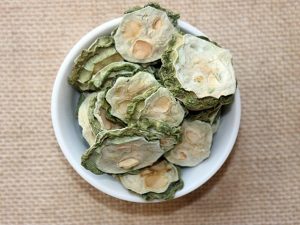
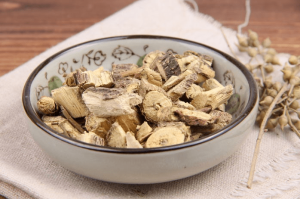
1. Tongcao: This product consists of round or nearly round thick slices. The surface is white or pale yellow, with shallow longitudinal grooves. It is light in weight, soft in texture, slightly elastic, with a flat cut surface exhibiting a silvery-white luster; the center is hollow or contains a translucent membrane, while solid specimens are rare. It has a faint odor and a bland taste.
2. Cinnabar-coated Tongcao: Resembles Tongcao in shape, with a uniform coating of cinnabar on the surface.
Botanical Information
Botanical Classification
Tongtuomu, a plant of the genus Tongtuomu in the Araliaceae family.
Morphological Characteristics
An evergreen shrub or small tree, 1–3.5 m tall. The stem is stout and unbranched; when young, its surface is densely covered with yellow stellate hairs or slightly covered with deciduous grayish-yellow soft hairs. The stem pith is large, white, and papery; the bark is dark brown and slightly wrinkled and fissured; new branches are pale brown or pale yellowish-brown, with distinct leaf scars and large lenticels.Leaves are large, alternate, and clustered at the stem apex; petioles are stout, cylindrical, and 30–50 cm long; stipules are membranous, conical, fused to the petiole at the base, and bear dense stellate tomentum;leaf blades are papery or thinly leathery, palmately 5–11-lobed; lobes typically 1/3–1/2 the total length of the blade, rarely up to 2/3, obovate-oblong or ovate-oblong; each lobe often has 2–3 further lobules; margins entire or coarsely toothed; upper surface dark green and glabrous; lower surface densely covered with white stellate tomentum.Umbels are aggregated into large, terminal or subterminal compound panicles, up to 50 cm or longer; the calyx is densely covered with stellate tomentum and is entire or nearly entire; there are 4 petals (rarely 4), triangular-ovate, 2 mm long, and densely covered with thick stellate tomentum on the outer surface;5 stamens, equal in number to the petals; ovary inferior, 2-chambered; 2 styles, free, with recurved tips. Fruit globose, about 4 mm in diameter, purplish-black when ripe. Flowering period: October–December; fruiting period: January–February of the following year.
Distribution Area
Distributed in Southwest China, as well as Shaanxi, Jiangsu, Anhui, Zhejiang, Jiangxi, Fujian, Taiwan, Hubei, Hunan, Guangdong, and Guangxi.
Growth Habits
It prefers a warm, humid environment with ample sunlight and is not very cold-tolerant; the overwintering temperature should remain above 5°C. It is suitable for cultivation in fertile sandy loam.