Paris, a name in traditional Chinese medicine. It refers to the dried rhizomes of Paris polyphylla Smith var. Yunnanensis (Franch.) Hand.-Mazz. (Yunnan Paris) or Paris polyphylla Smith var. Chinensis (Franch.) Hara (Seven-Leaf One-Flower), plants belonging to the genus Paris in the Liliaceae family. It has the effects of clearing heat and detoxifying, reducing swelling and relieving pain, and cooling the liver to calm convulsions.It is primarily used to treat boils and abscesses, sore throat, snake and insect bites, pain from falls and blows, and convulsions caused by fright.

Paris
Paris, a name in traditional Chinese medicine. It refers to the dried rhizomes of Paris polyphylla Smith var. Yunnanensis (Franch.) Hand.-Mazz. (Yunnan Paris) or Paris polyphylla Smith var. Chinensis (Franch.) Hara (Seven-Leaf One-Flower), plants belonging to the genus Paris in the Liliaceae family. It has the effects of clearing heat and detoxifying, reducing swelling and relieving pain, and cooling the liver to calm convulsions.It is primarily used to treat boils and abscesses, sore throat, snake and insect bites, pain from falls and blows, and convulsions caused by fright.
Chinese Name : 重楼
Latin Name : Paridis Rhizoma
Aliases : Zhao Xiu, Seven-Leaf One-Flower, Grass River Cart
Authentic Producing Area : Yunnan, Guangxi
Nature, Flavor & Meridian Tropism : Bitter in taste, slightly cold in nature; enters the Liver meridian
Benefits & Efficacy
Benefits
Clears heat and detoxifies; reduces swelling and relieves pain; cools the Liver and calms convulsions.
Indications
Boils and abscesses, sore and swollen throat, snake and insect bites, pain from falls and blows, convulsions and spasms.
Usage and Dosage
Decoct and take 3–9 g. For external use, apply an appropriate amount as a paste made from the powdered root.
Precautions
This herb is mildly toxic; excessive intake may cause poisoning.
Chemical Constituents
It primarily contains steroidal saponins, such as Chonglou saponins I, II, VI, and VII; it also contains steroidal ketones, ecdysone, and flavonoids.
Pharmacological Actions
This herb possesses antimicrobial, anti-inflammatory, analgesic, antitumor, and hemostatic effects.
Relevant Discussions
1. *Shennong Bencao Jing*: “It treats convulsions and epilepsy, head-shaking and tongue-wagging, heat in the abdomen, mania, boils and sores, genital erosion, expels intestinal parasites, and neutralizes snake venom.”
2. *Bencao Huiyan*: “Zhaoxiu cools the blood, dispels wind, and neutralizes the toxicity of abscesses. However, due to its bitter and cold nature, although it cools the blood, it is only suitable for conditions caused by blood heat, such as abscesses, boils, and sores; treatment should be discontinued once the condition is alleviated. Furthermore, it should not be taken in large doses or for prolonged periods.”
Applications
Clinical Applications
1. To treat abscesses, swellings, and carbuncles, it may be used alone as a powder mixed with vinegar for external application, or combined with Coptis, Red Peony Root, and Honeysuckle, as in the “Life-Saving Decoction” (from *Complete Collection of Surgical Life-Preservation*); to treat sore throat, mumps, and laryngeal obstruction, it is commonly used with Burdock Seed, Forsythia, and Isatis Root;To treat scrofula and phlegm nodules, it may be combined with Xiekucao, oyster shell, and Zhebei Mu; when used alone, grind it into a powder and dissolve in water for oral administration; additionally, apply the fresh root, pounded into a paste, externally to the affected area to treat venomous snake bites characterized by redness, swelling, and pain; it is also frequently combined with Banbianlian.
2. To treat extreme fever in children leading to wind-syndrome manifestations and convulsions of the hands and feet, use this herb alone, ground into a powder and taken orally with water, or combine it with Uncaria, Chrysanthemum, and Cicada Shedding (from *Simple Formulas for Health*).
3. To treat traumatic bleeding, contusions, and swelling and pain caused by blood stasis, use this herb alone, ground into a powder and taken orally with water, or combine it with Notoginseng, Dragon’s Blood, and Natural Copper.
Related Compatibility
1. Chonglou combined with Xiakucao: Chonglou excels at clearing heat, detoxifying, reducing swelling, and relieving pain, making it an essential herb for treating skin ulcers; Xiakucao excels at clearing liver fire and dispersing stagnation. When used together, their ability to clear heat, detoxify, disperse nodules, and reduce swelling is enhanced. This combination is suitable for conditions involving phlegm-fire stagnation, such as goiters and scrofula.
2. Paris polyphylla combined with Red Peony Root (Chishao): Paris polyphylla excels at clearing heat, detoxifying, reducing swelling, and relieving pain; Red Peony Root excels at clearing heat, cooling the blood, removing blood stasis, and relieving pain. When used together, their effects in clearing heat, detoxifying, reducing swelling, and relieving pain are enhanced. This combination is suitable for treating carbuncles and abscesses, as well as pain from falls and contusions.
3. Paris polyphylla combined with Arctium lappa seeds: Both herbs can clear heat, eliminate toxins, and reduce swelling. Paris polyphylla excels at clearing heat, eliminating toxins, and reducing swelling and pain; Arctium lappa seeds excel at dispersing wind-heat, promoting lung function to eliminate phlegm, and relieving throat discomfort and swelling. When combined, their effects in eliminating phlegm, relieving throat discomfort, detoxifying, and reducing swelling are enhanced. This combination is suitable for conditions such as lung-heat-induced cough and wheezing, sore throat, and tonsillitis.
4. Paris polyphylla combined with Uncaria: Both herbs can cool the liver, subdue wind, and calm convulsions. Paris polyphylla is bitter and cold, with a descending action; it excels at subduing wind-yang and clearing qi-fire. Uncaria is sweet and slightly cold, with a light and ascending action to disperse heat; it excels at clearing fire from the liver and pericardium while subduing wind and calming convulsions. When combined, their effects in cooling the liver, subduing wind, calming convulsions, and relieving spasms are enhanced. This combination is suitable for conditions such as liver heat stirring wind, high fever with convulsions, and childhood convulsions.
Medicinal Identification
Chonglou and Purple-flowered Groundsel: Both herbs are bitter and cold in nature and enter the Liver meridian. They function to clear heat, resolve toxins, and reduce swelling, and are used together to treat abscesses, boils, carbuncles, and venomous snake bites.However, Paris polyphylla is slightly toxic and excels at reducing swelling and relieving pain; it is also commonly used for pain resulting from falls and blows. Furthermore, it can cool the liver, subdue wind, and calm convulsions to treat febrile convulsions and spasms. Viola yedoensis, on the other hand, has a pungent flavor and excels at cooling the blood and reducing swelling; it is not only a key herb for treating carbuncles but can also treat boils, abscesses on the back, and erysipelas.
Related Medicines
Gongxuening Capsules, Compound Yanlian Tablets, Houshu Lozenges, Re-Du Qing Tablets, Sanjie Zhitong Plaster, Ruanjian Oral Liquid.
Related Prescriptions
Zhongtai Powder (*Shenghui Fang*), Duoming Pill (*Wai Ke Quan Sheng Ji*), and Goulou Decoction (*Xiao’er Yao Zheng Zhi Jue*).
Notes
Patients requiring treatment with Chinese herbal medicine should first consult a licensed Traditional Chinese Medicine (TCM) hospital, where a TCM practitioner will conduct a professional pattern differentiation and prescribe an herbal formula.
Processing & Preparation
Harvesting & Processing
Harvest in the fall, remove the fibrous roots, wash thoroughly, and sun-dry.
Processing Methods
Take the raw herbal material, remove impurities, sort by size, wash thoroughly, moisten thoroughly, slice thinly, and dry.
Storage Methods
Store in a dry container in a well-ventilated, dry place to prevent insect infestation.
Crude Drug Identification
Properties of Crude Drugs
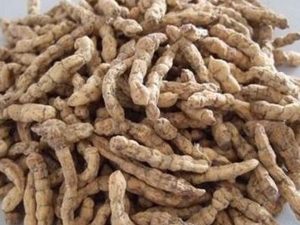
This product is nodular and flattened-cylindrical in shape, slightly curved, 5–12 cm long, and 1.0–4.5 cm in diameter. The surface is yellowish-brown or grayish-brown, with white areas where the outer skin has peeled off; it is densely covered with layered, raised, coarse ring-like patterns. One side has prominent nodules with elliptical, depressed stem scars, while the other side has sparse fibrous roots or wart-like fibrous root scars.The apex bears remnants of scale leaves and the stem. The texture is firm; the cross-section is flat, white to light brown, and powdery or horny. It has a faint odor and a slightly bitter, numbing taste.
Properties of Processed Slices
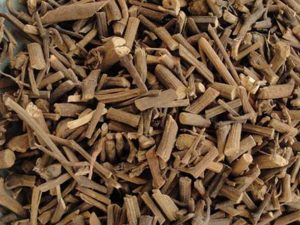
Slices are nearly circular, elliptical, or irregularly shaped. The surface is white, yellowish-white, or light brown; the peripheral epidermis is yellowish-brown or brownish-black, with a powdery or horny texture. It has a faint odor and a slightly bitter, numbing taste.
Botanical Information
Botanical Classification
A plant of the genus Paris in the Liliaceae family, specifically Yunnan Paris or Seven-Leaf One-Flower.
Morphological Characteristics
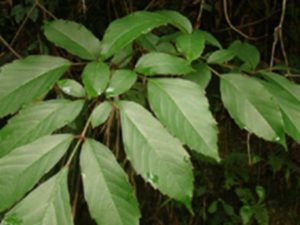
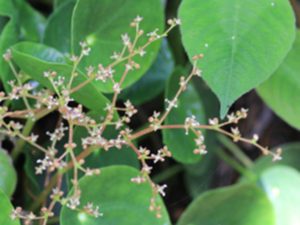
1. Yunnan Paridis: A perennial herb. Height: 5–10 cm. Leaves: 6–10, arranged in a whorl; petioles 0.5–6 cm long; leaf blades thick papery, lanceolate, ovate-oblong to obovate-lanceolate, 5–11 cm long, 2–4.5 cm wide.The flower stalk emerges from the stem apex, 5–24 cm long or longer, bearing a single terminal flower; the flower is hermaphroditic, with 3–7 outer perianth segments, lanceolate or oblong-ovate, green, 3.5–6 cm long; the inner perianth segments number 6–12, linear and slightly lanceolate, yellow, about half to nearly as long as the outer segments, 2–6 mm wide from the middle upward;There are 8–12 stamens; the anthers are 1–1.5 cm long, the filaments are shorter than the anthers, and the protruding portion of the connective is 1–2 mm. The capsule is spherical, and the seeds are enclosed in a red, succulent aril. Flowering occurs from June to July, and fruiting from September to October.
2. Seven-Leaf One-Flower: Plant height 30–130 cm. Rhizome fleshy, 1–3 cm in diameter. Leaves 5–8, arranged in whorls (usually 7), obovate-lanceolate, oblong-lanceolate, or oblanceolate, usually wedge-shaped at the base.The inner whorl of perianth segments is narrowly linear, usually widening from the middle upward; they are 1–1.5 mm wide and 1.5–3.5 cm long, ranging from one-third the length of the outer whorl to nearly equal in length or slightly longer. There are 8–10 stamens; the anthers are 1.2–2 cm long, 3–4 times the length of the filaments, with the protruding portion of the connective measuring 1–2 mm.The ovary is nearly spherical, ribbed, and bears a disc-shaped style base at the apex; the style is short and stout, and the stigma is 4–5-lobed. The capsule is spherical. Seeds are numerous and possess a bright red, succulent exocarp. Flowering occurs from May to July, and fruiting from August to October.
Distribution Area
1. Yunnan Paridis: Distributed in Fujian, Hubei, Hunan, Guangxi, Sichuan, Guizhou, and Yunnan. 2. Seven-Leaf One-Flower: Distributed in Sichuan, Guizhou, Yunnan, and southeastern Tibet.
Growth Habits
Prefers cool, shaded, and moist environments; best cultivated in deep, loose, fertile soil rich in humus or sandy loam.
Propagation Methods
Propagation is by seed or rhizome.
Cultivation Techniques
1. Seed Propagation: For seedling cultivation and transplanting, collect seeds in September–October when the seed coat turns red. Sow immediately after collection. Prepare raised beds 1.3 m wide; dig transverse furrows 3–5 cm deep with a center-to-center spacing of 20–25 cm. Sow seeds in a 10-cm-wide band and cover with approximately 3 cm of fine soil. Seedlings emerge in early spring of the following year; they produce only one leaf that year. Cultivate for 2–3 years before transplanting.During the seedling stage, pay attention to weeding and appropriate fertilization. Transplanting is carried out during the winter when the plants wither; plant at a row spacing of 20 cm × 12 cm, with a planting depth of 10–12 cm. Plant one seedling per hole. After planting, apply manure water, cover with wood ash, and finally backfill with soil.
2. Rhizome Propagation: This can be done at harvest time. Cut the rhizome from an old plant at the 3rd to 5th node counting backward from the stem tip to use as a planting rhizome.