

Cordyceps sinensis (Dongchongxiacao), a Chinese herbal medicine, is a dried composite of the stroma and larval corpse of the parasitic fungus *Cordyceps sinensis* (Berk.) Sacc. (family Clavicipitaceae) on the larva of a hepialid moth. It is mainly produced in Sichuan, Tibet, and Qinghai. This herb is sweet in taste and neutral in nature, entering the Lung and Kidney Meridians. It supports Kidney and Lung health, helps maintain normal blood circulation and respiratory function, and promotes general well-being. It is traditionally used to help maintain healthy Kidney essence, support male reproductive health and vitality, helps with occasional occasional lower back and knee discomfort, and support respiratory health during occasional cough and deficiency-related conditions.
Actions and Benefits
Function:supports Kidney and Lung health, and helps maintain normal blood circulation and respiratory comfort.
Indications:Kidney Deficiency and Essence Depletion pattern: supports healthy sexual function and occasional nocturnal emission, helps maintain lower back and knee comfort, supports normal respiratory function for occasional cough, and helps maintain overall vitality and occasional respiratory helps with occasional.
Usage and Dosage:Internal use: decoct and take 3-9g.
Precautions:For those with Yin Deficiency with Effulgent Fire, this should not be used alone.
Chemical composition:This product primarily contains nucleoside components (such as adenosine, adenine nucleoside, hypoxanthine nucleoside, hypoxanthine, adenine, guanine, uracil, etc.) and sterol components (such as ergosterol, etc.). In addition, it also contains proteins, fatty acids, amino acids, and polysaccharides.
Pharmacological Effects:This product supports immune function, helps maintain normal Kidney health, supports Lung health, supports Liver health, contributes to balanced endocrine function, and helps reduce occasional fatigue.
Related Discussion:
1. From ‘Ben Cao Cong Xin’ (New Compilation of Materia Medica): “supports Lung and Kidney health, helps maintain normal hemostatic function and clear respiratory passages, and promotes respiratory comfort.”
2. Examination of Medicinal Properties: “Helps preserve essence and tonify Qi, specifically supports the Gate of Life (Mingmen).”
Clinical Applications
Clinical Application
1. For supporting Kidney yang and replenishing essence and blood in patterns of deficiency—helping to maintain male vitality and occasional lower back and knee comfort: may be used alone steeped in wine, or combined with yang-supporting herbs such as Epimedium (Yinyanghuo), Eucommia (Duzhong), and Morinda (Bajitian) in a formula.
2. For supporting respiratory health when there is occasional cough with phlegm: may be used alone or combined with *Glehnia littoralis* (Shashen), *Fritillaria cirrhosa* (Chuanbeimu), *Asini Corii Colla* (Ejiao), *Rehmannia glutinosa* (Shengdi), *Ophiopogon japonicus* (Maidong), etc. In cases of dual deficiency of Lung and Kidney with weakened grasping of qi, and qi deficiency affecting normal breathing, it can be combined with *Panax ginseng* (Renshen), *Astragalus membranaceus* (Huangqi), *Juglans regia* (Hutaoren), etc.
3. To support recovery from wellness-induced weakness or help maintain normal sweating and temperature comfort: This product can be stewed with chicken, duck, pork, or other meats and taken. It helps support Kidney and foundational health, and supports Lung and defensive Qi functions.
Related Combinations
1. Cordyceps sinensis (Dongchongxiacao) paired with Panax ginseng (Renshen): Cordyceps sinensis, sweet and neutral in nature, excels at warming the Kidneys and tonifying the Lungs; Panax ginseng, sweet and warm, is adept at supplementing the Spleen and benefiting the Lungs. When used together, they enhance the effect of supporting Lung function and aiding in the intake of Qi. This combination is supportive for individuals with patterns of Lung and Kidney Deficiency, where the body’s ability to hold and receive Qi is diminished, helping to promote respiratory comfort and maintain normal function during occasional cough or wheezing.
2. Cordyceps sinensis (Dongchongxiacao) paired with Glehnia littoralis (Shashen): Cordyceps sinensis excels at tonifying Lung Qi and nourishing Lung Yin; Glehnia littoralis is adept at nurturing Lung Yin and clearing Lung Heat. When combined, they enhance the effect of moistening the Lung and supporting the body’s natural resolution of Phlegm, while helping to helps with occasional occasional cough and promote easy breathing. This combination is traditionally used for patterns of Lung Qi and Yin Deficiency, often associated with long-standing respiratory weakness and fatigue.
3. Cordyceps sinensis (Dongchongxiacao) combined with Psoralea corylifolia (Buguzhi): Cordyceps sinensis excels in warming the Kidney and supporting the Lung, helping to helps with occasional occasional cough and promote comfortable breathing; Psoralea corylifolia is adept at nourishing Kidney yang, supporting the body’s ability to hold Qi and helps with occasional breathing. When combined, these two herbs enhance the effect of supporting Kidney yang and assisting in comfortable breathing. This combination is suitable for individuals experiencing occasional discomfort related to Lung and Kidney weakness, difficulty in holding Qi, and chronic cough with weak breathing.
4、Cordyceps sinensis (Dongchongxiacao) combined with Eucommia ulmoides (Duzhong): Cordyceps sinensis excels at warming the Kidney and tonifying the Lung; Eucommia ulmoides is skilled at tonifying the Liver and Kidney. The combination enhances the effect of tonifying the Kidney and supporting yang vitality. It supports Kidney Yang Deficiency to help maintain reproductive health and normal urinary control.
5. Cordyceps sinensis (Dongchongxiacao) is particularly known for supporting Kidney warmth and Lung health, while Lycium barbarum (Gouqizi) is valued for nourishing the Liver and Kidney. When used together, these two herbs help maintain the warming and nourishing functions of the Kidney and Liver. This combination is beneficial for supporting lower back comfort and overall vitality in individuals with a tendency toward Liver and Kidney Deficiency.
6. Cordyceps sinensis (Dongchong Xiacao) combined with Asini Corii Colla (Ejiao): Cordyceps sinensis excels at warming the Kidneys and supplementing the Lungs; Asini Corii Colla is adept at nourishing the blood and supporting healthy hemostasis. When used together, this combination supports Kidney yang function and promotes blood nourishment and healthy circulation. It is commonly used to support individuals with Qi and Yin Deficiency, helping to maintain respiratory comfort and overall vitality.
7. Cordyceps sinensis (Dongchongxiacao) combined with Prunus armeniaca (Xingren): Cordyceps sinensis excels at supporting Kidney warmth and Lung nourishment; Prunus armeniaca is good for supporting respiratory comfort and clearing phlegm. The combination enhances the effects of supporting Lung and Kidney health, and helps maintain normal respiratory function. This pairing is traditionally used for individuals with Yin Deficiency patterns that may include occasional breathing difficulty, coughing, and chest discomfort.
Differentiation of Medicinal Application
1. Juglans regia (Walnut kernel) and Cordyceps sinensis (Cordyceps): Both are sweet in flavor and enter the Lung and Kidney Meridians (LU, KI). Both support the Kidneys and warm the Lungs, and help maintain healthy respiratory function. They may be used for occasional discomfort in the lower back and knees related to Kidney Yang Deficiency, respiratory weakness associated with Lung Deficiency, and occasional shortness of breath stemming from the Kidneys’ inability to grasp Qi. However, Juglans regia (Walnut kernel) is warm in nature and oily in texture, and also helps maintain normal bowel movements by supporting intestinal moisture—commonly used for occasional constipation due to fluid deficiency. Additionally, it supports urinary tract health and may aid in the body’s natural passage of urinary stones. Cordyceps sinensis (Cordyceps), on the other hand, is neutral in nature and primarily supports Kidney Yang, helping to maintain healthy vital energy. It also supports respiratory health and helps maintain normal blood circulation, and is traditionally used to support male reproductive health and vitality. It may be beneficial for occasional respiratory weakness with a tendency toward dryness, and for supporting recovery after wellness when one feels weak, experiences occasional spontaneous sweating, or has sensitivity to cold. Its effect is gentle in nature, and regular use over time may be beneficial.
2. Panax ginseng (Renshen) and Cordyceps sinensis (Dongchongxiacao): Both have a sweet flavor and enter the Lung and Kidney meridians. Both support the nourishment of the Lung and Kidney, help maintain healthy breathing, and assist with occasional Lung weakness and Kidney-related breathing discomfort. However, ginseng greatly supports vital Qi and helps maintain stability, often used when Qi is insufficient and pulse is weak. Ginseng also enters the Spleen meridian, helps tonify the Spleen and harmonize the center, invigorates Spleen Qi, and supports the source of transformation. It is a key herb for the Spleen, used for Spleen Qi deficiency with signs of imbalance such as fatigue, lack of energy, poor appetite, abdominal distension, and loose stools. Ginseng is sweet and warm but not drying, and helps generate body fluids to support occasional thirst and sweating due to heat affecting Qi and Yin. Ginseng also supports calmness and mental clarity, helpful for occasional restless sleep, forgetfulness, and Heart palpitations. Ginseng greatly supports vital Qi, promotes blood production, and supports both Qi and Blood. It is used for Spleen and Stomach weakness with insufficient transformation and Blood deficiency manifesting as a sallow complexion. Ginseng greatly supports vital Qi and helps support yang energy, useful for insufficient primal Qi, decreased vitality, and occasional reproductive health concerns in both men and women. Cordyceps sinensis is neutral in nature, primarily supports Kidney yang and vitality, and also helps with occasional respiratory discomfort and phlegm. It is good for Kidney deficiency with occasional reproductive health issues, chronic cough with occasional respiratory discomfort, and post-wellness weakness with spontaneous sweating and sensitivity to cold. However, its effect is mild and gentle; consistent use over time is recommended for best results.
3. Astragalus membranaceus (Huangqi) and Cordyceps sinensis (Dongchongxiacao): Both herbs enter the Lung Meridian (LU) and share the properties of supporting Lung Qi and Defensive Qi, consolidating the exterior to help maintain normal sweating patterns, which aids in supporting the body’s external defense for overall well-being when the exterior is deficient. However, Huangqi is a key herb for supporting Qi and helping to maintain healthy Yang energy. It supports the body’s natural recovery after wellness, helps maintain healthy Spleen function for energy and digestion, and supports the lifting of Qi for comfort in digestive and reproductive health. Huangqi also supports healthy blood production and circulation, helping to maintain normal blood levels and helps with occasional occasional discomfort from blood stagnation, and supports comfortable movement for joints and muscles. Additionally, Huangqi supports Lung Qi and Defensive Qi, helping to maintain the exterior and normal sweating for healthy respiratory function. Furthermore, Huangqi is known for its ability to warm and nourish the Spleen and Stomach, promote tissue regeneration, and support Qi and Blood to maintain the body’s natural detoxification processes, aiding in the healthy supports of skin and sores. Cordyceps sinensis has a balanced nature and primarily supports Kidney health and vitality, while also helping maintain normal respiratory function and healthy phlegm levels. It supports the body’s natural reproductive health, lower back and knee comfort, and respiratory health, especially during chronic cough and wheezing due to deficiency.
Related Medicinal Substances
固本强身胶囊 (Guben Qiangshen Jiaonang, Foundation-Consolidating and Body-Strengthening Capsule) 洛布桑胶囊 (Luobusang Jiaonang, Luobusang Capsule) 麝珠明目滴眼液 (Shezhu Mingmu Diyanye, Musk and Pearl Eye Drops to Support Eye Health)
Herbal Dietary Therapy (Yaoshan)
1. Cordyceps sinensis (Dongchongxiacao) Tea for Moisturizing Skin Support
(1) Functions: Helps moisten and nourish the skin, supporting its moisture content. Enhances skin radiance and softness. supports the replenishment of deficiencies, nourishes essential Qi (Jing Qi), and helps maintain respiratory comfort. Promotes the health of the Lung and Kidney systems according to traditional Chinese medicine principles. This product supports individuals with imbalances related to Lung and Kidney function, helps maintain normal reproductive vitality, and aids in recovery during periods of weakness after wellness.
(2) Ingredients: Cordyceps sinensis (Dongchongxiacao) 6g, Panax quinquefolius (Xiyangshen) 6g, Lycium barbarum (Gouqi) 6g.
Grind the Cordyceps sinensis (Dongchongxiacao) into powder for later use. Then place all the herbal ingredients into a cup and pour in about 500 ml of boiling water. Let it steep for several minutes before drinking.
(4) Usage: Take warm, 1-2 times daily.
2、Chongcao Jiayu Tang (Cordyceps and Softshell Turtle Soup)
(1) supports nourishing Yin and tonifying Qi, warming Yang and securing essence. helps maintain normal lower back comfort, leg strength, body warmth, urinary function, and menstrual regularity.
Ingredients: 3 pieces of Cordyceps sinensis (Dongchongxiacao), 1 soft-shelled turtle, 15g of Cornus officinalis (Shanzhuyu), and appropriate amounts of seasonings.
(3) Method: Place the processed softshell turtle (Jia Yu) into a pot. First heat over low flame (Wen Huo). Bring to a boil, then remove and set aside. Put it back into the pot together with Cordyceps sinensis (Dongchongxia cao) and Cornus officinalis (Shanzhuyu), add seasonings. Simmer over low flame (Wen Huo) to make a soup.
(4) Usage: Drink the soup and eat the meat, once per week.
3. Steamed Shrimp with Ophiocordyceps sinensis (Dongchongxiacao)
(1) Function: supports Kidney health and promotes yang vitality. It helps maintain healthy sexual function in men. However, it is not recommended for those experiencing cold and fever.
(2) Raw materials: Ophiocordyceps sinensis (Dongchongxiacao) 3g, processed Aconitum carmichaelii (Fuzi) 3g, Epimedium brevicornum (Yinyanghuo) 3g, Lycium barbarum (Gouqizi) 9g, 12 large prawns, 1 teaspoon salt, 3 cloves garlic.
(3) Preparation: Place all herbs into a covered cup, pour in half a cup of hot water, cover the lid, and allow to steep for 30 minutes. Strain and reserve the herbal liquid. Clean the grass shrimp and devein them. Place the grass shrimp and herbal liquid into a cooking vessel, then set the vessel inside an electric cooker. Add 1/2 cup of water to the outer pot and begin steaming. Once cooked, add salt and garlic. Mix well and arrange on a serving plate.
Usage: Take warm, 1-2 times daily.
Notes
For patients requiring Chinese herbal medicine supports, they should first visit a regular TCM hospital. After professional TCM pattern differentiation, a Chinese herbal prescription will be issued.
processing and preparation (Paozhi)
Harvesting and Processing:Harvest from the soil in early summer before the spores disperse. Sun-dry to 60–70% dryness, remove fibrous attachments and impurities, then sun-dry or dry at low temperature.
Storage Method
Store in a cool, dry place, and protect from insects.
Medicinal Material Identification
Macroscopic Characteristics
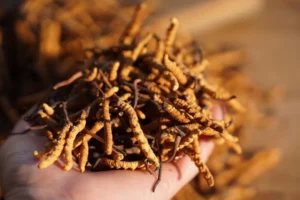
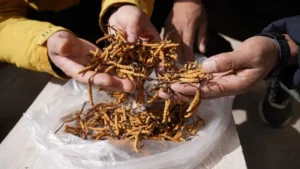
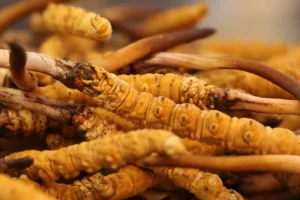
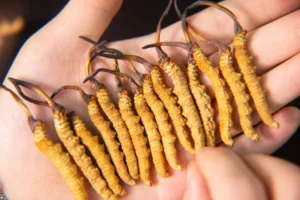
This product (Cordyceps sinensis, commonly known as Dongchongxiacao) is composed of an insect body attached to a fungal stroma growing from the insect’s head. The insect body resembles a silkworm, measuring 3-5 cm in length and 0.3-0.8 cm in diameter. Its surface is deep yellow to yellowish-brown, with 20-30 annular rings that are finer near the head; the head is reddish-brown. There are 8 pairs of legs, with the middle 4 pairs being more distinct. The texture is brittle, easily broken, and the fracture surface is somewhat flat, pale yellowish-white. The stroma is slender and cylindrical, 4-7 cm long and about 0.3 cm in diameter, with a deep brown to dark brown surface marked by fine longitudinal wrinkles, slightly expanded at the upper part. The texture is flexible, and the fracture surface is off-white. It has a slight fishy odor and a slightly bitter taste.
Characteristics of Prepared Herbal Pieces:Refer to the characteristics of the medicinal material.
Botanical Information
Distribution Area:Distributed in Tibet, Sichuan, Qinghai, and other areas.
authentic producing region (Daodi):Mainly produced in Sichuan, Tibet, and Qinghai.
Recommend 16 kinds of health-promoting Chinese herbal soups containing Cordyceps sinensis (Dongchongxiacoa):
1. Glehnia and Cordyceps Simmered Grass Turtle Soup: Benefits & Recipe
2. Nourishing Turtle Soup with Chinese Yam, Goji, and Cordyceps
3. Cordyceps and Sea Coconut Snake Soup: A Complete Medicinal Diet Guide
4. Cordyceps Stewed Duck: Traditional Chinese Medicinal Soup
5. Cordyceps-Ophiopogon-Polygonatum Decoction: Complete Guide to Benefits & Use
6. Cordyceps Flower and Bamboo Fungus Mushroom Soup: Recipe and Wellness Benefits
7. Cordyceps, Dried Scallop, Corn & Carrot Soup: Lung-Kidney Tonic
8. Cordyceps and Dendrobium Seabass Soup: A Nourishing TCM Recipe
9. Cordyceps, Poria, and Tangerine Peel Soup: Benefits & Recipe Guide
10. Cordyceps, Chinese Yam & Lotus Seed Pork Rib Soup: Complete Guide
11. Cordyceps Flower, Fish Maw & Conch Soup: Benefits & Recipe
12. Cordyceps and Astragalus Pigeon Soup Benefits & Recipe Guide
13. Cordyceps and Silkie Chicken Soup: Benefits, Recipe, and TCM Wisdom
14. Nourish Your Lungs and Kidneys with Cordyceps Tremella Lotus Seed Soup
15. Cordyceps and Fritillaria Soup: Benefits, Recipe & TCM Guide
16. Cordyceps and Snow Pear Soup: A Traditional Lung-Nourishing Recipe




Fascinating stuff! I’ve always been curious about how Cordyceps actually works in traditional medicine. The fact that it’s a fungus growing on a caterpillar is wild, but I’ve heard it’s great for energy and stamina. Anyone here tried it in tea or supplements?
Fascinating stuff! I’ve always been curious about Cordyceps but never knew it was actually a parasitic fungus on a moth larva. The sweetness and traditional uses make it sound like such a unique remedy. Has anyone here tried it? I’d love to hear about real experiences.
Fascinating! I’ve heard of cordyceps in wellness circles but never knew it was a fungus growing on a moth larva—nature is wild. The sweet taste and traditional
Fascinating stuff! I’ve heard a lot about Cordyceps for energy and immunity, but didn’t realize it’s actually a fungus growing on a caterpillar larva. Nature is wild. Has anyone here tried it in tea or supplements? Curious if it really lives up to the hype.