Mountain Soybean Vine, a name in traditional Chinese medicine. It refers to the stems, leaves, or roots of Rhynchosiadielsii Harms, a plant in the genus Rhynchosia of the Fabaceae family. The plant Rhynchosiadielsii is distributed in Hubei, Guangxi, and Sichuan provinces in China. It has the effects of dispelling wind and clearing heat, as well as calming convulsions and detoxifying. It is primarily used to treat wind-heat colds, coughs, high fever-induced convulsions in children, palpitations, and mastitis.

Mountain Soybean Vine
Mountain Soybean Vine, a name in traditional Chinese medicine. It refers to the stems, leaves, or roots of Rhynchosiadielsii Harms, a plant in the genus Rhynchosia of the Fabaceae family. The plant Rhynchosiadielsii is distributed in Hubei, Guangxi, and Sichuan provinces in China. It has the effects of dispelling wind and clearing heat, as well as calming convulsions and detoxifying. It is primarily used to treat wind-heat colds, coughs, high fever-induced convulsions in children, palpitations, and mastitis.
Chinese Name : 山黄豆藤
Latin Name : Rhynchosiadielsii Harms
Aliases : Crab’s Eye, Ancient Eye Wind, Three-Leaf Bean
Authentic Producing Area : Hubei, Guangxi, Sichuan
Nature, Flavor & Meridian Tropism : Taste: bitter and astringent; nature: neutral. Enters the Heart and Lung meridians
Benefits & Efficacy
Benefits
Dispels wind and clears heat; calms convulsions and detoxifies.
Indications
Wind-heat common cold, cough, febrile convulsions in children, palpitations, mastitis.
Usage and Dosage
Internal use: Decoct as a soup, 3–9 g.
Precautions
Avoid use in cases without fever. Excessive intake may cause loss of voice.
Relevant Discussions
1. *Chongqing Herbal Medicine*: “Dispels wind and clears heat. Treats wind-heat cough in children, various types of convulsions, and ‘Yellow Seven Wind’ (occurring in newborns 5–7 days old, characterized by generalized jaundice, high fever with convulsions, spitting of white foam, and refusal to feed).”
2. *Chronicle of Sichuan Traditional Chinese Medicine* (1979 edition): “Clears heat and dispels wind. Treats febrile convulsions in children, wind-heat syndrome, refusal to suckle, and foaming at the mouth; in adults, it treats palpitations and fatigue.”
Applications
Related Compatibility
1. For treating wind-heat in children, refusal to suckle, and spitting white foam: 3 g of Schisandra vine, 3 g of honeysuckle vine, 3 g of wind-dispelling vine, 3 g of wild patchouli, and 3 g of five-leaved wind. Decoct in water and take orally. (*Compendium of Sichuan Traditional Chinese Medicine*, 1979)
2. For heart fatigue and palpitations: 10 g of Mountain Soybean Vine, 10 g of Bamboo Leaf Heart, 10 g of Star Anise Maple Root, and 10 g of Night-Crossing Vine. Stew with pork and consume. (*Compendium of Sichuan Traditional Chinese Medicine*, 1979)
Processing & Preparation
Harvesting & Processing
Can be harvested year-round; wash thoroughly and sun-dry.
Crude Drug Identification
Botanical Information
Botanical Classification
A plant of the genus *Luhuo* in the Fabaceae family, specifically *Luhuo* with rhomboid leaves.
Morphological Characteristics
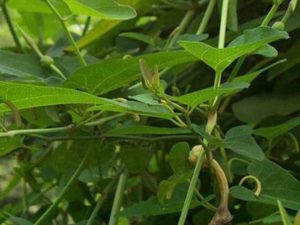
A twining herb. The stem is slender and elongated, densely covered with long, stiff yellow hairs or short soft hairs. The leaves are trifoliate and alternate; the terminal leaflet is nearly rhomboid-ovate, 4–10 cm long and 2–5 cm wide, with veins trifurcating from the base; the leaf blade is pubescent on both surfaces and bears glandular dots; the lateral leaflets are obovate, 3–7.5 cm long and 1.5–4.5 cm wide.Inflorescences are axillary racemes; florets are pedicellate and pubescent; corolla is yellow, 8–11 mm long;the calyx is campanulate and 5-lobed; there are 10 stamens in two whorls, with unilocular anthers; the style is single, curved at the base, hairy, with a capitate stigma; the ovary is superior, containing 2 ovules. The pod is broadly elliptic or obovate, concave in the middle, flattened, reddish-purple, and covered with short soft hairs. It contains 2 seeds. Flowering and fruiting occur from June to August.
Distribution Area
Distributed in Hubei, Guangxi, and Sichuan, China.