White Bean, a name in traditional Chinese medicine. It refers to the seeds of Vigna unguiculata (L.) Walp. var. cylindrica (L.) Ohashi, a plant in the genus Vigna of the Fabaceae family. It is cultivated throughout China. It has the effects of tonifying the middle burner and boosting qi, as well as strengthening the spleen and kidneys. It is primarily used to treat spleen and kidney deficiency and edema.

White Bean
White Bean, a name in traditional Chinese medicine. It refers to the seeds of Vigna unguiculata (L.) Walp. var. cylindrica (L.) Ohashi, a plant in the genus Vigna of the Fabaceae family. It is cultivated throughout China. It has the effects of tonifying the middle burner and boosting qi, as well as strengthening the spleen and kidneys. It is primarily used to treat spleen and kidney deficiency and edema.
Chinese Name : 白豆
Aliases : Rice Bean, Eyebrow Bean, White-eyed Bean, Sweet Bean, White Rice Bean
Nature, Flavor & Meridian Tropism : Taste: sweet and salty; nature: neutral; enters the Spleen and Kidney meridians
Benefits & Efficacy
Benefits
It tonifies the middle and boosts qi, and strengthens the spleen and kidneys.
Indications
Mainly used to treat spleen and kidney deficiency and edema.
Usage and Dosage
Internal use: Boil and eat, 90–150 g.
Precautions
Patients requiring treatment with Chinese herbal medicine should first consult a licensed Traditional Chinese Medicine (TCM) hospital, where a TCM practitioner will conduct a professional pattern differentiation and prescribe an herbal formula.
Relevant Discussions
1. *Sun Zhenren’s Dietary Taboos*: “Recommended for kidney disease.”
2. *Dietary Therapy Materia Medica*: “Nourishes the five viscera, harmonizes the middle, and supports the twelve meridians.”
3. *Rihua Zi*: “Warms the stomach and intestines.”
4. *A Study of Foods*: “Harmonizes the middle, benefits the kidneys, and supports the meridians.”
5. *Fujian Materia Medica*: “Harmonizes the middle and boosts qi; strengthens the spleen and benefits the kidneys.”
Applications
Clinical Applications
For treating edema: 140 g of white kidney beans, 20 g of minced garlic, and 30 g of white sugar. Decoct in water and drink. (*Common Anti-Cancer Herbal Remedies*)
Notes
References: [1] Editorial Committee of *Chinese Materia Medica*, State Administration of Traditional Chinese Medicine. *Chinese Materia Medica* [M]. Vol. 4. Shanghai: Shanghai Science and Technology Press, 1999. [2] Nanjing University of Chinese Medicine. *Encyclopedia of Chinese Materia Medica* [M]. 2nd ed. Shanghai: Shanghai Science and Technology Press, 2006.
Processing & Preparation
Harvesting & Processing
Harvest when the fruits ripen in September–October, remove the seeds, and sun-dry them.
Crude Drug Identification
Botanical Information
Botanical Classification
A species of the genus Vigna in the Fabaceae family, specifically Vigna frutescens.
Morphological Characteristics
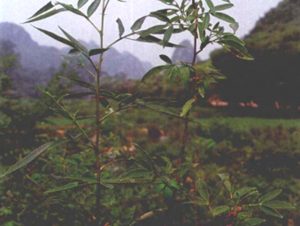
An annual herb, 20–40 cm tall, sometimes with a twining apex. Trifoliate compound leaves; petioles 6–11 cm long; terminal leaflet ovate-rhombic, 5–8 cm long, 4–7.5 cm wide, with an acute apex, a broadly cuneate or nearly rounded base, and entire margins; lateral leaflets obliquely ovate;Stipules are oblong-lanceolate, with the base extending downward to form a short spur. Racemes are axillary, with 2–3 flowers borne on the upper part of the rachis; the peduncle is 4–11 cm long, with a fleshy nectary between the rachis and the peduncle; flowers are approximately 2 cm long; the calyx is tubular, pale green, with lanceolate lobes, the upper two of which are often fused;The corolla is papilionaceous, yellowish-white with a slight purple tinge; the standard is rounded, and the keel is arched; the stamens are arranged in 2 bundles (9) + 1; the ovary contains several ovules, and the style is hairy along its ventral surface. The pod is linear-cylindrical, slightly flattened, 7–13 cm long.Each pod contains 5–10 seeds, which are oblong or nearly reniform, 7–9 mm long, and yellowish-white or dark red. Flowering occurs from July to August, and fruiting from September to October.
Distribution Area
It is cultivated throughout China.