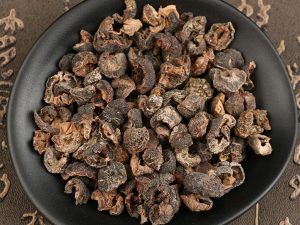
Toad Tongue, a name for a traditional Chinese medicinal material. It is the tongue of the Chinese giant toad (Bufo bufogargarizans Cantor) or the black-eyed toad (B. melanostictus Schneider) of the family Bufonidae. It has the efficacy of detoxifying and drawing out abscesses. It is primarily used to treat carbuncles.

Toad’s Tongue
Toad Tongue, a name for a traditional Chinese medicinal material. It is the tongue of the Chinese giant toad (Bufo bufogargarizans Cantor) or the black-eyed toad (B. melanostictus Schneider) of the family Bufonidae. It has the efficacy of detoxifying and drawing out abscesses. It is primarily used to treat carbuncles.
Chinese Name : 蟾舌
Nature, Flavor & Meridian Tropism : Taste: pungent, bitter, and sweet; nature: cool
Benefits & Efficacy
Benefits
Detoxifies and draws out boils.
Indications
Boils.
Usage and Dosage
External use: Take an appropriate amount, grind into a paste, and apply to the affected area.
Relevant Discussions
*Supplements to the Compendium of Materia Medica*: “Removes boils.”
Applications
Related Compatibility
For treating fish-belly boils: Take one tongue of a (leprous) shrimp, grind it into a paste, and apply it on a piece of red silk; the root of the boil will naturally emerge. Using a toad’s belly skin instead of silk yields excellent results. (*Complete Book of Experiences on Sores and Ulcers*, Toad Tongue Ointment)
Processing & Preparation
Harvesting & Processing
Capture in summer or fall; chop off the head to extract the tongue, wash thoroughly, and use fresh.
Crude Drug Identification
Botanical Information
Morphological Characteristics
1. Chinese Giant Toad: Body length generally exceeds 10 cm; the body is robust; the head is wider than it is long; the snout is rounded with a prominent snout ridge; the nostrils are near the tip of the snout; the distance between the eyes is greater than the distance between the nostrils; the eardrum is distinct; there are no palatine teeth, and neither the upper nor lower jaws have teeth.The forelimbs are long and stout; the fingers and toes are slightly flattened, with a faint marginal membrane on the sides of the fingers but no webbing; the finger lengths are, in order, 3, 1, 4, 2; the tubercles below the finger joints are mostly paired; there are two palmar protuberances, with the lateral one being larger.The hind limbs are stout and short; the tibio-tarsal joint extends forward to the shoulder level; the heels do not touch one another; the sides of the toes have marginal membranes, and the webbing is fairly well-developed; the medial metatarsal is elongated and large, while the lateral metatarsal is small and round.The skin is extremely rough; the top of the head is relatively smooth, with large, elongated parotid glands on both sides. The rest of the body is covered with round tubercles of varying sizes; those arranged in a relatively regular pattern are located behind the head, while those arranged diagonally run almost parallel to the parotid glands.In addition, the tubercles along the flanks are also arranged relatively regularly; those on the shins are larger; some specimens have indistinct tarsal folds; and the ventral skin is not smooth but covered with small tubercles.Color variation is considerable; during the breeding season, males are mostly blackish-green on the dorsal side, with pale markings on the flanks; females are paler on the dorsal side, with milky-yellow tubercles, and sometimes have oblique black longitudinal stripes extending from behind the eyes along the flanks; the ventral side is milky-yellow with fine brown or black patterns. Males are smaller and have black nuptial pads on the inner three toes, but lack vocal sacs.2. Black-eyed Toad: Body length 7–10 cm; males are slightly smaller. The head is high, and its width exceeds its length. The snout is rounded with a distinct snout ridge; the nostrils are near the tip of the snout. The interorbital distance is greater than the intranasal distance. The eardrum is large; there are no palatine teeth; both the upper and lower jaws are toothless; and the posterior end of the tongue lacks a notch.The head features very distinct black bony ridges or black lines along the snout ridge, the upper edge of the eye sockets, the anterior margin of the eardrum, and the margins of the upper and lower jaws. The top of the head is distinctly concave, and the skin is tightly attached to the skull. The forelimbs are slender and long; the fingers and toes are slightly flattened, with black tips; the digit order is 3, 1, 4, 2;subphalangeal tubercles are mostly paired; the lateral metacarpal tubercle is large, while the medial one is slightly smaller, both brown in color; the hind limbs are short, with the tarsometatarsal joint extending to the rear of the shoulder; the heels do not touch one another; the feet are shorter than the tibia; the sides of the toes are connected by a membrane forming a semi-web; subphalangeal tubercles are not prominent; the medial metatarsal tubercle is slightly larger than the lateral one.The skin is extremely rough; except for the top of the head, which is wart-free, the rest of the body is covered with round warts of varying sizes, some of which bear black spots or spines; the sides of the head feature oblong parotid glands; near the midline, from the back of the head to the hindquarters, there are two relatively regular rows of large warts arranged longitudinally.Large specimens of the Black-eyed Toad have their ventral surfaces covered with small spines. Body coloration varies considerably during their active period, generally appearing yellowish-brown with faint reddish-brown markings. Males possess black nuptial pads on the inner sides of the bases of the first and second digits, and a single subglottal vocal sac.
Distribution Area
1. Chinese Giant Toad: Found in Northeast China, North China, East China, Central China, as well as Shaanxi, Gansu, Qinghai, Sichuan, and Guizhou. 2. Black-eyed Toad: Found in Zhejiang, Jiangxi, Fujian, Taiwan, Hunan, Guangdong, Guangxi, Sichuan, Guizhou, and Yunnan.