Gan Tu, a name in traditional Chinese medicine. It is a claystone known as bentonite. Bentonite is a type of clay primarily composed of montmorillonite, mainly produced in Heilongjiang, Jilin, Liaoning, Hebei, and Zhejiang, though it is also found in other provinces. However, its mineral composition, impurity content, and adsorption properties may vary across different production sites and even among different strata within the same site. It possesses detoxifying properties and is used to treat food or fungal poisoning.

Gan Tu
Gan Tu, a name in traditional Chinese medicine. It is a claystone known as bentonite. Bentonite is a type of clay primarily composed of montmorillonite, mainly produced in Heilongjiang, Jilin, Liaoning, Hebei, and Zhejiang, though it is also found in other provinces. However, its mineral composition, impurity content, and adsorption properties may vary across different production sites and even among different strata within the same site. It possesses detoxifying properties and is used to treat food or fungal poisoning.
Chinese Name : 甘土
Aliases : Bai Dan, Bai Tan, Dan Dao, Tu Jing
Nature, Flavor & Meridian Tropism : Bitter in taste, slightly cold in nature. Enters the Lung and Large Intestine meridians
Benefits & Efficacy
Benefits
Detoxifying.
Indications
Used for food or fungal poisoning.
Usage and Dosage
Oral use: Take an appropriate amount, mix with warm water, and drink 300–500 ml.
Relevant Discussions
*Supplement to the Materia Medica*: “Treats poisoning from various grasses, leaves, and fungi. Mix the powder with hot water and take orally.”
Applications
Processing & Preparation
Crude Drug Identification
Properties of Crude Drugs
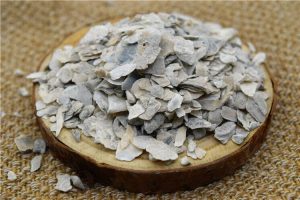
This product is in the form of clumps of earth, white or gray in color, though some may be tinged with a pale pink hue due to impurities. It is opaque with an earthy luster. It is soft; a fingernail can scratch a mark into it. It is highly absorbent; licking it creates a suction sensation. When placed in water, it swells immediately and then disintegrates into fine granules or powder. It has a slippery, greasy texture.It has a faint earthy odor and a bland taste. The best quality is characterized by a white color, a slippery texture, and strong water absorption.
Botanical Information
Morphological Characteristics
Montmorillonite has a monoclinic crystal structure. It commonly appears as cryptocrystalline, earthy masses, though it may occasionally be found in small flakes or granules. It is white, or may be light gray, light red, light green, or other similar colors. Its streak is white. It has an earthy luster. No perfect cleavage is visible to the naked eye. Its hardness is 1–2. The masses are soft and have a slippery feel.Relative density: 2–2.7. It swells when exposed to water, increasing in volume severalfold and turning into a paste-like substance. It possesses strong adsorption and ion-exchange capacities.