Lijiang Scutellaria, a name in traditional Chinese medicine. It is the root of Scutellaria likiangensis Diels, a plant in the Lamiaceae family. It is distributed in northwestern Yunnan. It has the effects of clearing heat and detoxifying, as well as stopping bleeding and stabilizing the fetus. It is commonly used for menopausal menorrhagia and fetal restlessness caused by internal heat.
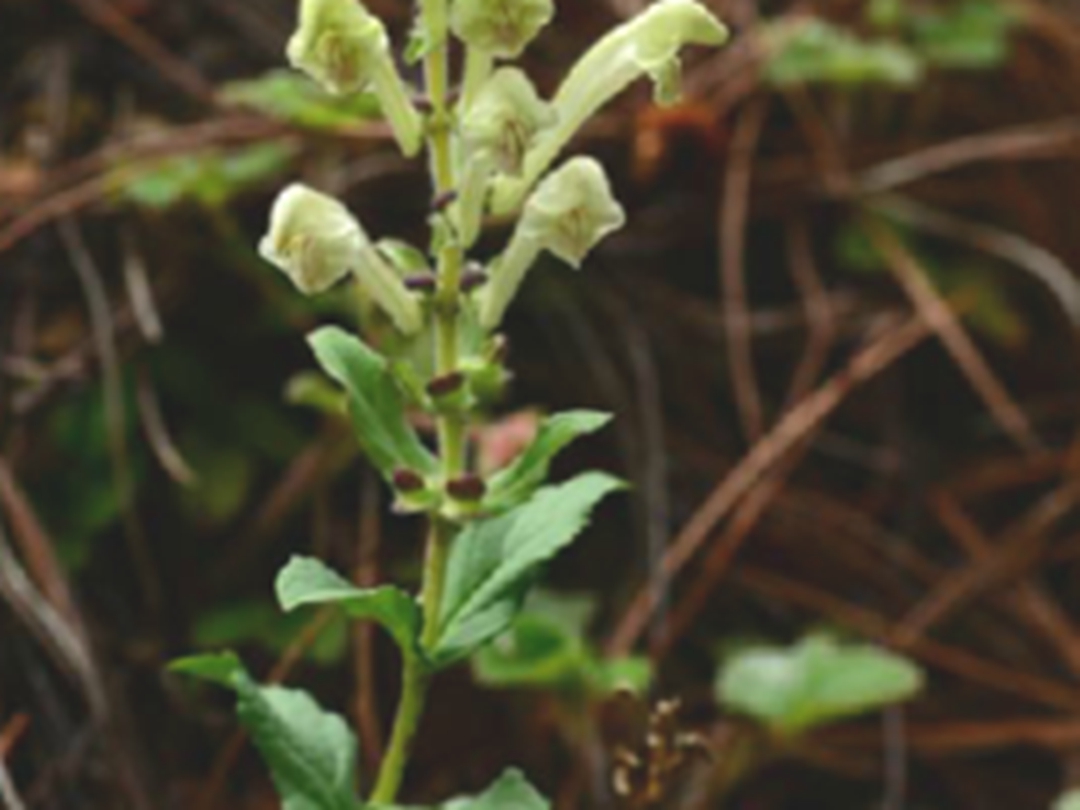
Lijiang Scutellaria
Lijiang Scutellaria, a name in traditional Chinese medicine. It is the root of Scutellaria likiangensis Diels, a plant in the Lamiaceae family. It is distributed in northwestern Yunnan. It has the effects of clearing heat and detoxifying, as well as stopping bleeding and stabilizing the fetus. It is commonly used for menopausal menorrhagia and fetal restlessness caused by internal heat.
Chinese Name : 丽江黄芩
Aliases : Small Scutellaria
Nature, Flavor & Meridian Tropism : Bitter in taste, cold in nature
Benefits & Efficacy
Benefits
Clears heat and detoxifies; stops bleeding and stabilizes the pregnancy.
Indications
Menopausal heavy menstrual bleeding and fetal restlessness due to internal heat.
Usage and Dosage
3–9 g.
Applications
Processing & Preparation
Harvesting & Processing
Harvest the rhizomes and roots in the fall, wash off the soil, and sun-dry.
Crude Drug Identification
Botanical Information
Botanical Classification
Lijiang Scutellaria (Lamiaceae).
Morphological Characteristics
A perennial herb; rhizomes are horizontal or oblique, fleshy, 2–12 mm in diameter, yellow inside, and often branched. Stems are 20–36 cm tall, erect, numerous, arising from the top of the rhizome, brownish-purple, quadrangular, covered with sparse, soft, downward-pointing pubescence, unbranched; internodes in the middle of the stem are 1.8–3.6 cm long.Leaves are stiffly papery, elliptic-ovate or elliptic; those toward the base are smaller, 1.3–3 cm long and 0.6–1.5 cm wide, with a rounded-obtuse apex, sometimes slightly notched; margins are mostly with very indistinct rounded-toothed serrations in the middle or above, or nearly entire; upper surface green, lower surface paler; upper surface sparsely covered with appressed, sparse soft hairs or nearly glabrous;the underside densely covered with depressed glandular dots and sparsely covered with small, loose soft hairs along the veins; lateral veins about 4 pairs, sunken on the upper surface and prominent on the lower surface relative to the midrib; petioles extremely short or nearly absent, 0–1.5 mm long. Flowers are opposite, arranged at the stem apex in a terminal raceme 6.5–12 cm long;flower pedicels 2–3 mm long, densely covered with appressed glandular microtrichomes along with the rachis; lower bracts resemble stem leaves but are smaller and narrower, 1.2–1.6 cm long; upper bracts are reduced, lanceolate-ovate or ovate, 3.5–10 mm long, entire, and densely covered with glandular microtrichomes on both surfaces.The calyx is 3 mm long at flowering, densely covered with glandular pubescence on the outside and often tinged with purple; the inner surface is glabrous. At fruiting, it is 5.5 mm long; the lobes are semicircular and spreading at flowering, 1.5 mm high, and erect and reflexed at fruiting, 3 mm high.The corolla is yellowish-white, yellow, or greenish-yellow, often tinged with pinkish-purple spots or stripes, 2.6–3 cm long, densely covered with glandular pubescence on the outside, and glabrous on the inside;the corolla tube is sac-like and swollen toward the front near the base, bending at an almost right angle; it is approximately 2.8 mm wide in the middle and about 6 mm wide at the throat; the corolla lobe is bilabiate, with the upper lip helmet-shaped, concave, and slightly notched at the apex; the central lobe of the lower lip is nearly circular, up to 8 mm wide, and the lateral lobes are ovate, 2.5 mm wide.There are 4 stamens, in two whorls; the filaments are flattened and covered with small cilia toward the base. The disk is thickened and raised toward the front; the ovary stalk is short. The style is slender and elongated. The ovary is smooth. The mature nutlet is ovoid, 1.75 mm long and 1.25 mm in diameter, dark brown, tuberculate, with a single umbilicus in the center of the ventral surface. Flowering period: June–August; fruiting period: August–September.
Distribution Area
Distributed in northwestern Yunnan.