Sanqi, a name in traditional Chinese medicine, refers to the dried roots and rhizomes of Panax notoginseng (Burk.) F.H.Chen, a plant of the Araliaceae family. It is primarily produced in Yunnan and Guangxi. This product has the effects of dispersing blood stasis and stopping bleeding, as well as reducing swelling and relieving pain. It is primarily used to treat hemoptysis, hematemesis, epistaxis, hematochezia, metrorrhagia and menorrhagia, traumatic bleeding, stabbing pain in the chest and abdomen, and swelling and pain caused by falls or blows.

Sanqi
Sanqi, a name in traditional Chinese medicine, refers to the dried roots and rhizomes of Panax notoginseng (Burk.) F.H.Chen, a plant of the Araliaceae family. It is primarily produced in Yunnan and Guangxi. This product has the effects of dispersing blood stasis and stopping bleeding, as well as reducing swelling and relieving pain. It is primarily used to treat hemoptysis, hematemesis, epistaxis, hematochezia, metrorrhagia and menorrhagia, traumatic bleeding, stabbing pain in the chest and abdomen, and swelling and pain caused by falls or blows.
Chinese Name : 三七
Latin Name : Notoginseng Radix et Rhizoma
Aliases : Mountain Lacquer, Golden Unchangeable, Blood Ginseng, Ginseng Sanqi, Sanqi, Tianqi, Yunnan Sanqi, Panlongqi
Authentic Producing Area : Yunnan, Guangxi
Nature, Flavor & Meridian Tropism : Sweet and slightly bitter in taste; warm in nature; enters the Liver and Stomach meridians
Benefits & Efficacy
Benefits
Dispels blood stasis and stops bleeding; reduces swelling and relieves pain.
Indications
Sanqi is primarily used to treat hemoptysis, hematemesis, epistaxis, hematochezia, metrorrhagia and menorrhagia, traumatic bleeding, stabbing pain in the chest and abdomen, and swelling and pain from falls or blows.
Usage and Dosage
1. Internal use: Decocted as a soup, 3–9 g; ground into powder, 1–3 g; or incorporated into pills or powders. 2. External use: Apply the juice after grinding; or mix the powder with a carrier and apply as a poultice.
Precautions
Use with caution during pregnancy.
Chemical Constituents
This product primarily contains saponins, flavonoid glycosides, amino acids, and other compounds. The active hemostatic component is notoginseng acid.
Pharmacological Actions
This herb possesses antithrombotic, anti-cerebral ischemia, anti-myocardial injury, antiarrhythmic, anti-inflammatory, cognitive-enhancing, and anti-fatigue effects.
Relevant Discussions
1. *Ben Cao Qiu Zhen*: “Sanqi has a bitter and warm nature and can disperse blood stasis. Therefore, for injuries caused by metal blades or scissors, as well as unstoppable bleeding from falls, blows, or wounds from canes, chewing it into a paste and applying it, or mixing it with a powder and applying it, will immediately stop the bleeding.Furthermore, for hemoptysis, epistaxis, hematochezia, bloody dysentery, metrorrhagia, menorrhagia, and retained lochia after childbirth, it is appropriate to either chew it oneself or take it as a powder mixed with rice water; the condition will be cured.”
2. *New Compilation of Materia Medica*: “Panax notoginseng root is a miraculous herb for stopping bleeding. Regardless of whether the bleeding originates from the upper, middle, or lower parts of the body, whenever blood is externally discharged, using this single herb alone is effective; when combined with herbs that tonify blood and qi, its efficacy is even more remarkable. This is because hemostatic herbs, when combined with tonifying herbs, avoid the risk of excessive agitation, while tonifying herbs, when combined with hemostatic herbs, achieve a state of calm and rest.”
Applications
Clinical Applications
1. To treat hemoptysis, hematemesis, epistaxis, and blood in the urine or stool, it may be combined with Huarishi and charred human hair, as in the Hua Xue Dan formula (*Medicine: Integrating Chinese and Western Principles*); to treat various types of traumatic bleeding, it may be used alone as a powder applied externally, or combined with dragon bone, dragon’s blood, and elephant skin, as in the Qi Bao San formula (*Supplement to the Compendium of Materia Medica*).
2. To treat unexplained abscesses and swellings accompanied by persistent pain, grind this herb into a powder and apply it mixed with rice vinegar; to treat ulcerated abscesses, it is often used in combination with Frankincense, Myrrh, and Catechu, as in the “Powder for Clearing Decay and Promoting Tissue Regeneration” (from *The Golden Mirror of Medical Orthodoxy*).
Related Compatibility
1. Notoginseng Combined with Bletilla: Notoginseng dispels blood stasis and stops bleeding, making it an excellent remedy for various internal and external bleeding conditions; Bletilla has astringent properties that stop bleeding, making it a key herb for treating bleeding from the lungs and stomach. When combined, one disperses and the other astringes, eliminating blood stasis and promoting the generation of new blood, thereby enhancing the hemostatic effect. This combination can be used for various bleeding conditions, particularly for hemoptysis and hematemesis caused by bleeding from the lungs and stomach.
2. Notoginseng Combined with Salvia: Notoginseng is warm in nature; it promotes blood circulation and dispels blood stasis, and is particularly effective at relieving pain. Salvia is cool in nature; it cools the blood, promotes blood circulation, unblocks meridians, and relieves pain. When combined, these two herbs complement each other’s effects, enhancing their ability to promote blood circulation, dispel blood stasis, unblock meridians, and relieve pain. This combination is suitable for various pain syndromes caused by blood stasis, and is especially indicated for chest pain radiating to the back or back pain radiating to the chest resulting from obstruction of the heart meridian.
3. Notoginseng combined with Angelica sinensis: Notoginseng resolves stasis, stops bleeding, reduces swelling, and relieves pain; Angelica sinensis nourishes and invigorates the blood, regulates menstruation, and alleviates pain. When combined, these two herbs enhance their ability to nourish and invigorate the blood, resolve stasis and generate new blood, regulate menstruation, and relieve pain. This combination is suitable for postpartum lochia retention and lower abdominal pain caused by persistent blood stasis and the failure to generate new blood.
4. Notoginseng Combined with Rhubarb: Notoginseng resolves blood stasis, reduces swelling, and relieves pain; rhubarb purges fire, cools the blood, and detoxifies. When combined, these two herbs work together to purge fire, cool the blood, disperse blood stasis, and reduce swelling. This combination is used for the early stages of heat-toxin sores and ulcers characterized by redness, swelling, heat, and pain.
Medicinal Identification
1. Raw Panax notoginseng vs. Processed Panax notoginseng: When used raw, Panax notoginseng is highly effective at resolving stasis, arresting bleeding, reducing swelling, and relieving pain; it is generally suitable for stasis-related bleeding, trauma, and pain associated with stasis-induced swelling. Processed Panax notoginseng has a weaker effect on arresting bleeding and resolving stasis, but is more focused on tonifying deficiency and strengthening the body; it is often used for deficiency-syndrome conditions, overwork-induced injuries, and cases of qi and blood deficiency.
2.Panax notoginseng and Sedum notoginseng: Both can resolve blood stasis, stop bleeding, and relieve pain, and are used to treat stasis-related bleeding, traumatic injuries, and pain and swelling caused by blood stasis. However, Panax notoginseng has a stronger effect in resolving blood stasis, stopping bleeding, and relieving pain, with outstanding therapeutic efficacy. Sedum notoginseng has similar effects to Panax notoginseng but is less potent; it can also calm the mind and soothe the spirit, and is often used to treat palpitations, insomnia, and restlessness.
Related Medicines
Panax notoginseng tablets, Chest-Relieving Tablets, Kang’erxin Capsules, Wuxin Capsules, Neck Pain Granules.
Related Prescriptions
Raw Rehmannia Decoction (*Insights into Medicine*), Blood-Resolving Pill (*Integrating Chinese and Western Medicine*).
Medicinal Diet Therapy
1. Panax notoginseng Powder Porridge:
(1) Effects: Nourishes blood, stops bleeding, resolves blood stasis, and clears heat. Suitable for metrorrhagia, menorrhagia, and other bleeding disorders.
(2) Ingredients: 3 g Panax notoginseng powder, 5 jujubes, 100 g japonica rice, and rock sugar to taste.
(3) Preparation: First, crush the Panax notoginseng into a fine powder. Rinse the japonica rice thoroughly and remove the pits from the red dates before washing them. Place all ingredients in a clay pot, add an appropriate amount of water, and simmer into porridge. When the porridge is nearly done, stir in rock sugar syrup to finish.
(4) Dosage: Consume twice daily.
2. Steamed Chicken with Panax Notoginseng:
(1) Benefits: Nourishes the blood; suitable for anemia, sallow complexion, and physical weakness due to prolonged illness.
(2) Ingredients: 20g Panax notoginseng, 1 hen, cooking wine, ginger, scallions, MSG, and salt to taste.
(3) Preparation: Pluck the chicken, remove the innards, wash it thoroughly, cut it into pieces, and chop them into small chunks before placing them in a bowl. Grind 10g of Panax notoginseng into powder and set aside; steam the remaining Panax notoginseng until tender, then slice it thinly.Wash the ginger and slice it; cut the scallions into sections. Place the Panax notoginseng slices in the bowl with the chicken, arrange the scallions and ginger around the chicken, pour in an appropriate amount of water, add cooking wine and salt, and steam in a steamer for about 2 hours. Remove from the steamer, discard the scallions and ginger, stir in MSG, and sprinkle the Panax notoginseng powder into the bowl, mixing thoroughly.
(4) Usage: Serve as a side dish with meals.
Notes
Patients requiring treatment with traditional Chinese medicine should first consult a licensed TCM hospital, where a TCM practitioner will conduct a professional diagnosis and prescribe the appropriate herbal formula.
Processing & Preparation
Harvesting & Processing
Harvest before flowering in the fall; wash thoroughly; separate the main root, lateral roots, and rhizome; then dry.
Processing Methods
1. Panax notoginseng: Take the raw herb, remove impurities, wash thoroughly, sort by size, rinse with water to soften, slice into extremely thin slices, and dry.
2. Panax notoginseng powder: Take Panax notoginseng, wash, dry, and grind into a fine powder.
Storage Methods
Store in a dry container in a cool, dry place to prevent mold and insect infestation.
Crude Drug Identification
Identification
1. The powder of this product is grayish-yellow. Starch granules are very numerous; single granules are round, semicircular, or round-polygonal, with a diameter of 4–30 μm; compound granules consist of 2–10 or more subgranules. Fragments of resin canals contain yellow secretions. Ladder-shaped, reticulate, and spiral vessels have diameters of 15–55 μm. Clusters of calcium oxalate crystals are rare, with diameters of 50–80 μm.
2. Take 0.5 g of the powdered sample,add 5 drops of water, mix thoroughly, then add 5 mL of n-butanol saturated with water, seal tightly, shake for 10 minutes, let stand for 2 hours, centrifuge, collect the supernatant, add three times the volume of water saturated with n-butanol, shake well, allow to separate into layers (centrifuge if necessary), collect the n-butanol layer, evaporate to dryness, dissolve the residue in 1 mL of methanol, and use this as the test solution.Separately, take ginsenoside Rb1 reference standard, ginsenoside Re reference standard, ginsenoside Rg1 reference standard, and notoginsenoside R1 reference standard; dissolve them in methanol to prepare a mixed solution containing 0.5 mg of each per 1 mL, which serves as the reference solution.Perform the test according to the thin-layer chromatography method (General Chapter 0502). Pipette 1 μL of each of the two solutions mentioned above and apply them separately to the same silica gel G thin-layer plate. Develop the plate using the lower phase of the mobile phase mixture of chloroform–ethyl acetate–methanol–water (15:40:22:10), which has been allowed to stand at a temperature below 10°C. Remove the plate,allow to air-dry, spray with sulfuric acid solution (1:10), and heat at 105°C until the spots become clearly visible. In the test sample chromatogram, spots of the same color appear at positions corresponding to those in the reference standard chromatogram; when examined under a UV lamp (365 nm), spots with the same fluorescence are observed.
Properties of Crude Drugs
1. Main root: Subconical or cylindrical, 1–6 cm long, 1–4 cm in diameter. Surface grayish-brown or grayish-yellow, with discontinuous longitudinal wrinkles and traces of lateral roots. The apex bears a stem scar, surrounded by tuberous projections. Heavy in weight, firm in texture; the cross-section is grayish-green, yellowish-green, or grayish-white, with the xylem arranged in a slightly radiating pattern. Slight odor; bitter taste with a sweet aftertaste.
2. Fibrous Strands: Cylindrical or conical in shape, 2–6 cm long, with a diameter of approximately 0.8 cm at the upper end and approximately 0.3 cm at the lower end.
3. Cut Ends: Irregular, shriveled, block-like or strip-like in shape, with several distinct stem scars and annular rings on the surface; the center of the cross-section is gray-green or white, while the edges are dark green or gray.
Properties of Processed Slices
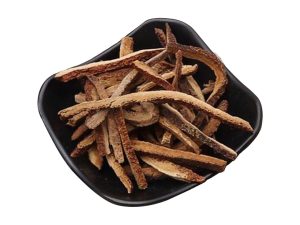
1. Notoginseng Slices: Thin slices with a cross-section that is gray-green, yellow-green, or grayish-white; the woody tissue exhibits a faintly radial arrangement, and the outer skin is gray-brown or grayish-yellow. It has a faint odor and a bitter taste with a sweet aftertaste.
2. Notoginseng Powder: A grayish-yellow powder. It has a faint odor and a bitter taste with a sweet aftertaste.
Botanical Information
Botanical Classification
Panax notoginseng, a plant of the genus Panax in the Araliaceae family.
Morphological Characteristics
A perennial herb, 30–60 cm tall. The rhizome is short; the primary root is obconical or cylindrical, 2–5 cm long and 1–3 cm in diameter, with wart-like protrusions and transverse lenticels. The stem is solitary and erect.Palmately compound leaves are arranged in a whorl at the stem apex; there are usually 5–7 leaflets, which are elliptic or oblong-lanceolate, 5–15 cm long, with a nearly rounded or cuneate base and finely serrated margins. A single umbel is terminal, bearing more than 80 florets; the flowers are yellowish-green and pentamerous;with a single pistil; the ovary is inferior and 2-chambered, and the style is 2-lobed at the apex. The drupe is berry-like, flattened-globose, and bright red when ripe. There are 1–3 seeds with white seed coats. Flowering occurs from June to August, and fruiting from August to October.
Distribution Area
It is distributed in Jiangxi, Hubei, Guangdong, Guangxi, Sichuan, Guizhou, Yunnan, Tibet, and other regions.