Dense-flowered Maytenus, a name in traditional Chinese medicine. It refers to the leaves of Maytenus confertiflorus J. Y. Luo et X. X. Chen, a plant belonging to the genus Maytenus in the Celastraceae family. The plant is distributed in Guangxi. It has the effects of removing blood stasis, relieving pain, detoxifying, and reducing swelling. It is primarily used to treat contusions and sprains, as well as lower back pain, and possesses antitumor properties; in modern times, it has been experimentally used to treat cancer.

Dense-flowered Maytenus
Dense-flowered Maytenus, a name in traditional Chinese medicine. It refers to the leaves of Maytenus confertiflorus J. Y. Luo et X. X. Chen, a plant belonging to the genus Maytenus in the Celastraceae family. The plant is distributed in Guangxi. It has the effects of removing blood stasis, relieving pain, detoxifying, and reducing swelling. It is primarily used to treat contusions and sprains, as well as lower back pain, and possesses antitumor properties; in modern times, it has been experimentally used to treat cancer.
Chinese Name : 密花美登木
Nature, Flavor & Meridian Tropism : Pungent and bitter in taste; cold in nature; enters the Lung and Liver meridians
Benefits & Efficacy
Benefits
It removes blood stasis, relieves pain, detoxifies, and reduces swelling.
Indications
It is primarily used to treat traumatic injuries and lower back pain. In recent times, it has been experimentally used in the treatment of cancer.
Usage and Dosage
Internal use: Decocted as a soup, 15–30 g; high doses may reach up to 60 g. External use: Apply an appropriate amount of fresh, crushed herb as a poultice.
Precautions
1. This herb is toxic; unauthorized use is strictly prohibited. Its clinical application must strictly follow a physician’s prescription and be conducted under the guidance of a professional. Strictly adhere to the dosage and treatment duration prescribed by the doctor; avoid making changes on your own. 2. Patients requiring treatment with traditional Chinese medicine should first consult a licensed TCM hospital, where a TCM prescription will be issued following a professional TCM differential diagnosis.
Chemical Constituents
The leaves contain euonymol, succinic acid, cinnamic acid, 3-hydroxycinnamic acid, rye lactone, and medenol.
Pharmacological Actions
Modern pharmacological studies indicate that this product possesses antitumor activity.
Relevant Discussions
1. *New Chinese Medicine*, 1979, (1): 43: “Detoxifies and reduces swelling; promotes blood circulation and removes blood stasis. Used to treat liver cancer.”
2. *Acta Pharmaceutica Sinica*, 1981, 16(1): 59: “In folk medicine, the leaves are pounded with wine to treat lower back pain.”
Applications
Clinical Applications
1. For treating contusions and bruises: 30 g each of Dense-flowered Meidengmu and Sumu, and 250 ml of rice wine; soak together and set aside; apply externally to the affected area. (*Practical Yao Pharmacology*)
2. For treating unexplained swellings and abscesses: appropriate amounts of Dense-flowered Meidengmu, Wild Rhubarb, and Wild Gold Coin; decoct in water and use for external washing. (*Practical Yao Pharmacology*)
Notes
References: [1] Lin Chunrui. *Encyclopedia of Traditional Chinese Medicinal Resources in Guangxi: Long’an Volume* [M]. Nanning: Guangxi Science and Technology Press, 2021: 181. [2] Zhu Hua. *Illustrated Compendium of Chinese Zhuang Medicine: Volume I* [M]. Nanning: Guangxi Science and Technology Press, 2017: 628. [3] Nanjing University of Chinese Medicine. *Encyclopedia of Chinese Materia Medica: Volume 2* [M]. 2nd ed. Shanghai: Shanghai Science and Technology Press, 2006: 3167–3168. [4] Du Tongfang, Huang Zhaosheng. *Illustrated Dictionary of Chinese Herbal Medicines: Volume 2* [M]. Guangzhou: Guangdong Science and Technology Press, 2011: 837.
Processing & Preparation
Harvesting & Processing
Harvested in summer and fall; sun-dried.
Crude Drug Identification
Properties of Crude Drugs
Leaves are elliptical or broadly ovate, 9–17–24 cm long and 3–8–15 cm wide. The leaves are thin and leathery, with a bluntly rounded or slightly pointed apex and a margin that is slightly wavy or nearly entire. The petiole is 0.7–1.1 cm long. The plant has a faint odor and a bland taste.
Botanical Information
Botanical Classification
Dense-flowered Meideng (a species of the genus Meideng in the family Celastraceae).
Morphological Characteristics
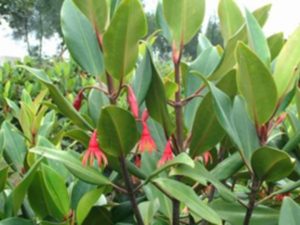
A shrub reaching up to 4 m in height, with stout, thorny branches. Leaves are alternate; petioles are 8–12 mm long; leaf blades are papery, broadly elliptic or obovate, 11–24 cm long and 3–10 cm wide, with a short acuminate or acute but blunt apex, a narrowly cuneate base, and margins that are nearly entire or very shallowly and sparsely toothed, often undulating along both margins.The petioles, leaf veins, and young branches are all purplish-red. Panicles are clustered, with inconspicuous main peduncles; flowers are small, with 5 sepals, 5 petals, 5 stamens, and 3 carpels. The capsule is triangular-globose, 10–14 mm long and 10–12 mm in diameter.Seeds are dark reddish-brown, elliptical or ovoid, approximately 7 mm long and 6 mm in diameter, with a pseudocarp. Flowering occurs from September to October; fruiting occurs from October to November.
Distribution Area
Distributed in Guangxi.