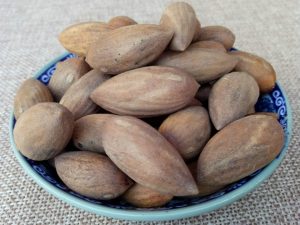
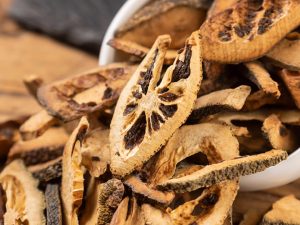
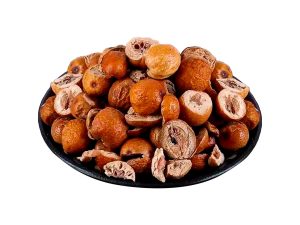
Hongshu Guo, a name in traditional Chinese medicine. It refers to the fruit and hypocotyl of Brugiera gymnorrhiza (L.) Lam., a plant of the Mangrovaceae family. It is distributed along the coasts of Fujian, Taiwan, Guangdong, Hainan, Guangxi, and other regions. It has astringent and antidiarrheal properties. It is commonly used to treat chronic diarrhea caused by loose bowels.

Mangrove Fruit
Hongshu Guo, a name in traditional Chinese medicine. It refers to the fruit and hypocotyl of Brugiera gymnorrhiza (L.) Lam., a plant of the Mangrovaceae family. It is distributed along the coasts of Fujian, Taiwan, Guangdong, Hainan, Guangxi, and other regions. It has astringent and antidiarrheal properties. It is commonly used to treat chronic diarrhea caused by loose bowels.
Chinese Name : 红树果
Benefits & Efficacy
Benefits
Astringent and antidiarrheal.
Indications
Chronic diarrhea due to loose bowels.
Usage and Dosage
Oral use: 3–10 g; extract the juice from fresh material, or grind the dried material into powder.
Precautions
~Contraindicated for diarrhea and dysentery caused by damp-heat.~
Relevant Discussions
*Marine Medicines* 1984, (4):45: “The fruit and hypocotyl are crushed to extract juice, which is used as an astringent for diarrhea.”
Applications
Processing & Preparation
Harvesting & Processing
Can be harvested year-round; use fresh or sun-dried.
Crude Drug Identification
Botanical Information
Botanical Classification
Mangrove (Rhizophora) species.
Morphological Characteristics
Mu Lan, also known as Red Tree, Changgu, Baoluo Jianding, Tie Lan, Daitou Lan, Jizhua Lang, Jianding, Jia Ding, and Jizhua Lan. A shrub or tree, often with knee-like aerial roots protruding above the water surface.Leaves are simple and opposite; petioles are 2.5–4.5 cm long; stipules are early deciduous; leaves are leathery, elliptic or narrowly elliptic, 7–14 cm long and 3–5.5 cm wide, with a slightly acuminate apex, a cuneate base, and entire margins that curl backward when dry.Flowers are solitary, 3–3.5 cm long; the pedicel is curved downward, 8–20 mm long; the calyx tube is nearly bell-shaped, dark yellowish-red; there are 11–13 calyx lobes, most commonly 12, which are linear and approximately as long as the calyx tube;The corolla is pale reddish-white, with the same number of lobes as the calyx but shorter; it is deeply bifid, densely covered with silky hairs at the base and nearly glabrous above, with one spiny hair between the fissures and 2–4 spiny hairs at the tips of the lobes; the number of stamens is double that of the petals, and they are slightly shorter than the petals; the ovary is semi-inferior, with 2–4 locules.The fruit is enclosed within and fused to the calyx tube; it is unilocular, and the calyx tube is longer than the lobes; there is a single seed that germinates before the fruit detaches from the parent tree; the hypocotyl is spindle-shaped, slightly angular, and 15–25 cm long. Flowering and fruiting occur almost year-round.
Distribution Area
Coastal regions of Fujian, Taiwan, Guangdong, Hainan, Guangxi, and elsewhere.