Akebia, a name in traditional Chinese medicine.It refers to the dried vine stems of plants belonging to the genus Akebia in the family Lardizabalaceae, specifically Akebia quinata (Thunb.) Decne., Akebia trifoliata (Thunb.) Koidz., or Akebia trifoliata (Thunb.) Koidz. var. australis (Diels) Rehd. It has the effects of promoting urination and relieving urinary obstruction, clearing the heart and relieving restlessness, and promoting menstruation and lactation.It is primarily used for urinary disorders, edema, restlessness with reddish urine, mouth and tongue sores, amenorrhea and insufficient lactation, and pain caused by damp-heat bi syndrome.

Akebia
Akebia, a name in traditional Chinese medicine.It refers to the dried vine stems of plants belonging to the genus Akebia in the family Lardizabalaceae, specifically Akebia quinata (Thunb.) Decne., Akebia trifoliata (Thunb.) Koidz., or Akebia trifoliata (Thunb.) Koidz. var. australis (Diels) Rehd. It has the effects of promoting urination and relieving urinary obstruction, clearing the heart and relieving restlessness, and promoting menstruation and lactation.It is primarily used for urinary disorders, edema, restlessness with reddish urine, mouth and tongue sores, amenorrhea and insufficient lactation, and pain caused by damp-heat bi syndrome.
Chinese Name : 木通
Latin Name : Akebiae Caulis
Aliases : Tongcao, Fuzhi, Dingweng
Authentic Producing Area : Jiangsu, Hunan, Hubei
Nature, Flavor & Meridian Tropism : Bitter in taste, cold in nature; enters the Heart, Small Intestine, and Bladder meridians
Benefits & Efficacy
Benefits
Promotes urination and relieves dysuria; clears the heart and relieves restlessness; regulates menstruation and promotes lactation.
Indications
Dysuria, edema, restlessness with reddish urine, mouth and tongue sores, amenorrhea and scanty lactation, and pain due to damp-heat bi syndrome.
Usage and Dosage
Internal use: Decocted as a soup, 3–6 g; or incorporated into pills or powders.
Precautions
Use with caution in cases of internal deficiency of body fluids, or in patients with damp-heat or seminal emission.
Chemical Constituents
The stems of Akebia contain betulin, hederagins, oleanolic acid, and Akebia saponins Sta, Stb, Stc, Std, Ste, Stf, Stg1, Stg2, Sth, Stj, and Stk.In addition, it contains stigmasterol, β-sitosterol, carotene, inositol, sucrose, and potassium salts.
Pharmacological Actions
This product has anti-inflammatory, diuretic, antithrombotic, lipid-lowering, and antioxidant effects.
Relevant Discussions
1. *Bie Lu*: Treats spleen-related jaundice characterized by constant drowsiness, restlessness, retching, and vocalizations; treats deafness; disperses abscesses, swellings, and various stubborn masses that fail to resolve; and treats gunshot wounds, malignant sores, testicular atrophy, limb fractures, nasal polyps, induces abortion, and eliminates the “three parasites.”
2. *Treatise on the Nature of Medicinal Substances*: It is primarily used to treat the five types of dysuria, promote urination, relieve urinary obstruction, treat excessive sleepiness, address severe edema, and eliminate restlessness and fever.
3. *Dietary Therapy Materia Medica*: When boiled and consumed as a decoction, it regulates women’s blood and qi, eliminates cold and heat that obstruct the flow of qi, and alleviates scrotal atrophy, traumatic wounds, and fractures; its boiled juice is excellent for brewing wine.
4. *Supplement to the Materia Medica*: Promotes urination and bowel movements; soothes the mind and relieves stagnant qi.
Applications
Clinical Applications
1. To treat short, red, and painful urination caused by damp-heat descending to the lower burner, it is often used in combination with Plantain Seed (Cheqianzi), Talc (Huashi), and Lycopodium (Qumai), as in the Ba Zheng San formula (*Formulas of the Bureau of Harmonious Preparations*).
2. To treat edema and beriberi with difficulty urinating, it is often used in combination with Poria, Alisma, and Mulberry Bark.
3. To treat heart fire rising upward, causing sores in the mouth and on the tongue, or heart fire descending to the small intestine, resulting in restlessness and red urine, it is frequently used with Raw Rehmannia, Bamboo Leaves, and Licorice, as in the Dao Chi San (from *Direct Decisions on Pediatric Medicines and Syndromes*).
4. For treating amenorrhea due to blood stasis, it is often used in combination with Peach Kernel (Taoren), Motherwort (Yimucao), and Salvia Root (Danshen).
5. For treating insufficient lactation or blocked milk ducts after childbirth, it can be decocted with pig’s trotters for oral administration; or used in combination with Wangbuliu Xing, Manchurian Pangolin Scale (Chuanshanjia), and Tongcao.
Related Compatibility
1. Akebia combined with Raw Rehmannia: Akebia clears heat from the Heart Meridian above and promotes the function of the Small Intestine below, thereby promoting urination and relieving dysuria; Raw Rehmannia excels at clearing heat, cooling the blood, and nourishing Yin to subdue Heart fire.When combined, Akebia, enhanced by Raw Rehmannia, promotes diuresis without damaging yin; Raw Rehmannia, enhanced by Akebia, further strengthens its ability to clear and descend Heart fire. Together, they achieve the effects of clearing the Heart, nourishing yin, promoting diuresis, and relieving dysuria. This combination is suitable for conditions such as scanty, painful, or painful urination with blood in the urine caused by Heart heat transferring to the Small Intestine, as well as symptoms of Heart-Meridian heat such as restlessness in the chest and heart, thirst, facial redness, and sores in the mouth and on the tongue.
2. Akebia combined with Lampwick Grass: Akebia can clear fire from the heart and lungs above and guide dampness from the small intestine and bladder below, causing pathogenic damp-heat to descend and be expelled through urination; thus, it excels at lowering fire and promoting diuresis. Lampwick Grass excels at draining and facilitating the flow through the orifices, helping to guide heat from the heart and lungs downward.When used together, these two herbs excel at promoting diuresis and eliminating heat, while also clearing the heart and reducing fire. This combination is suitable for conditions where heat in the Heart Meridian descends to the Small Intestine, or where heat accumulates in the bladder, or where damp-heat descends, presenting with symptoms of dribbling, painful, and difficult urination.
3. Akebia combined with Stephania: Akebia excels at unblocking blood vessels and draining damp-heat; Stephania excels at dispelling wind-dampness and relieving arthralgia. When used in combination, they have the effects of clearing heat, draining dampness, unblocking the vessels, and relieving pain. This combination is used to treat joint swelling and pain due to “adhesive arthralgia” or “painful arthralgia,” accompanied by restricted flexion and extension.
Medicinal Identification
1. Akebia and Fangji: Both are extremely bitter and cold in nature, with a strong tendency to descend. They possess potent effects in clearing heat, promoting diuresis, and unblocking orifices; therefore, they can be used for edema caused by stagnant damp-heat, difficulty urinating, and rheumatic arthralgia. However, since Fangji excels at both promoting diuresis and dispelling wind, it is more suitable for treating edema with distension, phlegm-retention with dyspnea, and rheumatic arthralgia;Akebia excels at clearing fire from the Heart and Small Intestine and can also promote the flow of blood and qi; therefore, it is more commonly used for conditions such as mouth and tongue sores, painful and scanty urination, and amenorrhea due to blood stasis caused by excessive fire in the Heart and Small Intestine.
2. Akebia and Alisma: Both promote the flow of water, so they can be used for conditions such as edema and beriberi caused by internal retention of dampness and obstruction of the water channels.However, Akebia tends to clear fire from the Heart and Small Intestine meridians, is particularly effective for treating painful and scanty urination due to heat, and can also promote the circulation of qi, blood, and joint function; it is used for amenorrhea, insufficient lactation, and damp-heat arthralgia. Alisma excels at clearing “ministerial fire” from the Kidney meridian and treating damp-heat in the bladder; therefore, it is suitable for conditions such as damp-heat dysuria, leukorrhea, deficiency of Kidney yin, and excessive deficient fire.
Related Medicines
Ba Zheng Compound, Fenqing Wulin Pills.
Related Prescriptions
Daochi Powder (*Direct Decisions on Pediatric Medicines and Syndromes*).
Notes
Patients requiring treatment with Chinese herbal medicine should first consult a licensed Traditional Chinese Medicine (TCM) hospital, where a TCM practitioner will conduct a professional pattern differentiation and prescribe an herbal formula.
Processing & Preparation
Harvesting & Processing
Harvest in the fall; cut off the stems, remove the small branches, and air-dry in the shade.
Processing Methods
Remove impurities, soak in water until thoroughly softened, then remove, slice, and dry.
Storage Methods
Store in a dry container and seal tightly. Keep in a well-ventilated, dry place. Protect from moisture.
Crude Drug Identification
Properties of Crude Drugs
This product is cylindrical, often slightly twisted, 30–70 cm long, and 0.5–2 cm in diameter. The surface is grayish-brown to grayish-brown; the rough outer bark has numerous irregular cracks or longitudinal grooves and prominent lenticels. Nodes are swollen or inconspicuous, with scars from lateral branches.Light in weight, firm in texture, and difficult to break; the fracture surface is irregular. The bark is relatively thick and yellowish-brown, with visible pale yellow granular spots; the wood is yellowish-white, with rays arranged radially; the pith is small or sometimes hollow, and is yellowish-white or yellowish-brown. It has a faint odor and a slightly bitter and astringent taste.
Properties of Processed Slices
This product consists of round, oval, or irregularly shaped slices. The outer surface is grayish-brown or grayish-brown. On the cross-section, the rays are arranged radially, and the pith is small or sometimes hollow. It has a faint odor and a slightly bitter and astringent taste.
Botanical Information
Botanical Classification
Plants of the genus Akebia in the family Lardizabalaceae, including Akebia trifoliata, Akebia trifoliata var. trifoliata, or Akebia trifoliata var. alba.
Morphological Characteristics
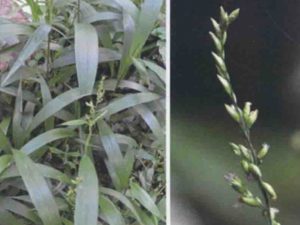
1. Akebia: A deciduous, woody, twining vine, 3–15 cm long. The entire plant is glabrous. Young branches are gray-green with longitudinal striations. Leaves are palmately compound, clustered at the tips of short branches; petioles are slender and elongated; there are 5 leaflets, obovate or elliptical, 3–6 cm long, with rounded apices that are often slightly notched or ending in a short, slender tip, rounded or cuneate bases, and entire margins.Short racemes are axillary; flowers are unisexual, with male and female flowers on the same plant; 1–2 female flowers are borne at the base of the inflorescence, while the upper part bears dense clusters of relatively slender male flowers; the perianth consists of 3 segments; male flowers have 6 stamens; female flowers are larger than male flowers and have 2–13 free carpels.The fruit is fleshy, berry-like, oblong, or slightly reniform, rounded at both ends, approximately 8 cm long and 2–3 cm in diameter; when ripe, it is purple, soft, and splits along the ventral suture. The seeds are numerous, oblong and slightly flattened, black or dark brown. Flowering occurs from April to May; fruit ripens in August.
2. Trifoliate Akebia: Similar to the previous species. The main distinguishing feature is that the leaves are trifoliate; the leaflets are ovate, broadly ovate, or oblong-ovate, with considerable variation in length and width. The apex is obtuse, slightly concave, or has a short tip; the base is rounded or cuneate, sometimes slightly cordate; the margin is shallowly lobed or wavy; and there are 5–6 pairs of lateral veins.
3. White Akebia: This variety is morphologically similar to Leafy Akebia, but its leaflets are entire and have a thicker texture.
Distribution Area
1. Akebia: Distributed in Shaanxi, Shandong, Jiangsu, Anhui, Jiangxi, Henan, Hubei, Hunan, Guangdong, Sichuan, Guizhou, and other regions. 2. Three-leaved Akebia: Distributed in Hebei, Shanxi, Shaanxi, Gansu, Shandong, Henan, and throughout the Yangtze River basin. 3. White Akebia: Distributed in Southwest China, as well as in Shanxi, Shaanxi, Jiangsu, Zhejiang, Jiangxi, Henan, Hubei, Hunan, Guangdong, and other regions.
Growth Habits
It prefers cool, moist environments and commonly grows in semi-shaded forest areas. Soils rich in humus or deep alluvial soils are ideal. It can be cultivated along forest edges or riverbanks.
Propagation Methods
Propagated by seed or layering.
Cultivation Techniques
1. Seed Propagation: Immediately mix freshly harvested seeds with moist sand and store them outdoors; sow in February–March of the following year. On prepared ground, dig furrows spaced about 30 cm apart, approximately 5–10 cm deep, with a sowing width of about 10 cm. Apply manure and livestock waste water, cover with wood ash, and then cover with 2 cm of soil.Apply fertilizer once after the seedlings have emerged uniformly. When the seedlings develop vines, thin them out, leaving one plant every 10 cm, and apply manure water once more. At the same time, insert small bamboo stakes with branches into the rows to support the vines.Transplant the seedlings after they have been cultivated for two years. Transplanting should be done in February–March before the vines begin to sprout. On the selected plot, plant the seedlings in holes spaced 1–1.5 cm apart, placing one seedling per hole. Cover with soil, press firmly, water, and guide the vines onto nearby support structures.
2. Layering Propagation: In February–March, bury old vines that are at least two years old in the soil; roots and shoots will develop from the nodes, growing into new plants. In February–March of the following year, dig them up, cut them into individual plants, and transplant them using the same method as seed propagation.