Jixueteng is a medicinal herb used to promote blood circulation and regulate menstruation. It consists of the dried vine stems of Spatholobus suberectus Dunn, a plant in the genus Spatholobus of the Fabaceae family. It is primarily produced in Guangxi. It has the effects of promoting and replenishing blood, regulating menstruation and relieving pain, and relaxing tendons and activating meridians. It is primarily used to treat irregular menstruation, dysmenorrhea, amenorrhea, rheumatic arthralgia, numbness and paralysis, and pallor due to blood deficiency.

Ji Xue Teng
Jixueteng is a medicinal herb used to promote blood circulation and regulate menstruation. It consists of the dried vine stems of Spatholobus suberectus Dunn, a plant in the genus Spatholobus of the Fabaceae family. It is primarily produced in Guangxi. It has the effects of promoting and replenishing blood, regulating menstruation and relieving pain, and relaxing tendons and activating meridians. It is primarily used to treat irregular menstruation, dysmenorrhea, amenorrhea, rheumatic arthralgia, numbness and paralysis, and pallor due to blood deficiency.
Chinese Name : 鸡血藤
Latin Name : Spatholobi Caulis
Aliases : Bloodvine, Horse Deer Vine, Purple-Stemmed Vine, Pig’s Blood Vine, Nine-Layer Wind, Red Vine, Blood-Activating Vine, Large Blood Vine, Blood Dragon Vine, Over-Hill Dragon, Five-Layer Blood
Authentic Producing Area : Mainly produced in Guangxi
Nature, Flavor & Meridian Tropism : Taste: bitter and sweet; nature: warm; enters the Liver and Kidney meridians
Benefits & Efficacy
Benefits
This herb promotes blood circulation, nourishes the blood, regulates menstruation, relieves pain, and relaxes tendons and activates meridians.
Indications
It is primarily used to treat irregular menstruation, dysmenorrhea, amenorrhea, rheumatic arthralgia, numbness and paralysis, and pallor due to blood deficiency.
Usage and Dosage
Decoct and take 9–15 g.
Precautions
1. Spatholobus stem should be used under the guidance of a qualified physician; avoid self-medication or excessive use.2. While taking this herb, avoid consuming cold or raw foods to prevent interference with its efficacy.3. Use with caution in individuals exhibiting symptoms of yin deficiency with excessive internal heat, such as heat in the palms and soles or night sweats.
Chemical Constituents
It primarily contains isoflavone compounds such as tribuloside and daidzein; triterpenoid compounds such as epiphellogenol and phellogenol; and steroid compounds such as β-sitosterol, carotene glycosides, brassicasterol, and milettol.
Pharmacological Actions
This product possesses pharmacological effects including antithrombotic, antitumor, hematopoietic promotion, analgesic, and antiviral properties.
Relevant Discussions
1. *Supplements to the Compendium of Materia Medica*: “Strengthens tendons and bones, relieves aches and pains; take with wine… Treats symptoms of blood and qi deficiency in the elderly, such as numbness in the hands and feet and paralysis; male deficiency leading to infertility and seminal emission with white discharge; stomach pain due to cold in both men and women; irregular menstruation in women, red and white vaginal discharge, blood deficiency due to overwork, and uterine cold preventing conception.”
2. *New Reference on Herbal Slices*: “Removes stagnant blood, generates new blood, and promotes the smooth flow of meridians. Treats summer heat-induced illness and wind-blood bi syndrome.”
3. *Modern Practical Chinese Herbal Medicine*: “A tonic herb for blood replenishment with fortifying properties, suitable for anemia-related neurological paralysis, such as aching and numbness in the limbs, lower back, and knees. It is also used for women with irregular menstruation or amenorrhea, and has the effects of promoting blood circulation and relieving pain.”
Applications
Clinical Applications
1. To treat menstrual irregularities, dysmenorrhea, and amenorrhea caused by blood stasis, combine with Danggui, Chuanxiong, Xiangfu, and other herbs.
2. To treat menstrual irregularities, dysmenorrhea, and amenorrhea caused by blood deficiency, combine with Danggui, Shu Di, Bai Shao, and other herbs.
3. To treat rheumatic pain and numbness in the limbs, it is combined with herbs that dispel wind-dampness, such as Duhuo, Weilingxian, and Sangjisheng.
4. To treat numbness in the hands and feet and limb paralysis caused by stroke, it is combined with herbs that tonify qi, invigorate blood, and unblock the meridians, such as Astragalus, Salvia miltiorrhiza, and Earthworm.
5. To treat limb numbness resulting from blood deficiency failing to nourish the tendons, as well as sallow complexion due to blood deficiency, it is combined with qi-tonifying and blood-nourishing herbs such as Astragalus and Angelica sinensis.
Related Compatibility
1. Jixueteng Combined with Angelica Root: Jixueteng excels at promoting blood circulation and dispersing blood stasis; Angelica Root excels at replenishing and nourishing blood. When used together, this combination ensures that blood circulation is promoted without causing damage, and blood is replenished without causing stagnation. It effectively invigorates and replenishes blood, regulating menstruation and relieving pain. It is suitable for irregular menstruation caused by both blood stasis and blood deficiency, amenorrhea, dysmenorrhea, and menstrual flow obstruction.
2. Milky Vine Combined with Du Huo: Milky Vine promotes blood circulation, nourishes the blood, relaxes tendons, and activates meridians; Du Huo dispels wind, overcomes dampness, relieves arthralgia, and alleviates pain. When used together, Milky Vine enhances Du Huo’s ability to dispel wind and dampness and relieve arthralgia. This combination is suitable for rheumatic arthralgia and numbness in the limbs.
3. Jixueteng Combined with Astragalus: Jixueteng, with a sweet and bitter taste, promotes and replenishes blood while also relaxing tendons and activating meridians; Astragalus, sweet and warm in nature, tonifies the middle and boosts qi to nourish the source of blood. When used together, these two herbs combine both tonifying and dispersing actions, integrating the principle of “tonification through dispersion.” This combination is suitable for conditions such as numbness in the limbs, soreness in the lower back and knees, and paralysis due to stroke, resulting from blood deficiency failing to nourish the tendons and blood stasis obstructing the meridians.
Medicinal Identification
1. Milky Vine and Cyperus: Both herbs have the function of regulating menstruation and are commonly used in gynecology to treat menstrual irregularities, amenorrhea, and dysmenorrhea. However, Milky Vine is sweet, bitter, and warm in nature; it excels at promoting blood circulation, replenishing blood, and regulating menstruation. It is primarily used to treat menstrual irregularities, irregular flow, dysmenorrhea, and amenorrhea caused by blood stasis or blood deficiency.Cyperus rhizome has a pungent and aromatic nature with dispersing properties; it is primarily used to soothe the liver, regulate qi, regulate menstruation, and relieve pain. It is mainly indicated for menstrual irregularities, amenorrhea, dysmenorrhea, distending pain in the flanks, breast distension and pain, epigastric and abdominal distension and pain, and hernia pain caused by liver qi stagnation.
2. Jixueteng and Achyranthes Root: Both herbs have the function of promoting blood circulation and regulating menstruation. They can be used to treat amenorrhea, dysmenorrhea, irregular menstruation, postpartum abdominal pain, trauma-induced pain, and rheumatic arthralgia caused by blood stasis.However, Jixueteng not only promotes blood circulation but also nourishes the blood; it is commonly used for amenorrhea, dysmenorrhea, and irregular menstruation caused by both blood stasis and blood deficiency, and is particularly suitable for those with blood deficiency complicated by stasis. Achyranthes Root, on the other hand, nourishes the liver and kidneys, strengthens tendons and bones, promotes diuresis and relieves dysuria, and directs fire (blood) downward; it is also commonly used for soreness in the lower back and knees, dysuria, edema, difficulty urinating, and upper-body heat syndromes.
3. Jixueteng and Loxia Vine: Both have the effect of unblocking the collaterals.However, Jixueteng is sweet, tonifying, and warming; it combines tonification with circulation, promotes and nourishes blood, and relaxes tendons and activates meridians. It is commonly used for pain caused by blood stasis or blood deficiency-related rheumatic arthralgia, as well as hemiplegia following a stroke. Loxia Vine is bitter and cool in nature; it dispels wind and unblocks the meridians, while also cooling the blood. It is commonly used for rheumatic arthralgia with heat or for tendon and meridian contractures accompanied by heat.
Related Medicines
Ruxi Xiao Capsules (Granules, Tablets), Compound Purple Ginseng Granules.
Medicinal Diet Therapy
A medicinal dish made with Jixueteng is Jixueteng Stewed with Eggs.
1. Benefits: Promotes blood circulation, nourishes the blood, and relaxes the tendons and meridians. Suitable for conditions such as amenorrhea, irregular menstruation, anemia, and a pale complexion.
2. Ingredients: 30 grams of Jixueteng, 2 eggs, a small amount of white sugar.
3. Preparation: Simmer the Jixueteng and eggs in 2 bowls of water. Once the eggs are cooked, peel them, then continue simmering until the broth is reduced to 1 bowl. Add a small amount of white sugar and serve.
4. Usage: Discard the herbal residue; drink the broth and eat the eggs. Consume every night.
Notes
Patients requiring treatment with traditional Chinese medicine should first consult a licensed TCM hospital, where a TCM practitioner will conduct a professional diagnosis and prescribe the appropriate herbal formula.
Processing & Preparation
Harvesting & Processing
Harvest the stems and vines in the fall and winter. Remove branches, leaves, and impurities; moisten thoroughly; slice; and sun-dry. Use raw or prepare as a decoction.
Processing Methods
Take the raw herbal material, remove impurities, sort by size, wash thoroughly, soak until thoroughly moistened, and slice; or soak for 12–24 hours, wash thoroughly, steam in a steamer until steam rises, slice into thin slices while still hot, and dry.
Storage Methods
Store in a dry container in a well-ventilated, dry place to prevent mold and insect infestation.
Crude Drug Identification
Identification
1. Cross-section of this product: Several rows of cork cells containing a brownish-red substance. The cortex is relatively narrow, with scattered groups of stone cells whose vacuoles are filled with a brownish-red substance; parenchyma cells contain calcium oxalate rhomboids. The vascular bundles are heteromorphic, arranged in several rings with the phloem and xylem alternating.The outermost layer of the phloem consists of a layer of thick-walled cells formed by clusters of stone cells and fiber bundles; the rays are mostly compressed; there are numerous secretory cells filled with a brownish-red substance, often arranged in bands of several to more than 10 cells in a tangential direction; there are relatively many fiber bundles, which are non-lignified to slightly lignified; the surrounding cells contain calcium oxalate crystals, forming crystal fibers, and the cell walls of the crystal-containing cells are thickened and lignified; clusters of stone cells are scattered.Some rays in the xylem contain a brownish-red substance; vessels are mostly solitary and scattered, subcircular, with a diameter of up to approximately 400 μm; wood fiber bundles also form crystalline fibers; a few wood parenchyma cells contain a brownish-red substance.
2. The powder of this specimen is brownish-yellow. Brownish-red clumps are scattered, varying in shape, size, and shade. It consists mainly of vessels with marginal pores, 20–400 μm in diameter; some contain yellowish-brown material.Stone cells occur singly or in groups of 2–3; they are pale yellow and rectangular, subcircular, subtriangular, or subsquare in shape, with a diameter of 14–75 μm and distinct striations. Cells surrounding fiber bundles contain calcium oxalate prisms, forming crystalline fibers. The calcium oxalate prisms are bipyramidal or irregular in shape.
3. Take 2 g of the powdered sample, add 40 mL of ethanol, subject to ultrasonic treatment for 30 minutes, filter, and evaporate the filtrate to dryness. Dissolve the residue in 10 mL of water, extract with 10 mL of ethyl acetate by shaking, evaporate the ethyl acetate solution to dryness, and dissolve the residue in 1 mL of methanol to prepare the test solution.Separately, take 2 g of the reference material (Milk-Vine) and prepare a reference material solution using the same method.Perform the test according to the thin-layer chromatography method (General Chapter 0502). Pipette 5–10 μL of the test solution and 5 μL of the reference herbal material solution, and apply them separately onto the same silica gel GF254 thin-layer plate. Develop the plate using a mobile phase of dichloromethane–acetone–methanol–formic acid (8:1.2:0.3:0.5), remove the plate,allow to air-dry, and examine under ultraviolet light (254 nm). In the test sample chromatogram, spots of the same color appear at positions corresponding to those in the reference herbal material chromatogram; spray with a 5% vanillin-sulfuric acid solution and heat at 105°C until the spots become clearly visible. Spots of the same color appear at positions corresponding to those in the reference herbal material chromatogram.
Properties of Crude Drugs
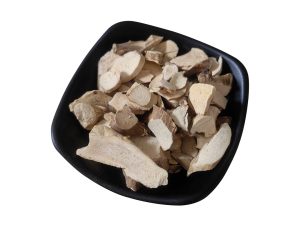
The stems and vines are flattened cylindrical, slightly curved, with a diameter of 2–7 cm. The surface is grayish-brown, sometimes with grayish-white spots; areas where the cork has peeled off appear reddish-brown, with distinct longitudinal grooves and small, punctate lenticels.The texture is hard and difficult to break; the fracture surface appears as irregular fragments. Slices of Sanguisorba are elliptical, oblong, or irregular oblique sections, 3–10 mm thick.The cross-section reveals reddish-brown or brown wood, with numerous vascular pores arranged irregularly. The bark contains resinous secretions ranging from reddish-brown to blackish-brown, which alternate with the wood to form 3–10 eccentric semicircular or circular rings. The pith is small and shifted to one side. It has a faint odor and an astringent taste. Specimens with abundant resinous secretions are considered superior.
Properties of Processed Slices
This product consists of irregular fragments or elliptical thin slices. The surface of the wood is light brown to brown, with numerous vascular pores; reddish-brown or blackish-brown resinous secretions are arranged alternately with the wood to form 3–8 eccentric semicircular rings, and the pith is offset to one side. The periphery is grayish-brown and rough, with a hard texture.It has a faint odor and an astringent taste.
Botanical Information
Botanical Classification
It is derived from the plant *Mimosa*, a member of the legume family (Fabaceae).
Morphological Characteristics
A woody vine growing up to several tens of meters in length. When an old stem is cut, several concentric rings are visible, and a chicken-blood-like sap oozes from the rings.The leaves are trifoliate and alternate; the terminal leaflet is broadly elliptical, 12–20 cm long and 7–15 cm wide, with an acute apex and a rounded or nearly cordate base, sparsely covered with short, stiff hairs on the upper surface, and bearing short, yellow, beard-like hairs between the veins on the lower surface; the lateral leaflets have an oblique base, with petioles approximately 6 mm long; the stipules are needle-like.Panicles are axillary, large, with numerous and densely packed flowers; the rachis and pedicels are covered with yellow soft hairs; flowers are about 10 mm long; the calyx is fleshy and tubular, 5-lobed, with the upper two lobes fused, and both surfaces bearing yellow soft hairs;The corolla is white and fleshy; the standard is nearly circular with a claw; both the wings and keel are about 7 mm long, each with a claw and an auricle; there are 10 stamens arranged in two groups, with 5 large and 5 small anthers; the ovary is covered with white, stiff hairs. The pod is tongue-shaped, 8–10 cm long, and covered with yellow soft hairs; it contains a single seed located at the apex of the pod.Flowering period: June–July; fruiting period: August–December.
Distribution Area
Distributed in Fujian, Guangdong, Guangxi, and Yunnan.