Chigucao, a name in traditional Chinese medicine, refers to the dried whole plant of Abrus cantoniensis Hance (a legume native to Guangdong). It is primarily produced in Guangdong and Guangxi. This herb has the effects of draining dampness and alleviating jaundice, clearing heat and detoxifying, and soothing the liver to relieve pain. It is primarily used to treat damp-heat jaundice, discomfort in the flanks, epigastric distension and pain, and swollen and painful breast abscesses.

Chicken Bone Grass
Chigucao, a name in traditional Chinese medicine, refers to the dried whole plant of Abrus cantoniensis Hance (a legume native to Guangdong). It is primarily produced in Guangdong and Guangxi. This herb has the effects of draining dampness and alleviating jaundice, clearing heat and detoxifying, and soothing the liver to relieve pain. It is primarily used to treat damp-heat jaundice, discomfort in the flanks, epigastric distension and pain, and swollen and painful breast abscesses.
Chinese Name : 鸡骨草
Latin Name : Abri Herba
Aliases : Yellow-headed Grass, Yellow-spike Grass, Large-leaved Rhubarb Grass, False Cowhage, Red Hen Grass, Pig’s Kidney Grass, Yellow Edible Grass, Small-leaved Dragon-scale Grass
Authentic Producing Area : Guangdong, Guangxi
Nature, Flavor & Meridian Tropism : Sweet and slightly bitter in taste; cool in nature; enters the Liver and Stomach meridians
Benefits & Efficacy
Benefits
Drains dampness and alleviates jaundice; clears heat and detoxifies; soothes the liver and relieves pain.
Indications
Chicken-Bone Grass is primarily used to treat damp-heat jaundice, discomfort in the flanks, distension and pain in the epigastric region, and swollen and painful mastitis.
Usage and Dosage
Internal use: Decoct and take 15–30 g.
Precautions
1. The seeds of this species are toxic; remove the seed pods before use to prevent poisoning. 2. Use with caution in individuals with a deficient-cold constitution or general weakness.
Chemical Constituents
This herb contains cassia alkaloids, cassia saponins, flavonoids, amino acids, sugars, cassia saponols, and glycyrrhetinic acid.
Pharmacological Actions
This herb possesses lipid-lowering, hepatoprotective, anti-fibrotic, antibacterial, antiviral, anti-inflammatory, and antioxidant effects.
Relevant Discussions
1. *Illustrated Compendium of Chinese Medicinal Plants*: “Treats rheumatic bone pain, bruises, and internal injuries caused by blood stasis; also serves as a cooling and antipyretic agent.”
2. *Compendium of Lingnan Herbal Medicine*: “Clears stagnant heat, soothes the liver, harmonizes the spleen, and promotes healing of fractures and injuries.”
Applications
Clinical Applications
1. To treat jaundice caused by stagnant damp-heat in the liver and gallbladder, it may be used alone or combined with herbs such as Yinchen (Artemisia capillaris) and Diercao (Eupatorium fortunei) to enhance its effects in clearing heat, detoxifying, draining dampness, and alleviating jaundice.
2. To treat discomfort in the flanks and epigastric pain caused by liver qi stagnation, it is often used in combination with Liangmianzhen (Euphorbia lathyris).
Related Compatibility
1. Chicken Bone Grass Combined with Yinchen: Both herbs drain dampness, relieve jaundice, clear heat, and eliminate toxins. Chicken Bone Grass also soothes the liver and relieves pain; Yinchen is highly effective at relieving jaundice and is a key herb for treating jaundice. When used together, these two herbs synergistically soothe the liver, drain dampness, eliminate toxins, and relieve jaundice. This combination is suitable for damp-heat jaundice accompanied by discomfort in the flanks.
2. Chicken Bone Grass Combined with White Peony Root: Chicken Bone Grass has the function of regulating the liver and relieving depression, while White Peony Root nourishes the blood, consolidates yin, soothes the liver, and relieves pain. When used together, this combination is suitable for symptoms of liver-stomach disharmony, such as pain in the chest and flanks, irritability and short temper, and poor appetite with slow digestion.
Related Medicines
Chicken Bone Grass Capsules, Stone-Dissolving Tablets.
Medicinal Diet Therapy
Chicken Bone Grass and Red Dates Decoction:
1. Effects: Clears heat, drains dampness, and alleviates jaundice. Suitable for patients with hepatitis B presenting with relatively severe damp-heat symptoms.
2. Ingredients: 60 grams of Chicken Bone Grass, 10 red dates.
3. Preparation: Wash the Chicken Bone Grass and red dates separately, place them in a clay pot, add 750 milliliters of water, and simmer until reduced to 250 milliliters.
4. Dosage: Take once daily for 1–3 consecutive months.
Notes
Patients requiring treatment with Chinese herbal medicine should first consult a licensed Traditional Chinese Medicine (TCM) hospital to receive a prescription following a professional TCM differential diagnosis.
Processing & Preparation
Harvesting & Processing
It can be harvested year-round; remove any mud and sand, then dry.
Processing Methods
Take the raw herbal material, remove impurities and pods, and cut into sections.
Storage Methods
Store in a dry container in a well-ventilated, dry place.
Crude Drug Identification
Identification
1. The powder of this product is grayish-green. Non-glandular trichomes are unicellular, with acute or long-acute apices, measuring 60–970 μm in length, 12–22 μm in diameter, and 3–6 μm in wall thickness; they exhibit distinct striations and wart-like projections. Stomata are paracytic. The parenchyma cells surrounding fiber bundles contain calcium oxalate rhomboids, forming crystalline fibers; the cell walls of these crystalline-containing cells are unevenly thickened.Stone cells are round, square-like, or oblong, with a diameter of 16–40 μm; some have slightly thickened walls. Cork cells are yellowish-brown. Calcium oxalate crystals have a diameter of 5–11 μm.
2. Take 2 g of the powdered sample, add 50 mL of methanol, and subject to ultrasonic treatment for 1 hour,filter; evaporate the filtrate to dryness; dissolve the residue in 10 mL n-butanol; extract three times with 10 mL of 2% hydrochloric acid solution by shaking; combine the acid extracts; adjust the pH to 7 with 5% sodium hydroxide solution; extract three more times with 5 mL of n-butanol by shaking; combine the n-butanol extracts; evaporate to dryness; dissolve the residue in 1 mL of methanol to prepare the test solution.Separately, prepare a reference solution of acacetin by dissolving the acacetin reference standard in 80% methanol to a concentration of 0.1 mg/mL.Perform the test according to the Thin-Layer Chromatography method (General Chapter 0502). Pipette 5–10 μL of the test solution and 2 μL of the reference solution, and apply them separately to the same silica gel G plate. Develop the plate using the upper layer of a n-butanol–acetic acid–water (4:1:5) mixture as the developing solvent. Remove the plate, allow it to air-dry,spray with indanone solution, and heat at 105°C until the spots become clearly visible. In the test chromatogram, spots of the same color appear at positions corresponding to those in the reference chromatogram.
Properties of Crude Drugs
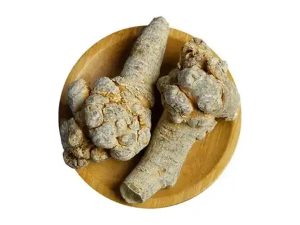
The roots are mostly conical, thicker at the top and tapering toward the bottom, branched, and of varying lengths, with a diameter of 0.5–1.5 cm; the surface is grayish-brown, rough, with fine longitudinal striations; lateral roots are extremely fine, some of which are broken off or leave residual fragments; the texture is hard. Stems grow in clumps, 50–100 cm long, with a diameter of approximately 0.2 cm;grayish-brown to purplish-brown, with slender branches sparsely covered with short soft hairs. The leaves are pinnately compound and alternate, with 8–11 pairs of leaflets, most of which have fallen off; the leaflets are oblong, 0.8–1.2 cm long; the apex is truncate with a small protruding tip, and the lower surface is covered with appressed hairs. It has a faintly fragrant odor and a slightly bitter taste.
Properties of Processed Slices
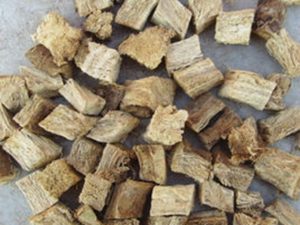
The roots are irregularly segmented; most are cylindrical, 0.2–1.5 cm in diameter, with a grayish-brown to purplish-brown surface that is rough and bears fine longitudinal striations; some are sparsely covered with short soft hairs; the cross-section is pale yellow. The leaflets are mostly deciduous, oblong, with a flat-cut apex and a small protruding tip; the lower surface is covered with appressed hairs. It has a faintly fragrant odor and a slightly bitter taste.
Botanical Information
Botanical Classification
A species of the genus Acacia in the Fabaceae family, specifically Guangdong Acacia.
Morphological Characteristics
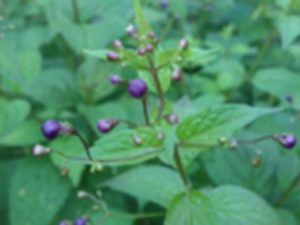
A climbing shrub, up to 1 m long; twigs and petioles are covered with coarse hairs. The taproot is stout, up to 60 cm long. The stem is slender, deep reddish-purple, with young parts densely covered with yellowish-brown hairs.Leaves are even-pinnate; there are 7–12 pairs of leaflets, which are obovate or oblong, 5–12 mm long, 3–5 mm wide, with a truncate apex bearing a small awn, a shallowly cordate base, sparsely covered with coarse hairs on the upper surface, and covered with appressed coarse hairs on the lower surface; the secondary veins are prominent on both surfaces; stipules are opposite.The raceme is short and axillary; flowers are about 6 mm long; the calyx is campanulate; the corolla is protruding and pale red; there are 9 stamens, fused into a tube, closely adnate to the standard, and separated at the upper part; the ovary is nearly sessile, and the style is short. The pod is oblong, flattened, sparsely hairy, and contains 4–5 seeds.Seeds are oblong, flattened, and blackish-brown; the hilum is prominent, waxy yellow, with a central pore and a marginal oblong ring; the radicle is brown and spiny, lying close to the pod margin. Flowering occurs in August; fruiting occurs from September to October.
Distribution Area
Distributed in Guangdong, Guangxi, and other regions.
Growth Habits
It prefers warm, humid conditions, is sensitive to cold, is drought-tolerant, and intolerant of waterlogging. It thrives in loose, fertile loam, sandy loam, or light clay soils with a pH of 5–6.5.