Cistanche is the name of a traditional Chinese medicine. It consists of the dried, scaly, fleshy stems of Cistanche deserticola Y.C.Ma or Cistanche tubulosa (Schrenk) Wight, plants belonging to the genus Cistanche in the Orobanchaceae family. It has the effects of tonifying kidney yang, nourishing essence and blood, and moistening the intestines to relieve constipation.It is primarily used to treat kidney yang deficiency, deficiency of essence and blood, impotence and infertility, soreness and weakness in the lower back and knees, weakness of tendons and bones, and constipation due to intestinal dryness.

Cistanche
Cistanche is the name of a traditional Chinese medicine. It consists of the dried, scaly, fleshy stems of Cistanche deserticola Y.C.Ma or Cistanche tubulosa (Schrenk) Wight, plants belonging to the genus Cistanche in the Orobanchaceae family. It has the effects of tonifying kidney yang, nourishing essence and blood, and moistening the intestines to relieve constipation.It is primarily used to treat kidney yang deficiency, deficiency of essence and blood, impotence and infertility, soreness and weakness in the lower back and knees, weakness of tendons and bones, and constipation due to intestinal dryness.
Chinese Name : 肉苁蓉
Latin Name : Cistanches Herba
Aliases : Rousongrong, Heishiling, Zongrong, Dijing, Mazu, Mazhi, Congrong, Dayun, Cunyun
Authentic Producing Area : Inner Mongolia, Xinjiang, Gansu
Nature, Flavor & Meridian Tropism : Sweet and salty in taste; warm in nature; enters the Kidney and Large Intestine meridians
Benefits & Efficacy
Benefits
Tonifies kidney yang, nourishes essence and blood, and moistens the intestines to relieve constipation.
Indications
Deficiency of kidney yang, deficiency of essence and blood, impotence and infertility, soreness and weakness in the lower back and knees, weakness of tendons and bones, intestinal dryness and constipation.
Usage and Dosage
Internal use: Decocted as a soup, 10–15 g; or incorporated into pills or powders; or steeped in wine.
Precautions
Not suitable for those with yin deficiency with excessive fire, loose stools, or heat-induced constipation.
Chemical Constituents
It primarily contains phenethyl alcohol glycosides, such as Echinops glycoside, Trichosanthin, Cistanche glycosides A, B, C, and H, Syzygium glycoside, Echinops glycoside, and Ginkgo glycoside; it also contains betaine, 8-epi-strychnoside, amino acids, and polysaccharides.
Pharmacological Actions
This product has sex hormone-like effects and also regulates gastrointestinal function, boosts immunity, and combats fatigue.
Relevant Discussions
1. *Shennong Bencao Jing*: “Treats the ‘Five Labors’ and ‘Seven Injuries,’ tonifies the middle jiao, … nourishes the five viscera, strengthens the yang, enhances essence and qi, promotes fertility, and treats masses and masses in women.”
2. *Rihua Zi Bencao*: “Treats male impotence and female infertility; moistens the five viscera; promotes muscle growth; warms the lower back and knees; and addresses seminal emission, hematuria, dribbling urine, leukorrhea, and genital pain in men.”
3. *Bencao Huiyan*: “It nourishes the Gate of Life, nourishes kidney qi, and is a tonic for essence and blood.” “For men with a deficient and cold Dan Yuan resulting in prolonged impotence, and for women with imbalances in the Chong and Ren meridians leading to disordered yin qi, this is a mild tonic formula—warm without being hot, tonifying without being harsh, warming without causing dryness, and lubricating without causing leakage—hence its name ‘Congrong’ (Leisurely).”
Applications
Clinical Applications
1. For treating men’s “Five Labors and Seven Injuries,” impotence, and residual dribbling after urination, it is often combined with Cuscuta seed, Dipsacus root, and Eucommia bark, as in the Cistanche Pill (Yixin Fang); it may also be used with Eucommia bark, Morinda root, and Placenta to treat kidney deficiency with bone atrophy and inability to move, as in the Diamond Pill (Zhang’s Medical Compendium).
2. For treating severe constipation caused by depletion of body fluids, it is often combined with Agarwood (Chenxiang) and Hemp Seed (Mazi Ren), as in the Moistening the Intestines Pills (Runchang Wan) from *Jisheng Fang*; or combined with Angelica Root (Danggui), Achyranthes Root (Niuxi), and Alisma (Zexie) to treat constipation, clear and prolonged urination, and soreness and coldness in the lower back and waist caused by kidney qi deficiency, as in the Jichuan Decoction (Jichuan Jian) from *Jingyue Quanshu*.
Related Compatibility
1. Cistanche combined with Suoyang: Cistanche tends to be warm and moisturizing, and is more effective than Suoyang at moistening the intestines and nourishing essence and blood; Suoyang tends to be warm and drying, and is more effective than Cistanche at invigorating yang and nourishing essence. When used together, these two herbs enhance the effects of tonifying kidney yang, nourishing essence and blood, and moistening the intestines. This formula is suitable for kidney deficiency-induced impotence, cold pain in the lower back and knees, or deficiency of essence and blood, as well as dry, hard stools.
2. Cistanche combined with Cornus officinalis: Cistanche excels at tonifying yang and nourishing essence; Cornus officinalis excels at tonifying the kidneys and consolidating essence. When used together, these two herbs enhance the effects of tonifying kidney yang and consolidating essence and qi. This combination is suitable for treating erectile dysfunction due to kidney deficiency and weakness in the lower back and knees.
3. Cistanche combined with Eucommia: Cistanche excels at tonifying the kidneys and nourishing essence; Eucommia excels at tonifying the liver and kidneys and strengthening the tendons and bones. When used together, these two herbs enhance the effects of tonifying the kidneys and strengthening the lower back. This combination is suitable for kidney deficiency-related lower back pain, soreness, and weakness.
4. Cistanche combined with Fire Hemp Seed: Cistanche excels at tonifying the kidneys, nourishing essence, moistening the intestines, and promoting bowel movements; Fire Hemp Seed nourishes and tonifies deficiencies, moistens dryness, and lubricates the intestines. When used together, these two herbs enhance the effect of moistening the intestines and promoting bowel movements, while also providing warming nourishment and tonification. This combination is suitable for conditions such as constipation due to fluid depletion caused by deficiency of qi and blood in the elderly.
5. Cistanche combined with Dodder Seed: Cistanche excels at warming and nourishing essence and blood; Dodder Seed excels at tonifying yang, nourishing yin, and consolidating essence. When used together, these two herbs enhance the effects of strengthening yang and nourishing essence. This combination is suitable for conditions such as erectile dysfunction due to kidney deficiency and cold pain in the lower back and knees.
6. Cistanche combined with Psoralea: Cistanche excels at tonifying the kidneys, nourishing essence, moistening the intestines, and promoting bowel movements; Psoralea excels at tonifying the kidneys, strengthening yang, consolidating essence, and reducing urinary leakage. When used together, these two herbs enhance the effects of tonifying the kidneys, nourishing essence, consolidating essence, and reducing urinary leakage. This combination is suitable for conditions such as erectile dysfunction due to kidney deficiency, premature ejaculation, female infertility, metrorrhagia, and leukorrhea.
7. Cistanche combined with Agarwood: Cistanche excels at tonifying the kidneys, nourishing essence, moistening the intestines, and promoting bowel movements; Agarwood excels at regulating qi, dispelling cold, and relieving pain. When combined, these two herbs work to moisten the intestines, promote bowel movements, regulate qi, and relieve pain. This combination is suitable for elderly individuals with constipation due to deficiency accompanied by excessive sweating and lower abdominal discomfort.
8. Cistanche combined with Morinda Root:Cistanche excels at tonifying the kidneys, nourishing essence, moistening the intestines, and promoting bowel movements; Morinda root excels at tonifying the kidneys, assisting yang, and strengthening tendons and bones. When used together, these two herbs have the effects of tonifying the kidneys, assisting yang, moistening the intestines, promoting bowel movements, and strengthening tendons and bones. This combination is suitable for conditions such as kidney yang deficiency, cold pain in the lower back and knees, erectile dysfunction, nocturnal emissions, weakness and flaccidity of tendons and bones, and constipation in the elderly.
9. Cistanche combined with Prepared Rehmannia Root: Cistanche excels at tonifying the kidneys, nourishing essence, moistening the intestines, and promoting bowel movements; Prepared Rehmannia Root excels at nourishing blood, replenishing yin, and enriching essence and marrow. When used together, these two herbs enhance the effects of tonifying the kidneys and nourishing essence. This combination is suitable for conditions such as erectile dysfunction, nocturnal emissions, cold pain in the lower back and knees, and infertility caused by kidney deficiency.
Medicinal Identification
1. Raw Cistanche and Wine-Processed Cistanche: Raw Cistanche is more effective at tonifying the kidneys, clearing turbidity, and lubricating the intestines to relieve constipation; it is often used for kidney qi deficiency, intestinal dryness with constipation, and leukorrhea. Wine-Processed Cistanche significantly enhances the ability to tonify the kidneys and assist yang; it is often used for erectile dysfunction, low back pain, and infertility caused by kidney yang deficiency.
2. Cistanche tubulosa and Epimedium: Both have a pungent taste and warm nature, entering the Liver and Kidney meridians. They can both warm and tonify kidney yang and are similarly used to treat conditions such as erectile dysfunction and infertility caused by kidney yang deficiency.However, Cistanche deserticola has a salty taste and enters the Large Intestine meridian; it has a gentle, moisturizing nature and a mild therapeutic effect. It also nourishes essence and blood, moistens the intestines, and relieves constipation, making it suitable for treating kidney yang deficiency, deficiency of essence and blood, as well as constipation caused by intestinal dryness and depletion of body fluids. Epimedium has a sweet taste and functions to warm the kidneys and strengthen yang; it also strengthens the tendons and bones and dispels wind-dampness. It is suitable for treating weakness in the lower back and knees due to liver and kidney deficiency, as well as wind-cold-dampness arthralgia and numbness in the limbs.
3. Cistanche and Psoralea: Both are warm in nature and enter the Kidney meridian; they can tonify Kidney yang and treat conditions caused by Kidney yang deficiency. However, Cistanche has a sweet and salty taste, a soft and moist nature, and a mild therapeutic effect; it tends to nourish essence and blood while also moistening the intestines and promoting bowel movements. It is suitable for treating weakness in the lower back and knees, weakness of the tendons and bones, and constipation due to dryness of the intestines and depletion of body fluids resulting from Kidney yang deficiency and insufficiency of essence and blood.Psoralea, with a bitter and pungent taste and entering the Spleen Meridian, excels at tonifying the Kidneys and assisting Yang; it can also consolidate essence and reduce urination, warm the Spleen to stop diarrhea, anchor Qi to relieve wheezing, and is therefore effective for treating diarrhea due to Spleen-Kidney Yang deficiency, wheezing due to Kidney deficiency, and vitiligo.
4. Cistanche and Walnut Kernels: Both are warm in nature and enter the Kidney meridian. They have the effects of tonifying the kidneys and strengthening yang, as well as moistening the intestines and promoting bowel movements. They are particularly effective for treating kidney yang deficiency, deficiency of essence and blood, weakness of tendons and bones, and constipation due to intestinal dryness. However, Cistanche is salty and moisturizing, with the ability to generate essence and nourish blood; it can also be used for conditions such as uterine cold and infertility caused by deficiency of essence and blood.Walnut kernels also enter the Lung Meridian; they have the effects of warming and tonifying the lungs and kidneys, as well as anchoring qi and alleviating wheezing, and are used to treat deficiency-type wheezing caused by the kidneys’ failure to anchor qi.
Related Medicines
Shengli Capsules, Qiangyang Baoshen Pills, Cistanche Laxative Oral Solution, Tongbianling Capsules, Longfengbao Capsules.
Related Prescriptions
Jichuan Decoction (*Jingyue Quanshu*), Rehmannia Decoction (*Shengji Zonglu*), Cistanche Pills (*Yixin Fang*), Cistanche Pills (*Shenghui Fang*).
Medicinal Diet Therapy
Cornus and Cistanche Wine
1. Effects: Nourishes the liver and kidneys. Suitable for conditions of liver and kidney deficiency, such as dizziness, tinnitus, palpitations, forgetfulness, weakness in the lower back and legs, and cold limbs.
2. Ingredients: 60 g Cistanche, 25 g Cornus officinalis, 35 g Schisandra, 40 g stir-fried Eucommia, 30 g each of Sichuan Achyranthes, Cuscuta, Poria cocos, Alisma, Rehmannia glutinosa, Cornus officinalis fruit, Morinda officinalis, and Polygala; 2,000 g high-proof liquor.
3. Preparation: Process and crush the above herbs, wrap them in a silk bag or fine gauze, place them in a clean porcelain jar or earthenware pot, pour in the high-proof liquor to cover, and seal the container. Leave to steep for 5 days in spring and summer, or 7 days in fall and winter. After this period, open the container, remove the herb bag, filter the liquid, and let it settle to clarify.
4. Dosage: Take once in the morning and once in the evening. Drink 10–15 ml warm on an empty stomach each time.
Notes
Patients requiring treatment with traditional Chinese medicine should first consult a licensed TCM hospital, where a TCM practitioner will conduct a professional diagnosis and prescribe the appropriate herbal formula.
Processing & Preparation
Harvesting & Processing
Harvest in spring when the shoots first emerge from the ground or in fall before the ground freezes; remove the stem tips. Cut into sections and sun-dry.
Processing Methods
1. Cistanche: Take the raw herb, remove impurities, sort by size, wash thoroughly, and soak briefly. Steam until the interior is no longer dry, then sun-dry until the moisture content is uniform throughout. Cut into thick slices and dry.
2. Wine-processed Cistanche: Take Cistanche slices, mix thoroughly with yellow wine, place in an airtight container, seal tightly, and heat over water or using steam until all liquid is absorbed. When the surface turns black, remove and dry. Use 30 kg of yellow wine for every 100 kg of Cistanche.
3. Cistanche Prepared with Black Beans: Soak the Cistanche in rice washing water for 3 days, changing the water once daily to remove all saltiness. Scrape off the surface scales and cut into 1.5-cm-thick slices;then take 5 kg of black beans and roast them until fragrant; divide them into 3 portions. Take one portion at a time, mix it with water and the Cistanche, and simmer over low heat until dry. Remove and sun-dry until half-dry, then steam thoroughly before sun-drying again. Repeat this process with another portion of black beans, steaming and sun-drying three times in total, until completely dry. For every 100 kg of Cistanche, use 10 kg of black beans.
Storage Methods
Store in a dry container; keep the wine-processed Cistanche and black bean-processed Cistanche tightly sealed in a cool, dry place to prevent insect infestation.
Crude Drug Identification
Properties of Crude Drugs
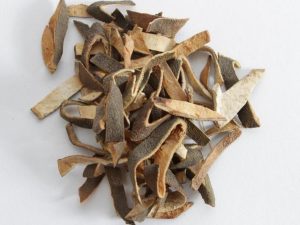
1. Cistanche: Flat-cylindrical in shape, slightly curved, 3–15 cm long, and 2–8 cm in diameter. The surface is brownish or grayish-brown, densely covered with fleshy scales arranged in an overlapping pattern; the tips of the scales are usually broken off.It is heavy, hard in texture, slightly flexible, and difficult to break; the fracture surface is brownish-red, with pale brown, dot-like vascular bundles arranged in wavy annular patterns. It has a faint odor and a sweet, slightly bitter taste.
2. Tubular-flowered Cistanche: Spindle-shaped, flattened spindle-shaped, or flattened cylindrical, slightly curved, 5–25 cm long, 2.5–9 cm in diameter. The surface is brownish-black to blackish-brown. The cross-section is granular, grayish-brown to grayish-black, with scattered dot-like vascular bundles.
Properties of Processed Slices
1. Cistanche: Irregular, round or flattened round thick slices. One side is brownish-black or grayish-brown. In the center are pale brown, dot-like vascular bundles arranged in wavy annular patterns. The periphery is grayish-black and scaly. The texture is hard and brittle. It has a faint odor and a sweet, slightly bitter taste.
2. Wine-processed Cistanche: Resembles Cistanche, with a black-brown surface; soft and moist in texture; slightly sweet in taste, with a faint aroma of wine.3. Black-bean-processed Cistanche: Resembles Cistanche, with a black surface.
Botanical Information
Botanical Classification
Cistanche and Cistanche tubulosa, plants of the genus Cistanche in the family Orobanchaceae.
Morphological Characteristics
1. Cistanche deserticola: A perennial herb, 0.4–1.6 m tall, with most of the plant growing underground. The stem is unbranched or branches into 2–4 stems from the base; it tapers gradually from the base upward, with a diameter of 2–5 cm.Leaves are broadly ovate, 0.5–1.5 cm long and 1–2 cm wide; those on the lower part of the stem are denser, while those on the upper part are sparser and narrower, 2–4 cm long and 0.5–1 cm wide, glabrous on both surfaces. The inflorescence is a spike, 15–50 cm long;The bracts of the inflorescence are relatively long, nearly as long as the corolla; the outer surfaces and margins of both the bracts and corolla lobes are sparsely pubescent or nearly glabrous; there are two small bracts, equal in length to the calyx. The calyx is campanulate, 1–1.5 cm long, with the apex shallowly 5-lobed; the lobes are nearly circular, 2.5–4 mm long.The corolla is tubular-campanulate, 3–4 cm long, 5-lobed at the apex; the lobes are nearly semicircular, 4–6 mm long, with margins often slightly revolute, and are pale yellowish-white or pale purple in color. There are 4 stamens; the filaments are covered with crinkled, long soft hairs at the base, and the anthers are densely covered with long soft hairs.The ovary is elliptical, approximately 1 cm long, with nectaries at the base. The capsule is ovoid, 1.5–2.7 cm long and 1.3–1.4 cm in diameter, often bearing a persistent style at the apex, and splits into two valves. Flowering occurs from May to June, and fruiting from June to August.
2. Tubular-flowered Cistanche:Plant height 60–100 cm; above-ground portion 30–35 cm tall. Stem unbranched, with a basal diameter of 3–4 cm. Leaves milky white, turning brown when dry; triangular, 2–3 cm long and about 5 mm wide; those on the upper part of the stem gradually narrow to triangular-lanceolate or lanceolate. Spicate inflorescence, 12–18 cm long and 5–6 cm in diameter;Bracts are oblong-lanceolate or ovate-lanceolate, 2–2.7 cm long, 5–6.5 mm wide, with soft hairs along the margins, glabrous on both surfaces; there are two bracteoles, linear-lanceolate or spatulate, 1.5–1.7 cm long, 2.5 mm wide, nearly glabrous.The calyx is tubular, 1.5–1.8 cm long, 5-lobed to near the middle; the lobes are similar to the corolla tube, milky white, turning yellowish-white when dry, nearly equal in size, and long-ovate-triangular or lanceolate, 0.6–1 cm long and 2.5–3 mm wide.The corolla is tubular-funnel-shaped, 4 cm long, 5-lobed at the apex; the lobes are purplish when in bud, turning brownish-yellow when dry, nearly equal in size, nearly circular, 8 mm long and 1 cm wide, glabrous on both surfaces.There are 4 stamens; the filaments are attached 7–8 mm from the base of the spur tube, 1.5–1.7 cm long, with a swollen base densely covered with yellowish-white long soft hairs; the anthers are ovate, 4–6 mm long, densely covered with yellowish-white long soft hairs, with a bluntly rounded base and no small tip.The ovary is oblong; the style is 2.2–2.5 cm long; the stigma is flattened and globose, with two shallow lobes. The capsule is oblong, 1–1.2 cm long and 7 mm in diameter. The seeds are numerous, nearly round, turning blackish-brown when dry, and reticulate on the outside. Flowering occurs from May to June; fruiting occurs from July to August.
Distribution Area
1. Cistanche deserticola: Found in desert regions such as Inner Mongolia, Ningxia, Gansu, and Xinjiang.2. Cistanche tubulosa: Found in southern Xinjiang.
Growth Habits
Cistanche is a parasitic plant, with hosts including Saxaul and White Saxaul. It thrives in desert environments. It prefers medium- to fine-grained sandy soil that is neutral or slightly alkaline, with relatively high salinity. The seeds are numerous, small, and light, with a thousand-seed weight of 0.086–0.091 g, and they have a relatively long viability.
Propagation Methods
Propagation is by seed.
Cultivation Techniques
Select sandy or semi-shifting sand desert areas suitable for the growth of host Saxaul. Utilize desert areas with naturally concentrated Saxaul groves, or establish artificial Saxaul groves. Dig seedbeds approximately 50–80 cm east or southeast of the Saxaul groves.The size of the seedbeds varies: they are 1–2 m long, about 1 m wide, and 50–80 cm deep. In areas with dense parasitic growth, a large trench can be dug to encircle multiple parasitic plants. Sow the seeds in holes in the seedbeds, apply camel, cow, or sheep manure, and cover with 30–40 cm of soil, leaving a trench or pit on the surface for watering.Keep the seedlings moist after sowing to encourage the host plant’s roots to extend into the seedbed. When sown in spring or fall, some seedbeds will show Cistanche parasitism within two years; a few plants will emerge and grow, while most will emerge, flower, and set seed within 2–4 years.
Pest and Disease Control
1. Diseases(1) Powdery mildew: Control by spraying with a 300-fold dilution of the Bo-10 biological agent or a 4,000-fold dilution of 25% triazole.(2) Root rot: Loosen the soil and, during the outbreak period, apply a 1,000-fold dilution of 50% carbendazim as a root drench.2. Pests(1) Seed Flies: Spray with a 90% diazinon solution diluted 800 times or a 40% malathion emulsifiable concentrate diluted 1,000 times, or apply the solution to the root zone.(2) Desert Rats: Place zinc phosphide or Dalong poison baits outside their burrows to lure and kill them.