Euryale is a commonly used medicinal herb for consolidating essence, stopping leukorrhea, and reducing urination. It is the mature seed kernel of Euryale ferox Salisb., a plant of the genus Euryale in the Nymphaeaceae family. It has the effects of tonifying the kidneys and consolidating essence, tonifying the spleen and stopping diarrhea, and removing dampness and stopping leukorrhea. It is primarily used to treat nocturnal emissions and premature ejaculation, enuresis and frequent urination, chronic diarrhea due to spleen deficiency, and white turbid discharge and leukorrhea.

Euryale
Euryale is a commonly used medicinal herb for consolidating essence, stopping leukorrhea, and reducing urination. It is the mature seed kernel of Euryale ferox Salisb., a plant of the genus Euryale in the Nymphaeaceae family. It has the effects of tonifying the kidneys and consolidating essence, tonifying the spleen and stopping diarrhea, and removing dampness and stopping leukorrhea. It is primarily used to treat nocturnal emissions and premature ejaculation, enuresis and frequent urination, chronic diarrhea due to spleen deficiency, and white turbid discharge and leukorrhea.
Chinese Name : 芡实
Latin Name : Euryales Semen
Aliases : Water Chestnut, Chicken-Head Fruit, Goose-Beak Fruit, Chicken Head, Goose Head, Knife-Shaped Water Chestnut, Chicken-Head Fruit, Su Huang, Huang Shi, Chicken-Head Bud, Chicken-Beak Lotus
Authentic Producing Area : Mainly produced in Jiangsu, Shandong, Hunan, Hubei, and Sichuan
Nature, Flavor & Meridian Tropism : Taste: sweet and astringent; Nature: neutral; Entering the Spleen and Kidney meridians
Benefits & Efficacy
Benefits
Nourishes the kidneys and consolidates essence; tonifies the spleen and stops diarrhea; dispels dampness and stops leukorrhea.
Indications
Mainly used to treat nocturnal emission and premature ejaculation, enuresis and frequent urination, chronic diarrhea due to spleen deficiency, cloudy leukorrhea, and vaginal discharge.
Usage and Dosage
Internal use: Decoction, 9–15 g.
Precautions
While taking this medicine, avoid cold and cooling foods (such as cold drinks and sashimi), raw and cold foods (such as ice cream), and spicy or greasy meals.
Chemical Constituents
It primarily contains starch, protein, fat, and various vitamins.
Pharmacological Actions
This product has anti-diabetic and anti-aging effects.
Relevant Discussions
1. *Shennong Bencao Jing*: “Sweet in taste, neutral in nature. Treats dampness-induced arthralgia, pain in the lower back, spine, and knees; tonifies the middle jiao; alleviates acute illnesses; enhances vital energy; strengthens the will; and sharpens the senses.”
2. *Compendium of Materia Medica*: “Quenches thirst and benefits the kidneys; treats urinary incontinence, seminal emission, leukorrhea, and vaginal discharge.”
3. *Seeking the Truth in Materia Medica*: “Its sweet taste tonifies the spleen, thus dispelling dampness and treating diarrhea and abdominal pain… Its astringent taste consolidates the kidneys, thus retaining qi and curing seminal emission, vaginal discharge, and urinary incontinence.”
4. *Explanation of Medicinal Properties*: “Sweet in taste, neutral in nature, non-toxic; enters the Heart, Kidney, Spleen, and Stomach meridians. Primarily calms the five viscera, tonifies the spleen and stomach, enhances essence and vital energy, stops seminal emission, warms the lower back and knees, dispels dampness-induced arthralgia, sharpens hearing and vision, and treats forgetfulness.”
Applications
Clinical Applications
1. To treat weakness and soreness in the lower back and knees caused by kidney deficiency, as well as seminal emission and premature ejaculation, it is often used in synergy with Schisandra chinensis, as in the Water-Land Immortal Pill (from *Ren Cun Tang’s Experienced Formulas*); it may also be combined with lotus seeds, lotus stamen, and oyster shell, as in the Golden Lock Semen-Consolidating Pill (from *Collected Explanations of Medical Formulas*).
2. To treat spleen deficiency with excessive dampness and chronic, persistent diarrhea, it is often used in combination with Atractylodes macrocephala, Poria cocos, and Vigna radiata.
3. To treat thin, clear leukorrhea resulting from concurrent spleen and kidney deficiency, it is often used in combination with Codonopsis pilosula, Atractylodes macrocephala, and Dioscorea opposita.
4. To treat yellow, thick vaginal discharge caused by damp-heat, it is combined with herbs that clear heat and drain dampness, such as Phellodendron bark and Plantain seed, as in the Yi Huang Decoction (*Fu Qingzhu’s Gynecology*).
Related Compatibility
Euryale Seed Combined with Schisandra Fruit: Euryale seed both strengthens the spleen and drains dampness, and is effective at tonifying the kidneys, consolidating essence, and stopping leukorrhea; Schisandra fruit has a descending nature in both its properties and flavor, with sour and astringent qualities that specialize in astringing essence and reducing urination.When combined, these two herbs complement each other, enhancing their effects in tonifying the kidneys and consolidating essence, tonifying the spleen and stopping diarrhea, and reducing urination and vaginal discharge. This formula is used for conditions such as deficiency of both the spleen and kidneys, chronic diarrhea, as well as kidney qi deficiency manifesting as nocturnal emissions, premature ejaculation, and red or white vaginal discharge.
Medicinal Identification
1. Euryale Seed, Plain-Stir-Fried Euryale Seed, and Bran-Stir-Fried Euryale Seed: Euryale seed has a sweet and astringent taste, a neutral nature, and enters the Spleen and Kidney meridians. It nourishes the kidneys and consolidates essence, tonifies the spleen and stops diarrhea, and eliminates dampness to stop leukorrhea. It can be used for conditions such as nocturnal emission, premature ejaculation, enuresis, frequent urination, chronic diarrhea due to spleen deficiency, cloudy urine, and leukorrhea.After stir-frying, their nature becomes slightly warm, enhancing their ability to tonify the spleen and consolidate and astringe. They are suitable for conditions of spleen deficiency and cases where deficiency predominates over excess. Plain stir-fried euryale seeds and bran-stir-fried euryale seeds have similar effects; both excel in tonifying the spleen and consolidating and astringing. They are primarily used for diarrhea due to spleen deficiency and seminal emission caused by kidney deficiency with an unstable semen gate, and may also be used for leukorrhea due to spleen deficiency.
2. Euryale Seed and Schisandra Fruit: Both herbs can astringe the intestines to stop diarrhea and consolidate the kidneys to retain essence. For cases of nocturnal emission or seminal emission due to kidney deficiency, as well as chronic diarrhea or dysentery due to spleen deficiency, these two herbs are often used in combination to enhance each other’s effects. However, Euryale Seed combines astringent properties with tonifying effects and can also drain dampness; therefore, it is more suitable for treating diarrhea caused by spleen deficiency with excessive dampness.Jinyingzi specializes in sour and astringent actions without any tonifying properties; for kidney deficiency-induced seminal leakage, using this herb to astringe and consolidate yields better results.
3. Euryale Seed and Phellodendron Bark: Both herbs can eliminate dampness and stop leukorrhea, and are used for damp-heat leukorrhea. However, Euryale Seed is sweet, astringent, and neutral in nature; it can tonify the kidneys and secure essence, strengthen the spleen and stop diarrhea, and eliminate dampness to stop leukorrhea. It is frequently used for conditions such as nocturnal emission and seminal leakage due to kidney deficiency with instability, chronic diarrhea caused by spleen deficiency with excessive dampness, damp-heat leukorrhea, and leukorrhea resulting from concurrent spleen and kidney deficiency.Phellodendron is bitter, cold, and descending; it clears heat and dries dampness, excelling at clearing and draining damp-heat in the lower jiao. It can be used for conditions such as damp-heat descending to the lower jiao, characterized by yellow, turbid, and foul-smelling leukorrhea, as well as dysentery caused by damp-heat. Its ability to clear heat and dry dampness is widely applied; it also treats damp-heat jaundice, turbid urinary discharge, and swelling and pain caused by beriberi.Phellodendron also has the effects of purging fire and detoxifying, clearing “phase fire,” and reducing fever and night sweats; it can be used to treat swollen and painful sores and ulcers, eczema and damp sores, yin deficiency fever, night sweats, and seminal emission.
4. Euryale Seed and Chinese Yam: Both herbs have the function of tonifying the spleen and stopping diarrhea. They are mild in nature, neither greasy nor drying; they are both tonifying and astringent, and are used for spleen-deficiency diarrhea as well as kidney-deficiency-induced seminal emission and vaginal discharge characterized by uncontrolled leakage. However, the astringent effect of Euryale Seed is stronger than that of Chinese Yam; it can also remove dampness and enters only the Spleen and Kidney meridians, not the Lung meridian.Chinese yam has a stronger tonifying effect than Euryale seed; it enters the three Yin meridians of the Lung, Spleen, and Kidney, and can also tonify Lung Yin to relieve coughs, as well as harmoniously tonify both Qi and Yin to treat diabetes.
5. Euryale Seed and Amomum: Both herbs can tonify the kidneys and secure essence, as well as strengthen the spleen and stop diarrhea; they are used for conditions such as seminal emission, spermatorrhea, and diarrhea due to spleen deficiency. However, Euryale Seed emphasizes astringency and consolidation; it can tonify the kidneys and secure essence, strengthen the spleen and stop diarrhea, eliminate dampness, and stop leukorrhea. It is frequently used for seminal emission and spermatorrhea caused by kidney deficiency with loss of consolidation, as well as for chronic, intractable diarrhea resulting from spleen deficiency with excessive dampness;In addition, it can be used for leukorrhea caused by damp-heat or by concurrent spleen and kidney deficiency. Yizhi tends to warm the kidneys and spleen; it can tonify the kidneys and assist yang, and its astringent nature helps secure essence and reduce urination, making it commonly used for enuresis and frequent urination. It also has the effects of warming the spleen, stopping diarrhea, and reducing excessive salivation, and is used for diarrhea due to spleen cold, abdominal cold pain, and excessive salivation.
Related Medicines
Suoyang Gujing Wan.
Related Prescriptions
Yi Huang Decoction (*Fu Qingzhu’s Gynecology*), Jin Suo Gu Jing Pills (*Collected Explanations of Medical Formulas*).
Medicinal Diet Therapy
A medicinal dish made with Euryale seed is Euryale Seed and Poria Porridge.
1. Effects: Tonifies the spleen and boosts qi. Suitable for urinary incontinence, cloudy urine, erectile dysfunction, and premature ejaculation.
2. Ingredients: 15 g of Euryale seed, 10 g of Poria, and an appropriate amount of rice.
3. Preparation: Crush the Euryale seed and Poria, add an appropriate amount of water, and simmer until soft. Then add the rinsed rice and continue cooking until it becomes a porridge.
4. Usage: Consume in divided doses throughout the day for several consecutive days.
Notes
Patients requiring treatment with traditional Chinese medicine should first consult a licensed TCM hospital, where a TCM practitioner will conduct a professional diagnosis and prescribe the appropriate herbal formula.
Processing & Preparation
Harvesting & Processing
Harvest the ripe fruits in late autumn or early winter; remove the fruit peel, extract the seeds, wash them thoroughly, then remove the hard shell (outer seed coat), and sun-dry them.
Processing Methods
1. Euryale Seed: Remove impurities.
2. Roasted Euryale Seed: Place the cleaned Euryale seeds in a pan, heat over low heat, and roast until the surface turns slightly yellow; remove and let cool.
3. Wheat Bran-Roasted Euryale Seed: Take wheat bran, sprinkle it into a hot wok, and heat over medium heat. When smoke begins to rise, add the cleaned Euryale seeds and stir-fry rapidly until the surface turns slightly yellow. Remove, sift out the wheat bran, and let cool. Use 10 kg of wheat bran for every 100 kg of Euryale seeds.
4. Earth-Powder-Roasted Euryale Seeds: Place Fuluogan powder in a wok and heat over medium heat until the powder becomes light and loose. Add the cleaned euryale seeds and stir-fry until the surface turns slightly yellow. Remove from heat, sift out the Fuluogan powder, and let cool. Use 20 kg of Fuluogan powder per 100 kg of euryale seeds.
5. Salt-roasted Euryale Seeds: Take the cleaned Euryale seeds, mix them thoroughly with salt water, and let them sit until thoroughly moistened. Place them in a hot pan and heat over low heat until dry. Remove and let cool. Use 2 kg of salt per 100 kg of Euryale seeds.
Storage Methods
Store in a dry container; keep salt-processed products tightly sealed. Store in a well-ventilated, dry place to prevent insect infestation.
Crude Drug Identification
Properties of Crude Drugs
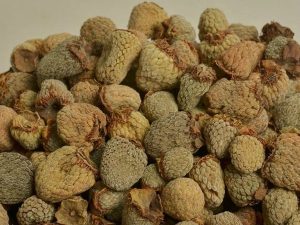
This product is star-shaped and spherical, mostly broken into pieces; intact specimens have a diameter of 5–8 mm. The surface is covered with a brownish-red or reddish-brown inner seed coat; one end is yellowish-white, accounting for about one-third of the total length, and features a pitted seed scar. When the inner seed coat is removed, the interior appears white. The texture is relatively hard; the fracture surface is white and powdery. It has a faint odor and a bland taste.
Properties of Processed Slices
1. Euryale Seed: See “Characteristics of the Medicinal Material.”
2. Roasted Euryale Seed: Resembles Euryale Seed in shape; the surface is yellow or pale yellow; the taste is bland with a slight sourness.
3. Bran-Roasted Euryale Seed: The surface is pale yellow and has a roasted bran aroma.
4. Earth-Roasted Euryale Seed: Resembles Euryale Seed in shape; the surface is coated with an earthy color.
5. Salt-Processed Euryale Seed: Resembles Euryale Seed in shape; the taste is slightly salty.
Botanical Information
Botanical Classification
Euryale, a plant of the genus Euryale in the Nymphaeaceae family.
Morphological Characteristics
A large, annual aquatic herb. The entire plant is covered with sharp spines. The rhizome is stout and short, with white fibrous roots and an inconspicuous stem. The primary leaves are submerged, arrow-shaped or elliptic-reniform, 4–10 cm long, and spine-free on both surfaces; the petioles are spine-free;later-developing leaves float on the water surface; they are leathery, elliptic-reniform to circular, 10–130 cm in diameter, dark green on the upper surface with numerous wrinkles, dark purple on the lower surface with short soft hairs, with prominent veins and margins curled upward. The petioles and flower stalks are stout, reaching up to 25 cm in length.Flowers are solitary, opening during the day and closing at night, approximately 5 cm long; sepals are 4, lanceolate, 1–1.5 cm long, with a purple inner surface; petals are numerous, oblong-lanceolate, 1.5–2 cm long, purplish-red, arranged in several whorls;numerous stamens; the ovary is inferior, with 8 carpels; the stigma is red, forming a concave, disc-shaped, flattened structure. The berry is spherical, 3–5 cm in diameter, spongy, and dark purplish-red. The seeds are spherical, approximately 10 mm in diameter, and black. Flowering occurs from July to August, and fruiting from August to September.
Distribution Area
Distributed in North China, Northeast China, East China, Central and South China, and Southwest China.
Growth Habits
Prefers a warm, humid climate with ample sunlight. Optimal temperature: 20–30°C. Water depth: 60–120 cm. Cultivate in ponds, reservoirs, or canals with relatively stable water levels and moderately loose silt. Soil should not be excessively acidic; cultivation is not recommended in cold regions.
Propagation Methods
Seed Propagation: Direct seeding or seedling transplantation.
Cultivation Techniques
1. Direct Seeding: Seeding can be done in both spring and fall. For fall seeding, use seeds harvested that same year. For spring seeding, select plump, dry seeds. Before sowing, wrap 3–4 seeds together in a ball of sticky mud, then plant them in holes spaced 1.6 m × 1.3 m apart. Use 15–22.5 kg of seeds per hectare.
2. Seedling Transplanting: To germinate stored seeds, rinse them with water and place them in a basin with shallow water to submerge them. Expose them to sunlight during the day and cover them at night. When the daytime temperature reaches 25°C and the nighttime temperature remains above 15°C, the seeds will sprout in about 8–10 days; then sow them in a seedling bed. Sow 300 seeds per square meter.Transplant the seedlings 30–40 days after sowing, when they have developed 2–3 cotyledons. Lift the seedlings along with the seed, wash the soil off the roots, and arrange them in wooden basins to protect them from direct sunlight. Plant them individually in the seedling pond in a 40–60 cm square grid, and irrigate to a depth of 10–50 cm. Gradually increase the water level to 30–40 cm 7–10 days before final planting.In early May, when the water caltrop plants have 4–5 green leaves and reach a diameter of 25 cm or more, they can be transplanted.
Pest and Disease Control
1. For leaf spot and leaf gall diseases, spray a 500-fold dilution of 50% carbendazim or a 1,000-fold dilution of 50% thiophanate-methyl mixed with 0.3% laundry detergent during the outbreak period.
2. For downy mildew, spray a 600-fold dilution of 65% zinc mancozeb wettable powder.
3. Lotus stem aphids and water chestnut purple leafhoppers: These two pests often occur together, clustering on leaves and stems to suck sap. Spray with a 4,000-fold dilution of 2.5% Deltamethrin.