Fennel refers to the dried, mature fruits of Foeniculum vulgare Mill., a plant of the genus Foeniculum in the Apiaceae family. It is primarily produced in Inner Mongolia and Shanxi. This product has the effects of dispelling cold and relieving pain, as well as regulating qi and harmonizing the stomach. It is mainly used to treat abdominal pain caused by cold hernia, testicular torsion, dysmenorrhea, cold pain in the lower abdomen, epigastric and abdominal distension and pain, and loss of appetite accompanied by vomiting and diarrhea.

Fennel
Fennel refers to the dried, mature fruits of Foeniculum vulgare Mill., a plant of the genus Foeniculum in the Apiaceae family. It is primarily produced in Inner Mongolia and Shanxi. This product has the effects of dispelling cold and relieving pain, as well as regulating qi and harmonizing the stomach. It is mainly used to treat abdominal pain caused by cold hernia, testicular torsion, dysmenorrhea, cold pain in the lower abdomen, epigastric and abdominal distension and pain, and loss of appetite accompanied by vomiting and diarrhea.
Chinese Name : 茴香
Aliases : Fenugreek, Small Fennel, Fennel Seeds
Authentic Producing Area : Inner Mongolia, Shanxi
Nature, Flavor & Meridian Tropism : Warm in nature, pungent in taste; enters the Liver, Kidney, Spleen, and Stomach meridians
Benefits & Efficacy
Benefits
Fennel has the effects of dispelling cold, relieving pain, regulating qi, and harmonizing the stomach.
Indications
Fennel is primarily used to treat abdominal pain caused by cold hernia, testicular torsion, dysmenorrhea, cold pain in the lower abdomen, epigastric and abdominal distension and pain, and loss of appetite accompanied by vomiting and diarrhea.
Usage and Dosage
1. Internal use: Decoct 3–6 g; or incorporate into pills or powders. 2. External use: Apply an appropriate amount as a paste made from ground powder; or heat and apply as a warm compress.
Precautions
Contraindicated for those with yin deficiency with excessive fire.
Chemical Constituents
It contains 3%–6% essential oil, with main components including trans-anise brain, limonene, furanone, anethole, γ-terpinene, α-pinene, and myrcene.It also contains approximately 18% fatty oil, with its fatty acids primarily consisting of rock-celery acid, as well as oleic acid, linoleic acid, palmitic acid, and arachidic acid. It also contains small amounts of anethole and anethaldehyde.
Pharmacological Actions
This product possesses pharmacological effects including analgesic, antibacterial, hepatoprotective, antidiabetic, and anxiolytic properties.
Relevant Discussions
1. *Newly Revised Materia Medica*: “Treats various forms of atrophy, cholera, and snake bites.”
2. *Kaibao Materia Medica*: “Treats cold qi in the bladder and kidneys, as well as cecal gas; regulates the middle burner to relieve pain and vomiting.”
3. *Compendium of Medical Essentials*: “Fennel greatly tonifies the Gate of Life and ascends to the region above the Shanzhong acupoint. When the fire of the Gate of Life is firmly established, the spleen and stomach can transform food and drink, thereby generating qi and blood, and dispelling all forms of cold. The liver and gallbladder also rely on the fire of the Gate of Life; when the wood qi of the liver flows smoothly, water and dampness do not accumulate, and deficiency wind does not arise. Its efficacy is second only to that of Aconite, though its action is slightly milder.”
Applications
Clinical Applications
1. For small intestine colic with chest tightness and loss of consciousness: 1 liang each of fennel (stir-fried with salt) and trichosanthes peel (stir-fried with wheat bran), and half a liang of myrrh. Grind all ingredients into a powder. Take 1 qian per dose, mixed with hot wine. (*Taiping Shenghui Fang*)
2. For pain caused by cold hernia: 4 qian of Sichuan Melia fruit, 3 qian of Wood Fragrance, 2 qian of Fennel, and 1 qian of Evodia fruit (soaked in hot water). Decoct in a continuous stream of water and take orally. (Daqi Decoction from *Collected Explanations of Medical Formulas*)
3. For cold qi stagnation in the chest and abdomen, causing abdominal pain and diarrhea: 1 liang of Aniseed (lightly roasted), 2 liang of Licorice (roasted, coarsely chopped), 2 liang of Galangal (stem removed, soaked in river water for three days with daily water changes, sliced, then stir-fried with 4 liang of sesame oil until slightly blackened and air-dried), and 3 liang of Salt (roasted).Combine all ingredients and stir-fry until hot; immediately transfer to a bowl, cover with the bowl itself to prevent air from entering, and let cool before grinding into a fine powder. Take two qian per dose, mixed with plain hot water. (Ji She Xiang Decoction from *Health Family Treasure*)
4. For pain under the ribs: One liang of small fennel (stir-fried), five qian of trichosanthes peel (stir-fried with wheat bran). Grind the above into a powder. Take three qian per dose, mixed with salted water.(*Pocket Formulary*)
5. For kidney-deficiency-induced low back pain, inability to turn over in bed, and a preference for lying down accompanied by fatigue and weakness: Fennel (roasted, ground into a powder). Split a pork kidney open and slice it thinly without severing the layers; interlayer the slices with the powdered herb, wrap in rice paper, and braise until tender. Chew thoroughly and swallow with wine. (*Essentials of Diagnosis and Treatment*)
6. For lower-body wasting syndrome with urine as thick as grease: Fennel (roasted) and Chinese toon (roasted), in equal parts. Grind into a fine powder. Take three qian per dose, mixed with one zhan of warm wine, before meals. (*Selected Essentials for Saving Lives*)
7. For treating all types of water retention and swelling of the limbs: Fennel seeds (roasted), Wuyao (raw), Gaoliang ginger (soaked in hot water, then dried), and green tangerine peel (pulp removed)—one liang each. Pound the herbs into a fine powder and sift. Take two qian per dose, mixed with half a zhan of wine; boil for several minutes, strain out the residue, and drink while still slightly warm. (Miaoxiang Decoction from *Shengji Zonglu*)
8. For frequent urination at night and uncontrollable thirst: Fennel seeds (any amount), washed clean, mixed with a small amount of salt, and stir-fried into a powder. Take a glutinous rice cake the size of a palm, roast it until soft and cooked just before bedtime, dip it in the fennel powder, and eat it, washing it down with warm wine. (From *Pu Ji Fang*)
9. For enuresis: 6 g of fennel seeds and 15 g of silkworm cocoons. Place them inside a pig’s bladder, bake until dry, and grind into a powder. Take 3 g twice daily. (*Jilin Chinese Herbal Medicine*)
10. For deficient qi rising upward, causing tinnitus and deafness: Roasted fennel seeds, wood fragrant, and black pepper (stems removed); grind all together into a powder.Externally, grind rock salt into a powder, mix it with glutinous rice flour, and cook into a paste to form pills. Take 30–40 pills each time, washed down with salted water. (From *Collected Effective Prescriptions of Danliao*: Rock Salt Qi-Descending Pills)
11. For dental caries: Burn fennel and platycodon root until charred but retaining their properties, grind into a powder, and apply as a poultice; if it dries out, moisten with oil. (From *Simple and Easy Prescriptions for Health*)
Related Compatibility
1. Fennel Combined with Wuyao: Fennel is pungent and warm; it warms the Kidney and Liver, dispels cold, and relieves pain. Wuyao has a pungent taste that promotes dispersion; it is warm in nature and dispels cold. It enters the Lung to promote circulation and enters the Spleen to soothe the middle burner, thereby regulating Qi, dispelling cold, and relieving pain. When combined, these two herbs enhance their ability to dispel cold and relieve pain, and are commonly used to treat abdominal pain caused by cold hernia.
2. Fennel combined with tangerine seeds: Fennel is pungent and warm, entering the Liver meridian, and can dispel cold and relieve pain; tangerine seeds are bitter and neutral, entering the Liver meridian, and can regulate qi, disperse nodules, and relieve pain. When used together, their efficacy in regulating qi and relieving pain is enhanced, specifically treating cold hernia pain caused by Liver qi stagnation, as well as testicular torsion and distending pain.
3. Fennel combined with Cyperus: Fennel is pungent and warm; it warms the middle burner, dispels cold, and relieves pain, and is particularly effective at regulating the qi of the spleen and stomach to stimulate appetite and stop vomiting. Cyperus has a pungent taste that promotes the flow of qi; it enters the Spleen Meridian and excels at relieving pain, while also soothing the middle burner and descending qi. When combined, these two herbs harness fennel’s pungent-warm nature to dispel cold and Cyperus’s ability to regulate qi and relieve pain, working together to regulate qi, dispel cold, and alleviate pain.This combination is suitable for epigastric and abdominal distension and pain caused by cold in the stomach and qi stagnation.
4. Fennel combined with Cinnamon: Fennel is pungent and warm in nature; it warms the liver, dispels cold, regulates qi, and relieves pain. Cinnamon is pungent, sweet, and extremely hot; it warms the kidneys and liver, dispels cold, and relieves pain. When fennel is combined with cinnamon, it warms the kidneys and liver to dispel cold, thereby warming deficiency-cold in the lower jiao and dispersing cold-induced qi stagnation.Indicated for cold pain in the testicles, lower abdominal pain, and hernia pain.
5. Fennel combined with Agarwood: Fennel not only warms the kidneys and liver, regulates qi, and relieves pain, but also harmonizes the middle burner to stop vomiting and stimulates the appetite with its aromatic properties; Agarwood not only regulates qi and relieves pain, warms the middle burner and kidneys, but also warms the middle burner to dispel cold, subdues counterflow, and stops vomiting.When combined, these two herbs enhance the effects of regulating qi and relieving pain, as well as subduing counterflow and stopping vomiting. Suitable for abdominal pain caused by cold hernia due to cold stagnation in the liver meridian, as well as stomach pain and vomiting resulting from deficiency-cold in the spleen and stomach.
Medicinal Identification
Anise and Salt-Processed Anise: When used raw, anise has a pungent, dispersing nature and a strong qi-regulating effect; it excels at warming the stomach and relieving pain. It is used for vomiting with poor appetite, cold pain in the lower abdomen, or distending pain in the epigastrium and abdomen, and can also be used for pain caused by cold hernia.Salt-processed fennel has a slightly milder pungent and dispersing action and specializes in descending energy. It excels at warming the kidneys and dispelling cold, treating hernias and relieving pain. It is used for hernia pain, testicular heaviness and pain, and lower back pain due to kidney deficiency.
Related Medicines
Qianjin Zhidai Pills (water pills, large honey pills), Miaojie Pills, Urinary Obstruction Relief Tablets, Shixiang Warm Navel Ointment, Tianqi Dysmenorrhea Capsules.
Related Prescriptions
Wentong Decoction (*Medicine: Integrating Chinese and Western Insights*), Bentun Pills (*Insights into Medicine*), Huanshao Dan (*Yang Family’s Prescriptions*), Shixiang Pills (*Complete Works of Jingyue*), and Shaofu Zhuyu Decoction (*Corrections in Medical Literature*).
Notes
Patients requiring treatment with Chinese herbal medicine should first consult a licensed Traditional Chinese Medicine (TCM) hospital to receive a prescription following a professional TCM differential diagnosis.
Processing & Preparation
Harvesting & Processing
Harvest the plants in early autumn when the fruits are just ripe, sun-dry them, thresh the fruits, and remove impurities.
Processing Methods
1. Fennel: Take the raw herb, remove the stalks and impurities, and sift out any dust or debris.
2. Roasted Fennel: Take the cleaned fennel and roast it over low heat until it turns a light yellow color with slight scorch marks, or until it turns a deep yellow; remove and let cool.
3. Salt-Processed Fennel: Take the cleaned fennel, mix thoroughly with salt water, and after it has fully absorbed the salt, roast over low heat until it turns a light yellow color; remove and let cool. Use 2 kg of table salt for every 100 kg of fennel.
4. Processing Fennel: Dissolve coarse rock salt in a mixture of rice wine, vinegar, and children’s urine; add the cleaned fennel, mix thoroughly, let it sit briefly, then stir-fry over low heat until it turns a light yellow color. Remove and let cool. For every 100 kg of fennel, use 1.7 kg of coarse rock salt, and 6.25 kg each of rice wine, vinegar, and children’s urine.
Storage Methods
Store in dry containers; keep the salt-cured fennel and processed fennel tightly sealed and place in a cool, dry location.
Crude Drug Identification
Identification
1. Cross-section of the fruit: The exocarp consists of a single layer of flattened cells covered by a cuticle. Vascular bundles are present along the longitudinal ridges of the mesocarp, surrounded by numerous lignified reticulate cells; on the abaxial surface, there is one large, elliptical, brown oil duct between each longitudinal ridge, and two oil ducts at the junction, for a total of six.The endocarp consists of a single layer of flattened parenchyma cells of varying lengths. The seed coat cells are flattened and elongated, containing brown substances. The endosperm cells are polygonal and contain numerous starch grains, each of which contains minute clusters of calcium oxalate crystals.
2. Take 2 g of the powdered sample, add 20 mL of ether, sonicate for 10 minutes, filter, and evaporate the filtrate to dryness. Dissolve the residue in 1 mL of chloroform to prepare the test solution.Separately, take an anethole reference standard, dissolve it in ethanol to prepare a solution containing 1 μl per ml, and use this as the reference solution. Perform thin-layer chromatography (General Chapter 0502): pipette 5 μl of the test solution and 1 μl of the reference solution, and apply them separately onto the same silica gel G plate. Develop the plate using a mobile phase of petroleum ether (60–90 °C)-ethyl acetate (17:2.5) as the developing agent until the front reaches 8 cm. Remove the plate, allow it to air-dry, and spray with dinitrophenylhydrazine solution. In the test chromatogram, orange-red spots corresponding to those in the reference chromatogram appear at the same positions.
Properties of Crude Drugs
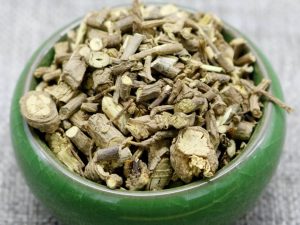
This product consists of double-seeded fruits that are cylindrical in shape, some slightly curved, 4–8 mm long, and 1.5–2.5 mm in diameter. The surface is yellowish-green or pale yellow; both ends are slightly pointed; the apex bears a residual, yellowish-brown, protruding columnar base; and the base sometimes has a minute fruit stalk. The mericarps are oblong, with 5 longitudinal ridges on the dorsal surface; the junctions are flat and relatively wide.The cross-section is slightly pentagonal, with the four sides on the dorsal surface approximately equal in length. It has a distinctive aroma and a slightly sweet, pungent taste.
Properties of Processed Slices
1. Fennel: See the “Characteristics” section for this medicinal material.
2. Roasted Fennel: Resembles fennel; the surface is pale yellow to brownish-yellow with scorched spots; the aroma is more intense.
3. Salt-Preserved Fennel: Resembles fennel; the surface is pale yellow; the aroma is more intense, with a slightly salty taste.
4. Processed Fennel: Resembles fennel in appearance; the surface is pale yellow; it has a fragrant aroma with a slight hint of alcohol and vinegar; the taste is slightly salty.
Botanical Information
Botanical Classification
Fennel, a plant of the genus Foeniculum in the Apiaceae family.
Morphological Characteristics
A perennial herb, 0.4–2 m tall. Possesses a strong aroma. The stem is erect, smooth, glabrous, gray-green or pale white; the upper part branches out widely, with fine longitudinal grooves on the surface. Stem leaves are alternate; the petioles of lower stem leaves are 5–15 cm long, while those of middle or upper leaves are sheathing at the base or entirely sheathing, with membranous margins on the leaf sheaths;the leaf blade is broadly triangular in outline, approximately 30 cm long and 40 cm wide, and four- to five-times pinnately compound; the terminal segments are filiform, 0.5–5 cm long and 0.5–1 cm wide.Compound umbels are terminal or lateral, 3–15 cm in diameter, with peduncles up to 25 cm long; there are no involucres or involucel; rays number 6–30, 1.5–10 cm long;Each umbellule bears 14–30 flowers; the pedicels are slender and unequal in length, 0.3–1.2 cm long; the flowers are small, with no calyx teeth; the petals are yellow, obovate or nearly obovate, pale yellow, approximately 1.5 mm long and 1 mm wide, curled inward from the middle upward, with a slightly concave apex;There are 5 stamens; the filaments are slightly longer than the petals; the anthers are ovoid, pale yellow, and longitudinally dehiscent; the ovary is inferior and 2-chambered; the base of the style is conical; the style is extremely short, spreading outward or lying flat against the base of the style.The compound schizocarp is oblong, 3.5–6 mm long and 1.5–2 mm wide, with 5 sharp principal ridges; each ridge groove contains 1 oil tube, and the fused surface contains 2 oil tubes; the ventral surface of the endosperm is nearly straight or slightly concave. Flowering occurs from May to June, and fruiting from July to September.
Distribution Area
It is cultivated throughout China.
Growth Habits
It prefers a humid, cool climate, is salt-tolerant, and highly adaptable; it is not particular about soil type, but flat, fertile, loose, well-drained sandy loam or slightly alkaline black soil is preferred.
Propagation Methods
Propagation is usually by seed.
Cultivation Techniques
Seed propagation: Spring sowing in March–April; fall sowing in September–October. For row sowing, dig furrows 25 cm apart with a depth of 5–7 cm; for hole sowing, dig holes with a row and plant spacing of 30 cm × 30 cm. Mix the seeds with fine soil, scatter them evenly into the furrows or holes, cover with 1.5–2.5 cm of soil, and lightly tamp down. The seed rate is 15–30 kg per hectare.Seeds germinate in 10–15 days.
Pest and Disease Control
1. Diseases include gray spot disease; to prevent this, soak seeds in 50°C water for 3–5 minutes before sowing, then let them air dry before planting.
2. Pests include the yellow-winged fennel moth, which damages the fruit; spray with 7216 microbial insecticide powder to control the larvae, achieving an effectiveness rate of 87%–99%.