Manshanhong is the name of a traditional Chinese medicine. It consists of the leaves of Rhododendron dauricum L., a plant belonging to the genus Rhododendron in the family Ericaceae. It has the effects of relieving coughs, expelling phlegm, and alleviating wheezing. It is primarily used to treat coughs, wheezing, and excessive phlegm.

Full Mountain Red
Manshanhong is the name of a traditional Chinese medicine. It consists of the leaves of Rhododendron dauricum L., a plant belonging to the genus Rhododendron in the family Ericaceae. It has the effects of relieving coughs, expelling phlegm, and alleviating wheezing. It is primarily used to treat coughs, wheezing, and excessive phlegm.
Chinese Name : 满山红
Latin Name : Rhododendri Daurici Folium
Aliases : Yingshanhong, Yingshanhong, Shanbengzi, Kaoshanhong, Dazixiang, Jindalai, Northeast Manshanhong
Nature, Flavor & Meridian Tropism : Bitter in taste, cold in nature; enters the Lung Meridian
Benefits & Efficacy
Benefits
Relieves cough, eliminates phlegm, and alleviates wheezing.
Indications
Cough, wheezing, and excessive phlegm: This herb is bitter and cold in nature, and has a good effect in resolving phlegm and relieving cough, but its effect in relieving wheezing is relatively weak.
Usage and Dosage
Internal use: Decoct 15–30 g; or steep in wine.
Precautions
Not yet established.
Chemical Constituents
The leaves and flowers contain essential oils, including rhododendronone (dauricone), hinokitiol, menthol, and α-, β-, and γ-eucalyptol. The leaves also contain various flavonoids, such as rhododendronin, hyperoside, isohyperoside, and quercetin;coumarin-like compounds, such as scopolin and umbelliferone; phenolic acids, such as vanillic acid and rhododendron alcohol; hydroquinone; and trace amounts of rhododendron toxin.
Pharmacological Actions
1. Effects on the Respiratory System: Decoctions of Rhododendron delavayi exhibit a marked antitussive effect, with rhododendronone as the primary active ingredient; aqueous solutions of Rhododendron delavayi and its active ingredient, rhododendronin, demonstrate significant expectorant activity; and alcohol-extracted aqueous solutions can counteract bronchospasm, exhibiting bronchodilatory effects. 2. Antimicrobial effects: Decoctions and ethanol extracts of Rhododendron delavayi inhibit the growth of Staphylococcus aureus, Staphylococcus albus, Streptococcus pyogenes, and Pseudomonas aeruginosa. 3. Effects on the Cardiovascular System: At appropriate doses, Rhododendron preparates exhibit digitalis-like cardiotonic effects; at high doses, they can slow the heart rate and weaken contractility. 4. In addition, Rhododendron also has a blood pressure-lowering effect.
Relevant Discussions
1. *Manual of Common Chinese Herbal Medicines in Heilongjiang*: Used to treat chronic bronchitis and bronchial asthma.
2. *Manual of Common Chinese Herbal Medicines in Northeast China*: Suppresses cough and expels phlegm. Used to treat chronic bronchitis and cough.
3. *Compendium of Medicinal Plants of the Changbai Mountains*: Used to treat chronic tracheitis; it is effective for suppressing cough and expelling phlegm, but its bronchodilatory effect is somewhat weaker.”Foreign reports indicate that this product can treat myocarditis and gastroenteritis.
Applications
Clinical Applications
It produces good results when used alone to treat cough, wheezing, excessive phlegm, and shortness of breath. It has now been formulated into Rhododendron Extract Tablets, Rhododendron Oil, and Rhododendron Softgels for clinical use.
Related Compatibility
1. Man Shan Hong combined with Loquat Leaf: Man Shan Hong is bitter and cold, specializing in expectoration and cough suppression; Loquat Leaf is bitter and slightly cold, excelling at clearing the lungs and suppressing cough. When used together, these two herbs clear the lungs, resolve phlegm, and suppress cough. This combination is suitable for coughs caused by lung heat, accompanied by counterflow of qi, shortness of breath, and thick, yellow phlegm.
2. Man Shan Hong combined with Dwarf Tea: Man Shan Hong is bitter and cold, excelling at resolving phlegm, relieving cough, and alleviating wheezing; Dwarf Tea is bitter, pungent, and neutral, excelling at relieving cough and resolving phlegm. When used together, these two herbs work synergistically to resolve phlegm and relieve cough. This combination is suitable for cough and wheezing due to lung heat with copious phlegm, or for cough and wheezing caused by cold phlegm.
Medicinal Identification
Red Mountain Flower and Dwarf Ground Tea: Both can eliminate phlegm, relieve cough, and alleviate wheezing, and both can treat symptoms of cough, wheezing, and excessive phlegm caused by external pathogens or internal imbalances. However, Red Mountain Flower excels at eliminating phlegm and relieving cough, while its effect on alleviating wheezing is relatively weak; Dwarf Ground Tea has a stronger effect on relieving cough and eliminating phlegm, and it can also clear and drain damp-heat, as well as promote blood circulation and resolve blood stasis.
Related Medicines
Full Mountain Red Oil Gel Capsules, Powerful Cough-Relief Capsules, Scutellaria and Full Mountain Red Cough-Relief Tablets (granules, oral solution, capsules), Cough and Wheezing Relief Syrup (capsules, tablets).
Processing & Preparation
Harvesting & Processing
Harvest in the fall; dry in the sun or in the shade for use.
Storage Methods
Store in a cool, dry place, protected from moisture and heat.
Crude Drug Identification
Identification
1. Cross-section of the leaf: Upper epidermal cells are rectangular, covered by a cuticle, with shield-shaped trichomes in the depressions; lower epidermal cells are nearly circular, with undulating walls, and contain stomata and shield-shaped trichomes. Guard cells are arranged in 2–3 rows; spongy cells are subcircular.The vascular bundle in the midrib is of the double-cordate type, with a ring of discontinuously arranged bundle sheath fibers in the periphery; multiple rows of thick-walled cells are present on the inner sides of the upper and lower epidermis, and the upper surface of the leaf veins bears single-celled non-glandular trichomes. Parenchyma cells and spongy cells contain clusters of calcium oxalate crystals.
2. Take 5 g of coarse powder of this product, add 50 mL of ethanol, subject to ultrasonic treatment for 15 minutes,filter; evaporate the filtrate to dryness; add 40% ethanol to the residue and dissolve it in three portions on a water bath, 10 mL each time; filter while hot; combine the filtrates; evaporate the ethanol; extract the aqueous solution with diethyl ether by shaking twice, 15 mL each time; combine the diethyl ether solutions; evaporate to dryness; dissolve the residue in 1 mL of methanol to prepare the test solution.Separately, take 5 g of reference material of Rhododendron delavayi and prepare a reference material solution using the same method. Take a reference standard of rhododendronine, dissolve it in methanol to prepare a solution containing 1 mg per mL, and use this as the reference standard solution.Test by thin-layer chromatography (General Chapter 0502): Pipette 5 μL of each of the three solutions mentioned above and apply them separately onto the same silica gel G plate. Use a developing system of toluene–ethyl acetate–formic acid (7:2:0.5) in a developing chamber pre-saturated with the developing system for 15 minutes. Develop the plate, remove it, and allow it to air-dry.spray with aluminum trichloride solution, heat at 105°C until the spots become clearly visible, and examine under a UV lamp (365 nm). In the test sample chromatogram, fluorescent spots of the same color appear at positions corresponding to those in the reference herbal material chromatogram and the reference standard chromatogram.
Properties of Crude Drugs
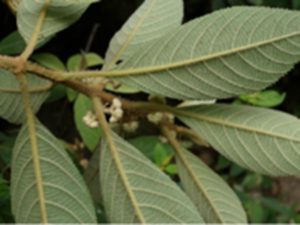
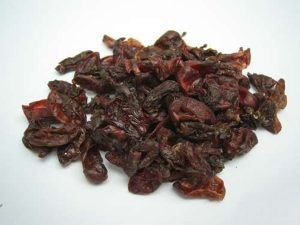
Most leaves are rolled back into a tube-like shape; some are shriveled and broken.When flattened, intact leaves are oblong or obovate, 2–7.5 cm long and 1–3 cm wide, with a blunt apex, a nearly rounded or broadly cuneate base, and entire margins. The upper surface is dark green to brownish green with scattered pale yellow glandular scales; the lower surface is grayish green with numerous glandular scales. The midrib is prominent on the lower surface, and there are 4–6 pairs of lateral veins.The petiole is 3–10 mm long and nearly leathery. It has a distinctive aromatic odor and tastes slightly bitter with a faintly pungent aftertaste. Specimens with intact leaves and a dark green color are considered superior.
Properties of Processed Slices
See “Characteristics of Medicinal Materials.”
Botanical Information
Botanical Classification
Xing’an Rhododendron (Rhododendron xinganii), a member of the genus Rhododendron in the family Ericaceae.
Morphological Characteristics
A semi-evergreen shrub, 1–2 m tall. The bark is pale gray. It is highly branched; the twigs are slender and curved, dark gray, with scales and soft hairs. The buds are ovate, and the bud scales are broadly ovate. Leaves are alternate; petioles are 2–5 mm long and finely hairy;leaf blades are nearly leathery, clustered on the upper part of the twigs, elliptic or ovate-oblong, 1–7 cm long, 1–3 cm wide, with a blunt apex bearing a short point, a cuneate base, and entire margins; the upper surface is dark green with scattered white glandular scales, while the lower surface is pale green and densely covered with glandular scales. In winter, the leaves curl into a tube and emit a fragrance when rubbed.1–4 flowers are borne at the branch tips, blooming before the leaves emerge; they are pink or purplish-red; the sepals are small and lobed, with the outer surface densely covered with scales;the corolla is funnel-shaped, about 1.8 cm long, 5-lobed, and pubescent on the outside; there are 10 stamens, protruding beyond the corolla, with pubescent filament bases; the ovary is single, with the ovary wall densely covered with glandular scales; the style is longer than the petals and persistent. The capsule is oblong, about 1.2 cm long, and dehisces at the apex. Flowering occurs from May to June, and fruiting from July to August.
Distribution Area
It is distributed in Inner Mongolia, Jilin, Heilongjiang, and other areas.
Growth Habits
Highly adaptable. Grows best in acidic or neutral sandy loam or clay loam soils; not suitable for alkaline soils.
Propagation Methods
Propagated by division.
Cultivation Techniques
Division: It is best to divide the plant in early spring or in the fall after leaf fall. Dig up the mother plant and separate it into clumps, ensuring each clump has one stem. Plant each clump in its own hole, covering the soil and firming it down. It can also be propagated by seed.