Sheep Gallbladder, a name for a traditional Chinese medicinal material. It is the bile of the goat (Capra hircus Linnaeus), sheep (Ovis aries Linnaeus), or blue sheep (Naemoredus gorul Hardwick) from the Bovidae family. It has the effects of clearing heat and detoxifying, improving vision and removing corneal opacities, and relieving coughs.It is primarily used to treat red, swollen, and painful eyes; blindness and night blindness; corneal opacities; coughs associated with pulmonary tuberculosis; febrile convulsions in children; sore throat; jaundice; dysentery; constipation; and heat-toxin sores and ulcers.
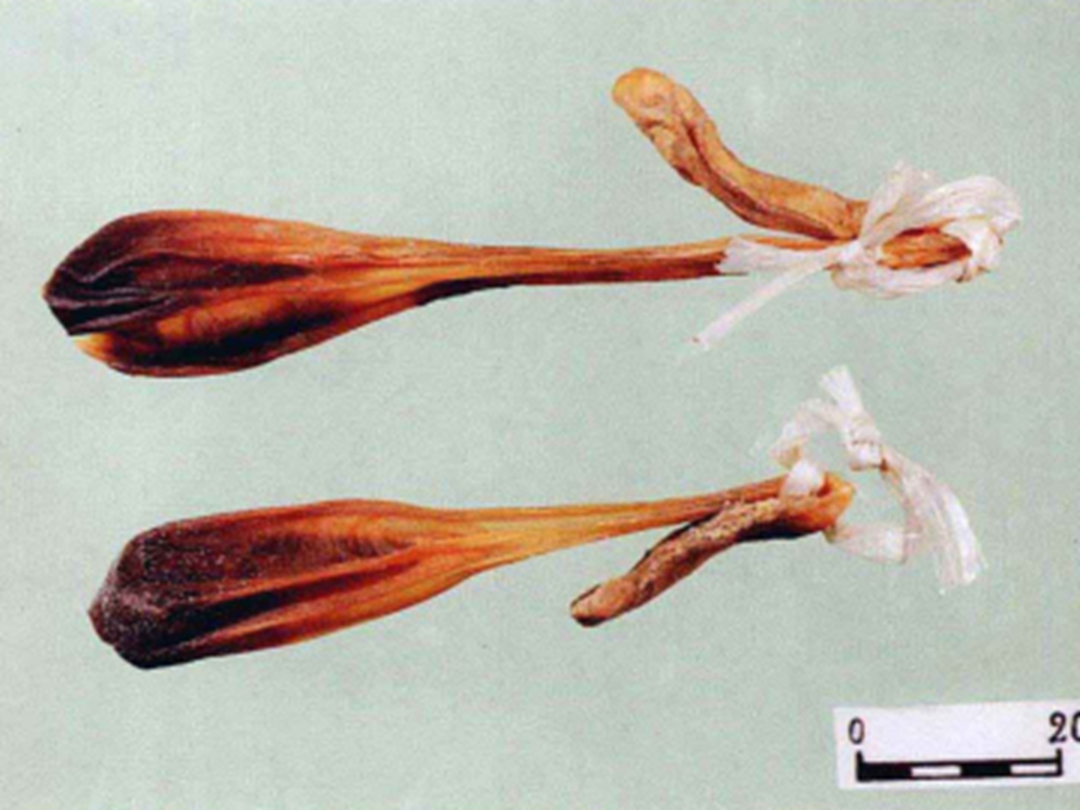
Goat Gallbladder
Sheep Gallbladder, a name for a traditional Chinese medicinal material. It is the bile of the goat (Capra hircus Linnaeus), sheep (Ovis aries Linnaeus), or blue sheep (Naemoredus gorul Hardwick) from the Bovidae family. It has the effects of clearing heat and detoxifying, improving vision and removing corneal opacities, and relieving coughs.It is primarily used to treat red, swollen, and painful eyes; blindness and night blindness; corneal opacities; coughs associated with pulmonary tuberculosis; febrile convulsions in children; sore throat; jaundice; dysentery; constipation; and heat-toxin sores and ulcers.
Chinese Name : 羊胆
Nature, Flavor & Meridian Tropism : Bitter in taste, cold in nature; enters the Liver and Gallbladder meridians
Benefits & Efficacy
Benefits
Clears heat and detoxifies; improves vision and removes corneal opacities; relieves cough.
Indications
Red, swollen, and painful eyes; blindness and night blindness; corneal opacities; cough due to pulmonary tuberculosis; febrile convulsions in children; sore throat; jaundice; dysentery; constipation; and heat-toxin sores and ulcers.
Usage and Dosage
Internal use: Prepare as a decoction or dry and grind into powder; take 0.3–0.6 g; or incorporate into pills or powders. External use: Apply an appropriate amount topically, instill into the eyes, or administer as an enema.
Precautions
*Chronicle of Sichuan Traditional Chinese Medicine* (1962 edition): “Contraindicated for those with constitutional deficiency without damp-heat.”
Chemical Constituents
The bile of goats or sheep contains bile acids, deoxycholic acid, and chenodeoxycholic acid, which are often bound to taurine and glycine. It also contains bilirubin, biliverdin, mucoprotein, cholestanol, lecithin, fatty acids, and other components.It has also been reported that the main components of sheep bile include bile acid salts; bile acids in bile are generally bound to glycine and taurine to form conjugated bile acids. Since bile is weakly alkaline, these conjugated bile acid salts are typically sodium salts. The primary bile acids in both goats and sheep are cholic acid and deoxycholic acid, with the cholic acid content in both being approximately 10 times higher than that of deoxycholic acid.
Pharmacological Actions
1. Effects on the central nervous system: Goat bile acids and their salts exhibit significant anti-penta-nitroaniline convulsive effects and possess some antipyretic properties; however, their efficacy is inferior to that of porcine bile acids. 2. Effects on the Digestive System: Sodium cholate (bile salt) is a mixture of bile salts extracted from the bile of animals such as cattle, pigs, and sheep. It is a natural cholagogue; when taken orally, it increases bile secretion, emulsifies water-insoluble fats to facilitate the action of pancreatic lipase on fats, and promotes the absorption of fat digestion products and fat-soluble vitamins A, D, K, and E.Dehydrocholic acid, derived from the oxidation of bile acids extracted from the bile of pigs, cattle, and sheep, also promotes bile secretion. It primarily increases the water content in bile without increasing its solid components; that is, it stimulates the liver to secrete large amounts of low-viscosity bile to keep the bile ducts unobstructed. Its cholagogue effect is rapid but short-lived, and it can also facilitate the expulsion of small stones from the bile ducts. In addition, dehydrocholic acid has a certain promoting effect on the digestion and absorption of fats. 3. Effects on the Respiratory System: When administered orally at 37.5 mL/kg, sheep bile exhibits a significant antitussive effect on coughing in mice induced by ammonium hydroxide aerosol, with an intensity similar to that of pig bile; an oral administration of 50 mL/kg in mice, as assessed by the phenol red test, demonstrated a significant expectorant effect, with greater potency than pig bile. 4. Antimicrobial Effects: In vitro tests showed that sheep bile exhibits a significant inhibitory effect on Bordetella pertussis, with greater potency than pig bile but less than chicken bile. At concentrations of 1/1000 and 1/100, sheep bile inhibits the growth of Mycobacterium tuberculosis (human and bovine strains) and Mycobacterium smegmatis.Other reports indicate that sheep bile exhibits a stronger inhibitory effect on Mycobacterium tuberculosis than bovine or porcine bile, with sodium taurocholate and sodium deoxycholate being its primary antitubercular components. When guinea pigs were administered sheep bile for two weeks and then inoculated with Mycobacterium tuberculosis, the organ lesions in the treated group were milder than those in the control group. 5. Other Effects: When sheep bile is co-incubated with [14C] stachyomycin (I), it oxidizes the latter into a more polar dioxide; the 2,3-double bond of stachyomycin (I) opens to form an eight-membered ring, yielding the new compound 2,18-dioxo-2,18-dihydro-stachyomycin (II).This conversion effect persists even after sheep bile is boiled to inactivate the enzymes. Intraperitoneal injection of 4 mg/kg of Compound I into mice induces severe tremors, whereas 40 mg/kg shows no tremor-inducing effect. Sheep bile can also be used to convert tremor-inducing indole diterpenes, such as phorbol, into compounds with higher polarity that are more readily eliminated. The main components of sheep bile are similar to those of bovine bile, namely cholic acid and deoxycholic acid. In addition, it contains small amounts of farnesoic acid.
Relevant Discussions
1. *The Supplementary Records*: “Blue sheep bile: Treats cataracts and improves eyesight.”
2. *Treatise on the Nature of Medicinal Substances*: “When applied to the eyes, it treats red opacities, white films, and watery eyes caused by wind; it also neutralizes poisonous insect venom.”
3. *Qianjin·Dietary Therapy*: “Blue sheep bile: Treats various sores and promotes the regeneration of blood vessels in the body.”
4. *Newly Revised Materia Medica*: “Treats malnutrition-induced dampness and epidemic heat sores; take it mixed with vinegar.”
5. *Jingzhu Materia Medica*: “Mountain goat bile kills parasites and treats toxic diseases spreading to the joints. Sheep bile promotes the healing of sores.”
6. *Ben Cao Qiu Yuan*: “Treats wind-induced tearing and dry eyes, red opacities and white cataracts, post-illness blindness, and eye injuries; promotes bowel movements; applied topically to treat hot sores in place of a finger.”
7. *Sui Xi Ju Dietary Spectrum*: “Clears gallbladder heat and replenishes bile. Specifically treats all kinds of eye diseases, and also treats sores and ulcers caused by parasitic toxins.”
8. *Qingdao Handbook of Chinese Herbal Medicine*: “Calms the liver and clears heat. Treats redness, swelling, and pain in the eyes, as well as tearing in the wind.”
9. *Illustrated Compendium of Medicinal Plants of the Qinghai-Tibet Plateau*: “Treats drug poisoning and food poisoning. Sheep bile: applied topically to stop bleeding.”
10. *Medicinal Animals of Inner Mongolia*: “Reduces inflammation, promotes tissue regeneration, and stops bleeding and pain.”
Applications
Related Compatibility
1. For swollen, painful, dry, and itchy eyes, accompanied by blurred vision, tearing, and photophobia: Take one billy goat gallbladder and steam it until cooked on top of rice. Mix it with winter honey, add a small amount of cinnabar powder, and grind repeatedly into a paste. After meals and before bedtime, take a small spoonful, hold it in the mouth, and swallow. It may also be applied directly to the eyes. (*Direct Point Formulas*: Flower and Herb Paste)
2. For treating conjunctivitis, ulcerated conjunctival inflammation, pain, itching, and photophobia, as well as gelatinous-like swelling of the eyelid skin and flesh resembling a peach or plum, accompanied by occasional hot tears: Take one ram’s gallbladder from the twelfth lunar month, fill it with honey, add a small amount of cinnabar powder, and hang it to dry in the shade. When using, place one gallbladder in a porcelain container, dissolve it in water, and instill the solution into the eyes. Alternatively, take a small amount and let it dissolve in the mouth. (*Introduction to Medicine*: Herbal Ointment)
3. For treating eye injuries caused by foreign objects: One sheep gallbladder, three chicken gallbladders, and two carp gallbladders. Break open the gallbladders, mix the contents thoroughly, and apply frequently to the affected eye. (From *Shenghui Fang*: Three Gallbladder Eye Drops Formula)
4. For treating severe constipation: Insert a sheep gallbladder into the anus using a tube, pushing it in deeply until it reaches the desired depth; it will then be expelled. (From *Qianjin Yaofang*)
5. For treating constipation in children accompanied by lower back fullness and oppression, shortness of breath, and a heavy, exhausted sensation: One sheep’s gallbladder, one he of honey, and half a liang of salt crystals. Simmer the ingredients together until they form a syrup-like consistency, then roll into a strand as thick as a tendon and about one cun long. Insert it into the lower passage; relief will follow shortly. (From *Shenghui Fang*: “Running Horse Arrow Formula”)
6. For hemorrhoidal fistulas and anal sores: In the twelfth lunar month, take one sheep’s gallbladder, mix in one fen of powdered camphor, and hang it in a breezy place to dry. When using, dissolve it in cool water and apply frequently to the affected area. Take Sophora japonica wine or the Modified Liver-Draining Decoction internally. (From *Jingyue Quanshu*: Sheep’s Gallbladder Ointment)
7. For paronychia that has not yet formed an abscess: Pour hot water over it to force the abscess to rupture; once it has drained, repeat this seven times. After each application, immerse the affected area in cold water; once finished, immerse it again. Repeat this process three times, then apply sheep gallbladder ointment. (From *Wai Tai*, citing *Cui’s Formulas*)
Processing & Preparation
Harvesting & Processing
When slaughtering a goat, open the abdomen and remove the gallbladder; tie off the bile duct tightly and hang it in a well-ventilated area to dry. Alternatively, use fresh bile in the preparation.
Crude Drug Identification
Botanical Information
Morphological Characteristics
1. Mountain Goat: Body length 1–1.2 m; weight 10–35 kg. Long head, short neck, large ears, and a narrow, elongated muzzle. Both males and females have a pair of horns on the forehead, with males having larger horns; the base of the horns is slightly triangular, the tips curve slightly backward, and the horns are hollow with a horny texture, featuring ring-like patterns on the surface or tubercles on the front.Males have a long, raceme-like beard under the jaw. The limbs are slender, the tail is short, and it does not hang down much. The entire body is covered with coarse, straight, short hair; coat colors include white, black, gray, and various black-and-white patterns. 2. Sheep: Sheep are among the earliest domesticated livestock. Their body weight varies by breed, ranging from a minimum of 20 kg to a maximum of 150–200 kg. Physical characteristics also vary widely.In some breeds, both males and females have horns; in others, neither has horns; and in still others, only males have horns. Horn shape and tail structure also vary by breed. In breeds closer to their wild ancestors, the coat consists of two layers: an outer layer of coarse hair that repels rain, and an inner layer of fine down that retains heat. However, in improved breeds, only the inner layer of down remains. Between the second and third toes of both the front and hind limbs is a gland that opens toward the front.They possess tear glands. 3. Blue Sheep: Body length 0.9–1.1 m, tail length 13–17 cm, weight approximately 30 kg. The limbs are short, and the hooves are narrow. The suborbital glands are highly reduced; they have foot glands but no inguinal glands. Both males and females have horns, which are short and straight, extending diagonally backward and upward; the bases of the two horns are very close together, and the tips curve slightly downward.The rest of the horns have ring-like ridges. The body is generally grayish-brown, though individual variation exists, ranging from dark gray to brownish-gray. There is a white spot behind the throat. The limbs, abdomen, and tail are nearly the same color as the body.
Distribution Area
1. Mountain Goats: Found throughout the country. 2. Sheep: Found throughout most of the country, with higher populations in the northern and northwestern regions. 3. Blue Sheep: Found in Northeast China, North China, and in Shaanxi, Gansu, Zhejiang, Fujian, Hubei, Guangdong, Guangxi, Sichuan, Yunnan, and Tibet.