Huaqi Orchid, a name in traditional Chinese medicine. It is the root bark of the orchid Cymbidium faberi Rolfe (family Orchidaceae). It has the effects of moistening the lungs and relieving cough, clearing and draining damp-heat, and killing parasites. It is used for coughs, cloudy and painful urination, red and white vaginal discharge, nosebleeds, ascariasis, and head lice.
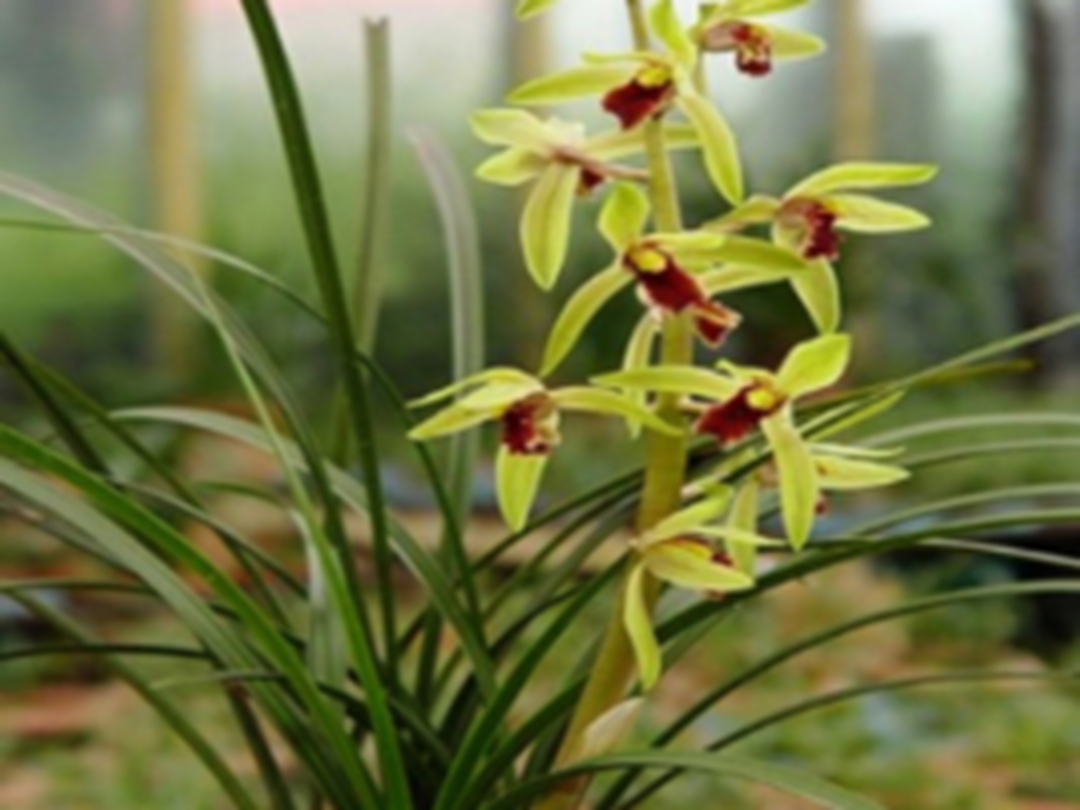
Huaqi Orchid
Huaqi Orchid, a name in traditional Chinese medicine. It is the root bark of the orchid Cymbidium faberi Rolfe (family Orchidaceae). It has the effects of moistening the lungs and relieving cough, clearing and draining damp-heat, and killing parasites. It is used for coughs, cloudy and painful urination, red and white vaginal discharge, nosebleeds, ascariasis, and head lice.
Chinese Name : 化气兰
Aliases : Tu Baibu
Nature, Flavor & Meridian Tropism : Bitter, sweet, and cool in nature. Entering the Lung and Large Intestine meridians
Benefits & Efficacy
Benefits
Moistens the lungs and relieves cough; clears and drains damp-heat; kills parasites.
Indications
Used for cough, painful and turbid urination, red and white vaginal discharge, nosebleeds, ascariasis, and head lice.
Usage and Dosage
Internal use: Decocted as a soup, 3–9 g; or incorporated into powders. External use: Apply an appropriate amount; decoct in water for washing.
Relevant Discussions
*The Supplementary Records*: “The rhizome treats fever and sweating due to typhoid fever, facial swelling caused by stroke, thirst due to internal heat, and promotes diuresis.”
Applications
Related Compatibility
1. For chronic cough: 6 g of Tu Baibu. Decoct in water and take orally; use white wine as a vehicle. One dose daily.
2. For ascariasis: 30 g of Tu Baibu. Grind into a fine powder, mix with flour to make steamed buns, and consume within 3 days.
3. For head lice: An appropriate amount of Tu Baibu. Decoct in water and use for washing. (Formulas 1–3 are from *Shaanxi Chinese Herbal Medicine*)
Processing & Preparation
Harvesting & Processing
Harvest in the fall, remove the woody core, and sun-dry.
Crude Drug Identification
Botanical Information
Botanical Classification
Orchidaceae: Cymbidium
Morphological Characteristics
Cymbidium, also known as orchid grass, nine-segment orchid, summer cymbidium, fire-burned orchid, February orchid, summer orchid, nine-seed orchid, and thread orchid.A terrestrial plant. Leaves grow in clusters of 7–9, highly erect, 25–80 cm long, approximately 1 cm wide; the middle and lower parts are often folded, the tips gradually tapering to a point, the basal joints indistinct, and the margins finely serrated; with prominent, translucent veins. The flower stalk is erect, 30–80 cm tall, greenish-white or purplish-brown, covered with several long sheaths;the raceme bears 6–12 or more flowers; the floral bracts are usually shorter than the ovary stalks, with the lowest one being longer, up to 3 cm; the flowers are pale yellowish-green; the sepals are nearly equal in size, narrowly lanceolate, 3–4 cm long, 6–8 mm wide, with acute tips;Petals slightly smaller than sepals; lip not distinctly 3-lobed, shorter than the sepals, lateral lobes erect with purple spots, median lobe elliptic, upper surface bearing translucent papillate hairs, margins ciliate, with white spots tinged with purplish-red; lip disk bearing two slightly arched folds from the base to the middle. Flowering period: April–May.
Distribution Area
Eastern China, Central and Southern China, Southwest China, and Shaanxi. Cultivated throughout these regions; numerous varieties, forms, and cultivars exist.