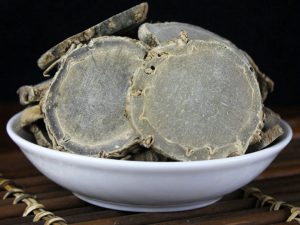
Li La Gen is the name of a traditional Chinese medicine. It consists of the roots and root bark of Rhamnus crenata Sieb. et Zucc., a plant in the Rhamnaceae family.It is distributed in Central and South China, Southwest China, as well as Shaanxi, Jiangsu, Anhui, Zhejiang, Jiangxi, Fujian, and Taiwan. It has the effects of clearing heat, detoxifying, killing parasites, and promoting diuresis. It is commonly used to treat scabies, stubborn tinea, boils, eczema, hives, ringworm of the scalp, and trauma.
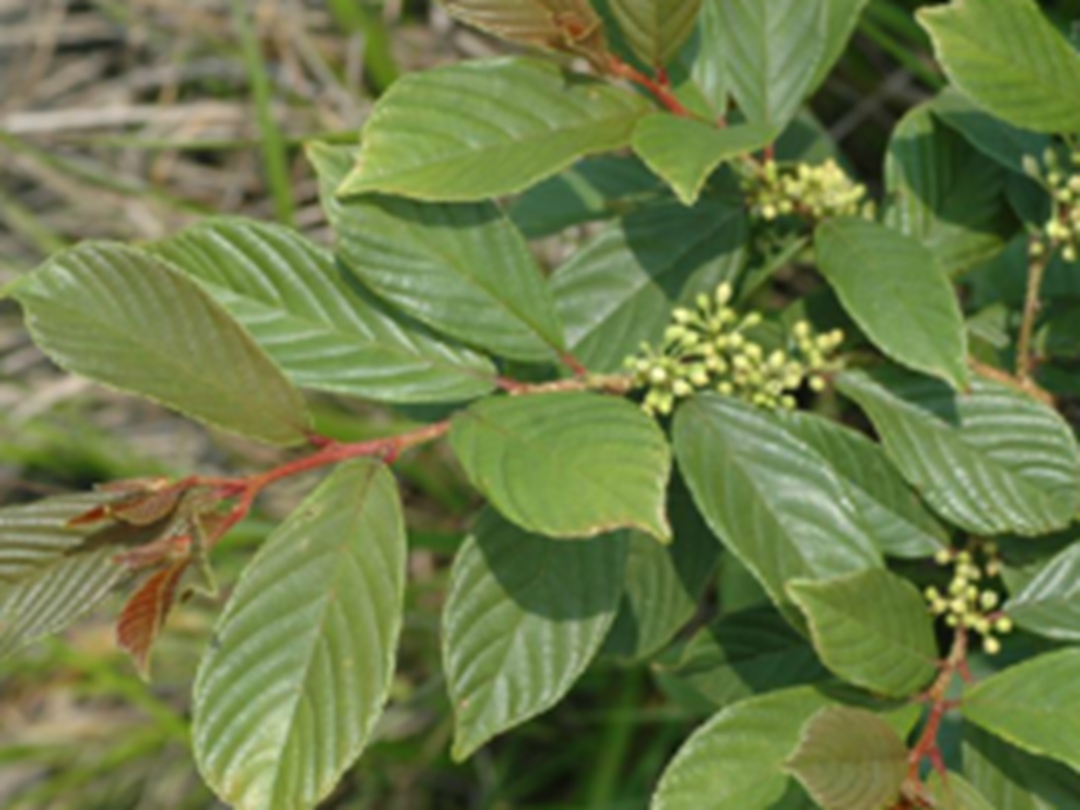
Li La Gen
Li La Gen is the name of a traditional Chinese medicine. It consists of the roots and root bark of Rhamnus crenata Sieb. et Zucc., a plant in the Rhamnaceae family.It is distributed in Central and South China, Southwest China, as well as Shaanxi, Jiangsu, Anhui, Zhejiang, Jiangxi, Fujian, and Taiwan. It has the effects of clearing heat, detoxifying, killing parasites, and promoting diuresis. It is commonly used to treat scabies, stubborn tinea, boils, eczema, hives, ringworm of the scalp, and trauma.
Chinese Name : 黎辣根
Latin Name : Rhamnus crenata Sieb. et Zucc.
Aliases : Li Luo Gen, Hong Dian Cheng, Yi Sao Guang, Tie Bao Jin, Shan Lü Li Gen, Li Tou Gen, Liu Li Gen, Tu Huang Bai, Ma Ling Xian, Na Jing, Shan Liu Li, Shan Huang, Liu Li Chai, Lai Li Chai, Ku Li Gen.
Authentic Producing Area : Central and South China, Southwest China, Shaanxi, Jiangsu, Anhui, Zhejiang, Jiangxi, Fujian, Taiwan
Nature, Flavor & Meridian Tropism : Bitter and pungent in taste; neutral in nature; enters the Liver and Large Intestine meridians
Benefits & Efficacy
Benefits
Clears heat and detoxifies; kills parasites and promotes diuresis.
Indications
Scabies, stubborn tinea, boils, eczema, urticaria, scabies-like sores, and trauma from falls or blows.
Usage and Dosage
External use: Use an appropriate amount to prepare a decoction for fumigation and washing; or pound into a paste for application; or grind into a powder and mix with a carrier for application; or grind with vinegar and rub onto the affected area. Internal use: Prepare a decoction, 3–5 g; or steep in wine.
Precautions
This product is toxic; it is primarily for external use, and caution should be exercised when taken internally.
Pharmacological Actions
1. Irritation to the skin and mucous membranes. 2. Enhances the activity of acid phosphatase.
Relevant Discussions
1. *Illustrated Compendium of Plant Names and Characteristics*: “Kills parasites and neutralizes toxins.”
2. *Hunan Materia Medica*: “Dispels wind and kills parasites; removes dampness from the spleen. Primarily used to treat scabies, leprosy-like sores, and gangrenous foot ulcers.”
Applications
Related Compatibility
1. For treating ringworm of the scalp: 9 g of mountain green hedge root. Decoct in water and drink; also use the decoction to wash and rub the affected area. (*Commonly Used Folk Herbs of Zhejiang*)
2. For treating toxic sores and ringworm: Decoct Li Luo root and leaves in water for external washing; or grind the root bark into a powder, mix with tea oil, and apply to the affected area. (*Enshi Handbook of Chinese Herbal Medicine*)
Notes
*Illustrated Compendium of Plant Names and Characteristics*: “Li La Gen grows on the hills and ridges of Changsha. It forms small clumps with fine, ochre-black stems. The leaves are long, glossy, and stiff—narrow at the base and widening toward the tip with a pointed end. The upper surface is deep green, while the underside is pale with ochre streaks. The roots near the stem are large and round, with slender tails measuring five or six cun in length. It bears fruit in autumn; the fruit is green when unripe and black when ripe. It has a sweet taste and is edible.”
Processing & Preparation
Harvesting & Processing
Harvest after autumn; use fresh or slice and sun-dry. Alternatively, peel and sun-dry.
Crude Drug Identification
Botanical Information
Botanical Classification
A plant of the Rhamnaceae family, Long-leaved Rhamnus.
Morphological Characteristics
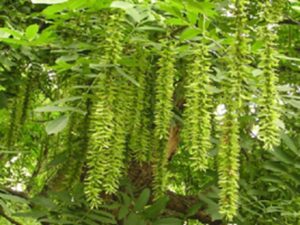
Long-leaved Rhamnus, also known as Blunt-toothed Rhamnus or Long-leaved Rhamnus. A deciduous shrub or small tree, up to 7 meters tall; young branches are reddish and hairy, later becoming glabrous; twigs are sparsely covered with soft hairs.Leaves are papery, obovate-elliptic, elliptic, or obovate, rarely oblanceolate-elliptic or oblong, 4–14 cm long and 2–5 cm wide; apex acuminate, caudate-acuminate, or abruptly reduced to a short point; base cuneate or obtuse; margin with rounded teeth or fine serrations; upper surface glabrous,the underside pubescent or more or less pubescent along the veins; 7–12 lateral veins on each side; petiole 4–10(12) mm long, densely pubescent. Flowers in clusters of several or more than 10, densely arranged in axillary cymes; main inflorescence stalk 4–10, rarely 15 mm long, pubescent; flower stalks 2–4 mm long, pubescent;sepals triangular and equal in length to the calyx tube, sparsely pubescent on the outside; petals nearly round, 2-lobed at the apex; stamens equal in length to the petals but shorter than the sepals; ovary globose, glabrous, 3-chambered, each chamber containing 1 ovule; style undivided, stigma inconspicuous.The drupe is globose or obovoid-globose, green or red, turning black or purplish-black when ripe, 5–6 mm long and 6–7 mm in diameter; the fruit stalk is 3–6 mm long, glabrous or sparsely covered with short hairs, and contains three locules, each with one seed; the seeds are ungrooved. Flowering occurs from May to August, and fruiting from August to October.
Distribution Area
Distributed in Central and South China, Southwest China, as well as Shaanxi, Jiangsu, Anhui, Zhejiang, Jiangxi, Fujian, and Taiwan.