Lianjiang, a name in traditional Chinese medicine. It is the rhizome of Rhizoma Alpiniae Chinensis, a plant in the Zingiberaceae family. It has the effects of warming the middle burner and aiding digestion, dispelling cold and relieving pain, promoting blood circulation, and relieving cough and wheezing. It is primarily used to treat cold-induced stomach pain, dysphagia and vomiting, abdominal pain and diarrhea, indigestion, cold and painful rheumatic joints, trauma, and wind-cold-induced cough and wheezing.
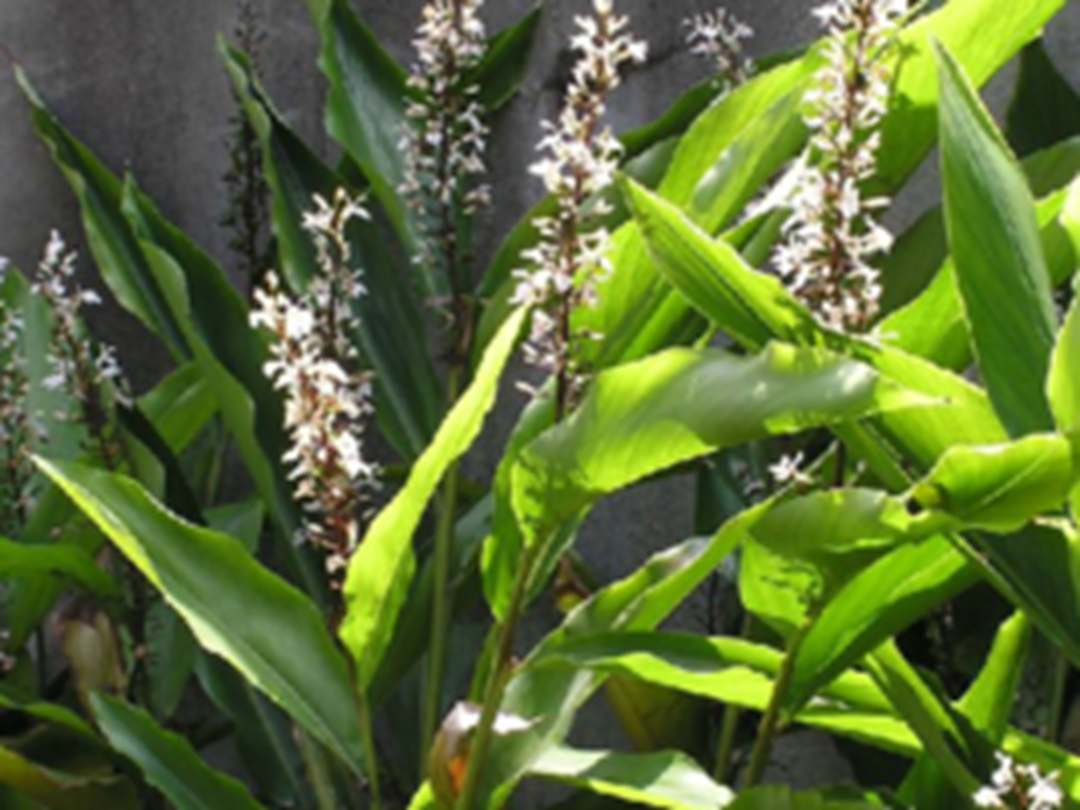
Lianjiang
Lianjiang, a name in traditional Chinese medicine. It is the rhizome of Rhizoma Alpiniae Chinensis, a plant in the Zingiberaceae family. It has the effects of warming the middle burner and aiding digestion, dispelling cold and relieving pain, promoting blood circulation, and relieving cough and wheezing. It is primarily used to treat cold-induced stomach pain, dysphagia and vomiting, abdominal pain and diarrhea, indigestion, cold and painful rheumatic joints, trauma, and wind-cold-induced cough and wheezing.
Chinese Name : 廉姜
Latin Name : Rhizoma Alpiniae Chinensis
Aliases : Yin, Jianghui, Mountain Ginger, Jianghuo, Jianganfeng, Zuogan, Jiangan, Dagan, Ginger Leaf, Epimedium
Nature, Flavor & Meridian Tropism : Pungent in taste, warm in nature; enters the Spleen, Stomach, and Liver meridians
Benefits & Efficacy
Benefits
Warms the middle burner and aids digestion; dispels cold and relieves pain; promotes blood circulation; relieves cough and calms wheezing.
Indications
Mainly used for cold-induced stomach pain, dysphagia and vomiting, abdominal pain and diarrhea, indigestion, cold pain in rheumatic joints, trauma, and wind-cold-induced cough and wheezing.
Usage and Dosage
Internal use: Decocted as a soup, 6–15 g; or steeped in wine. External use: Pounded and applied as a poultice.
Chemical Constituents
The seeds contain 0.6% oil, which includes 0.5% palmitic acid and a phenolic compound; the low-temperature fraction of the oil contains 7% 1,8-cineole, while the high-temperature fraction contains 30% α-dianthen and a sesquiterpenol. It also contains zingiberene and shanjiangene.
Pharmacological Actions
1. Effects on isolated intestinal smooth muscle: At low doses, a decoction of Huashan ginger enhances small intestinal contractions in mice and guinea pigs; at high doses, it exerts an inhibitory effect, manifested as reduced muscle tone and decreased amplitude. It can partially antagonize the tonic and tetanic contractions of the intestinal tract induced by acetylcholine or barium chloride.The non-volatile components of Huashan ginger slightly enhanced small intestinal motility in rabbits, while the volatile components initially caused mild intestinal excitation, followed by marked inhibition, characterized by decreased tone, slowed contraction frequency, and reduced amplitude. Depending on concentration, these components could partially or completely antagonize the intestinal excitation or spasm induced by acetylcholine or barium chloride. 2. Effects on intestinal propulsive motility: A 0.5 g/kg oral administration of Huashan ginger decoction to mice accelerates intestinal propulsive motility.
Relevant Discussions
1. *Supplements to the Materia Medica*: Mainly treats cold in the stomach, vomiting of water, and loss of appetite.
2. *Compendium of Materia Medica*: Warms the middle burner, descends qi, aids digestion, and enhances mental clarity.
3. *Illustrated Treatise on the Names and Realities of Plants*: Treats stomach disorders.
4. *Guizhou Herbal Medicine*: Dispels cold, relieves pain, and alleviates wheezing.
5. *Catalog of Medicinal Plants of Guangxi*: Treats cold-induced stomach disorders, dysphagia and vomiting, abdominal pain and diarrhea, and indigestion.
;
Applications
Clinical Applications
1. For stomach pain: 30g of mountain ginger. Simmer in water and drink.
2. For cold and painful rheumatic joints: 30g each of mountain ginger, heather vine, camphor tree root, and red hemp. Simmer in water and drink three times daily.
3. For wheezing and cough: An appropriate amount of mountain ginger. Soak in children’s urine for 3 days, remove and sun-dry, then steep 30g in 250g of wine. Take 15g each morning and evening.
4. For cough due to pulmonary tuberculosis: 15g each of mountain ginger, dried ginger, and walnut kernels. Steam with 30g of honey and consume. (Formulas 1–4 are from *Guizhou Herbal Medicine*)
Related Compatibility
;
Processing & Preparation
Harvesting & Processing
Harvest in the fall; remove the stems and leaves, wash thoroughly, cut into sections, and sun-dry.
Crude Drug Identification
Properties of Crude Drugs
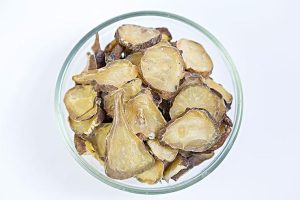
The rhizome is cylindrical or tuberous, 7–10 cm long and 0.3–1 cm in diameter, tapering to a point at the tip, and often branched. The surface is grayish-yellow or brownish-yellow, with distinct nodes; the nodes bear scale-like remnants of petioles and traces of fibrous roots. The internodes are 0.3–1 cm apart and feature relatively straight longitudinal wrinkles.The texture is hard and tough, making it difficult to break; the cross-section is pale yellow and fibrous. It has a faintly fragrant aroma and a slightly pungent taste. The best specimens are firm, stout, with a pale yellow cross-section, and a strong, fragrant aroma.
Botanical Information
Botanical Classification
A plant of the Zingiberaceae family, known as Hualang Ginger.
Morphological Characteristics
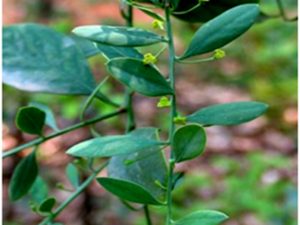
A perennial herb, approximately 1 m tall. The rhizome is creeping and fleshy. Leaves are alternate; petioles are sheathing and clasp the stem; the ligule is membranous, 4–10 mm long, bifid, and ciliate along the margins;leaf blades are lanceolate or ovate-lanceolate, 20–30 cm long and 3–10 cm wide, with an acuminate or caudate-acuminate apex, a gradually narrowing base, and both surfaces glabrous; the inflorescence is a terminal racemose panicle, 10–30 cm long, with short branches 3–10 mm long, each bearing 2–4 flowers;Bracteoles 1–3 mm long, falling off at flowering; flowers white; calyx tubular, ca. 5 mm long, 3-toothed at the apex; corolla tube slightly exceeding the calyx, corolla lobes oblong, ca. 6 mm long, the posterior one larger and sac-like; labellum ovate, 6–7 mm long, apex slightly concave; 2 lateral staminodes, awl-shaped, ca. 1 mm long;Filaments approximately 5 mm long; anthers approximately 3 mm long; ovary glabrous. Fruit globose, 5–8 mm in diameter. Flowering period: May–July; fruiting period: June–December.
Distribution Area
Distributed in Anhui, Jiangxi, Fujian, Hubei, Hunan, Guangdong, Guangxi, Sichuan, Guizhou, Yunnan, and other regions.