Niujinzi is the name of a traditional Chinese medicine. It consists of the leaves, roots, or root bark of Syzygium buxifolium Hook. et Arn., a plant in the genus Syzygium of the Myrtaceae family.It is distributed in the provinces and regions of Anhui, Zhejiang, Jiangxi, Fujian, Hubei, Guangxi, Guangdong, and Guizhou. It has the effects of clearing heat and detoxifying, as well as promoting urination and relieving asthma. It is commonly used to treat edema, asthma, burns and scalds, scrofula, boils, and lacquer dermatitis.
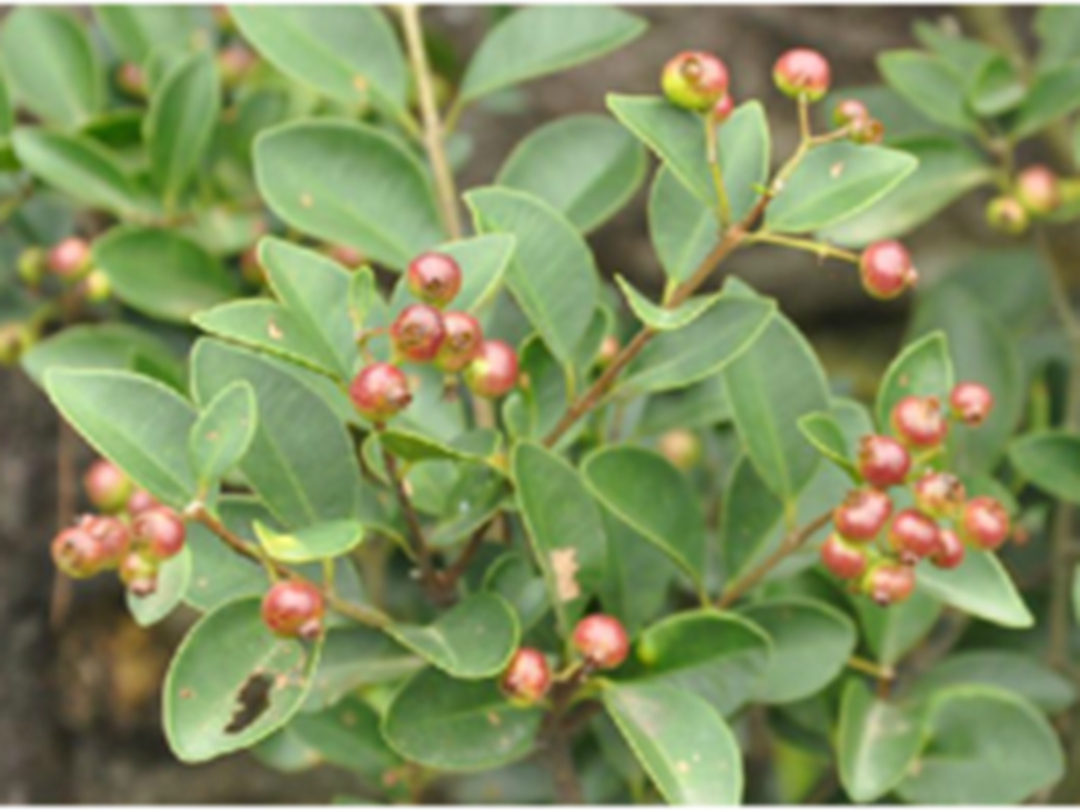
Niujinzi
Niujinzi is the name of a traditional Chinese medicine. It consists of the leaves, roots, or root bark of Syzygium buxifolium Hook. et Arn., a plant in the genus Syzygium of the Myrtaceae family.It is distributed in the provinces and regions of Anhui, Zhejiang, Jiangxi, Fujian, Hubei, Guangxi, Guangdong, and Guizhou. It has the effects of clearing heat and detoxifying, as well as promoting urination and relieving asthma. It is commonly used to treat edema, asthma, burns and scalds, scrofula, boils, and lacquer dermatitis.
Chinese Name : 牛金子
Aliases : Small-leaved Persea, Fish-scale Tree, Slender-seeded Lotus, False Boxwood, Mountain Black Pearl
Nature, Flavor & Meridian Tropism : Sweet in taste, neutral in nature
Benefits & Efficacy
Benefits
Clears heat and detoxifies; promotes urination and relieves wheezing.
Indications
Used for edema, asthma, burns and scalds, scrofula, boils, and lacquer dermatitis.
Usage and Dosage
Take 15–30 grams of the root and root bark, decoct in water, and drink the decoction; for external use, grind into a powder, mix with tea oil, and apply to the affected area. For external use, take an appropriate amount of fresh leaves, pound them into a paste, and apply to the affected area (for boils and abscesses); or decoct in water and use the liquid to wash the affected area (for lacquer dermatitis); or grind dried leaves into a powder, mix with tea oil, and apply to the affected area (for burns and scalds).
Precautions
Use with caution during pregnancy.
Applications
Notes
The wood and bark of the related species Syzygium cordatum Hochst. contain friedelin, epifriedelinol, β-sitosterol, asjunolic acid, gallic acid, ellagic acid, and tannins.The bark and leaves contain leucodelphinidin and leucocyanidin.
Processing & Preparation
Harvesting & Processing
Harvest in summer and fall, then sun-dry for later use.
Crude Drug Identification
Botanical Information
Botanical Classification
A plant of the genus Syzygium in the Myrtaceae family, specifically Syzygium chinanum.
Morphological Characteristics
A shrub or small tree, 0.5–5 meters tall. The stem is profusely branched, with quadrangular twigs. Simple leaves are opposite;with short petioles; leaf blades are leathery, highly variable in shape—elliptic, obovate, or narrowly obovate—typically 1–3 cm long and 1–2 cm wide, with a blunt or slightly acuminate apex, a gradually narrowing base, inconspicuous lateral veins, yellowish-brown when dry, and scattered glandular dots on the underside. Cymes are terminal or axillary, 2–4 cm long;Flowers are white, about 4 mm in diameter; the calyx is inversely conical, about 3 mm long, with short, blunt lobes; petals are 4, small, and fall off one by one; stamens are numerous, 3–4 mm long. The berry is ovoid, 6–10 mm in diameter, purplish-black, containing a single seed.
Distribution Area
Distributed in Anhui, Zhejiang, Jiangxi, Fujian, Hubei, Guangxi, Guangdong, Guizhou, and other provinces and regions.