Patrinia is a commonly used herb for clearing heat and detoxifying. It is the dried whole herb of Patrinia scabiosaefolia Fisch. (yellow-flowered Patrinia) or Patrinia villose Juss. (white-flowered Patrinia) from the Patriniaceae family. It has the effects of clearing heat and detoxifying, removing blood stasis and draining pus, and promoting the elimination of dampness.It is primarily used to treat intestinal abscesses, lung abscesses, boils and carbuncles, damp-heat diarrhea and dysentery, jaundice with dark urine, red, swollen, and painful eyes, and postpartum abdominal pain caused by blood stasis.

Patrinia
Patrinia is a commonly used herb for clearing heat and detoxifying. It is the dried whole herb of Patrinia scabiosaefolia Fisch. (yellow-flowered Patrinia) or Patrinia villose Juss. (white-flowered Patrinia) from the Patriniaceae family. It has the effects of clearing heat and detoxifying, removing blood stasis and draining pus, and promoting the elimination of dampness.It is primarily used to treat intestinal abscesses, lung abscesses, boils and carbuncles, damp-heat diarrhea and dysentery, jaundice with dark urine, red, swollen, and painful eyes, and postpartum abdominal pain caused by blood stasis.
Chinese Name : 败酱草
Latin Name : Herba Patrinine
Aliases : Yellow-flowered Patrinia, Dragon-bud Patrinia, Yellow-flowered Dragon-bud
Nature, Flavor & Meridian Tropism : Pungent and bitter in taste; slightly cold in nature; enters the Stomach, Large Intestine, and Liver meridians
Benefits & Efficacy
Benefits
It has the effects of clearing heat and detoxifying, removing blood stasis and expelling pus, and promoting the elimination of dampness.
Indications
It is primarily used to treat intestinal abscesses, lung abscesses, boils, carbuncles, and furuncles; damp-heat diarrhea and dysentery; jaundice with dark urine; redness, swelling, and pain in the eyes; and postpartum abdominal pain due to blood stasis.
Usage and Dosage
Internal use: Decocted, 9–15 g. External use: Apply an appropriate amount of the fresh herb, pounded into a paste, to the affected area.
Precautions
Use with caution in patients with spleen and stomach deficiency. According to *Ben Cao Hui Yan*: “It is contraindicated for patients with chronic illness resulting in stomach deficiency and spleen weakness, diarrhea with anorexia, and all diseases characterized by deficiency-cold and downward collapse.”
Chemical Constituents
Main triterpenoid constituents: Houttuynia saponins A–F, ivy saponin, oleanolic acid, etc.;flavonoids: luteolin, quercetin, rutin, isohuparin, isodulcinin, etc.; coumarins: scopolin, heptaphyllin, etc.; and also contains essential oils, cycloartenolides, and sterols.
Pharmacological Actions
This product exhibits antimicrobial, sedative, and antitumor effects.
Relevant Discussions
1. *Mingyi Bielu*: “Treats abscesses and swellings, edema, internal heat, wind-induced arthralgia due to deficiency, and postpartum pain.”
2. *Treatise on the Nature of Medicinal Substances*: “Treats stubborn arthralgia caused by toxic wind; primarily breaks up long-standing blood stasis; transforms pus into fluid; and treats various postpartum disorders.”
3. *Compendium of Materia Medica*: “It is highly effective at draining pus and breaking up blood stasis; therefore, Zhang Zhongjing used it to treat abscesses, and it is also employed in ancient gynecological formulas.”
Applications
Clinical Applications
1. For the initial stage of intestinal abscess characterized by abdominal pain and constipation, where pus has not yet formed, it is commonly used in combination with honeysuckle, dandelion, peony bark, and peach kernels; for intestinal abscesses where pus has already formed, it is commonly used with coix seed and aconite, as in the Coix Seed, Aconite, and Baijiang Powder (from *Essentials of the Golden Cabinet*).This herb can also be used to treat lung abscesses accompanied by coughing up pus and blood; it is often combined with Houttuynia cordata, Reed Rhizome, and Platycodon root. For treating abscesses, swellings, and toxic sores—whether ulcerated or not—it is commonly combined with Honeysuckle and Forsythia; it can also be pounded into a paste from the fresh herb and applied topically, both methods being effective.
2. For treating postpartum blood stasis and stabbing abdominal pain, *The Simple and Easy Formulas for Health* recommends decocting this herb alone or combining it with herbs such as Wulingzhi, Xiangfu, and Danggui.
Related Compatibility
1. Patrinia scabiosa combined with Coix seed: Patrinia scabiosa excels at clearing heat and detoxifying, as well as resolving abscesses, draining pus, removing blood stasis, and relieving pain; Coix seed is effective at clearing heat from the lungs and intestines, draining pus, and resolving abscesses. When used together, the effects of clearing heat, detoxifying, resolving abscesses, and draining pus are enhanced.This combination is suitable for cases of intestinal abscesses where pus has already formed, as well as for swollen and toxic sores.
2. Patrinia scabiosa combined with Qinpi: Patrinia scabiosa is effective at clearing and draining damp-heat and toxic heat from the stomach and intestines, and it can also remove blood stasis and relieve pain; Qinpi, which is bitter and cold in nature, excels at clearing damp-heat from the intestines and also has astringent properties to stop dysentery and vaginal discharge.When used together, these two herbs not only enhance the effect of clearing damp-heat and stasis toxins from the intestines but also provide astringent properties. This combination is suitable for dysentery, diarrhea, and leukorrhea caused by damp-heat and blood stasis stagnation in the large intestine.
Medicinal Identification
Houttuynia cordata and Fishy-smell Grass: Both herbs have a pungent, cold nature and function to clear heat, eliminate toxins, resolve abscesses, and expel pus. They are commonly used to treat heat-toxin abscesses and swellings, lung abscesses with purulent discharge, and damp-heat-induced diarrhea and dysentery.However, Patrinia scabiosa primarily enters the Stomach and Large Intestine meridians and is frequently used for intestinal abscesses, while also treating lung abscesses; it also enters the Liver meridian, where it clears and drains damp-heat and excessive fire from the liver and gallbladder, making it suitable for red, swollen, and painful eyes and damp-heat jaundice; furthermore, it can remove blood stasis and relieve pain, and is used for postpartum abdominal pain caused by blood stasis obstruction.Houttuynia cordata, on the other hand, is specifically directed to the Lung Meridian and excels at clearing and dispersing lung heat; it is a key herb for treating lung abscesses with purulent discharge and coughs caused by lung heat. It also promotes urination and relieves dysuria, making it effective for treating painful and scanty urination due to heat.
Related Medicines
Lungqing Tablets, Appendicitis Anti-inflammatory Tablets, Kangfu Anti-inflammatory Suppositories.
Related Prescriptions
Coix Seed and Baijiang Decoction (*Qianjin Fang*), Baijiang Powder (*Shenghui Fang*), Baijiang Powder (*Shenghui Fang*), Baijiang Grass Powder (*Yilue Liushu*).
Notes
Patients requiring treatment with Chinese herbal medicine should first consult a licensed Traditional Chinese Medicine (TCM) hospital, where a TCM practitioner will conduct a professional pattern differentiation and prescribe an herbal formula.
Processing & Preparation
Harvesting & Processing
Harvest before flowering in summer; sun-dry until half-dry, bundle into bundles, then dry in the shade.
Processing Methods
Remove impurities, moisten, cut into sections, and sun-dry.
Storage Methods
Store in a well-ventilated, dry place.
Crude Drug Identification
Properties of Crude Drugs
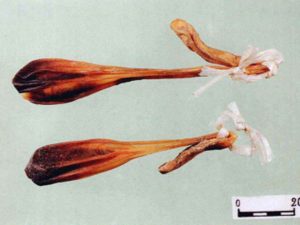
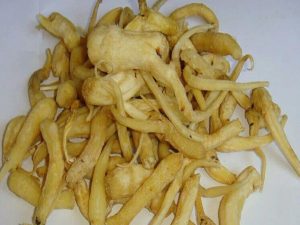
1. Yellow-flowered Patrinia: The rhizome is cylindrical and curved, 5–15 cm long and 2–5 mm in diameter, with the apical end reaching up to 9 mm in thickness; the surface is covered with cork that peels off easily and is purplish-brown or dark brown; nodes are arranged at varying densities and bear bud scars and root scars; the cross-section is fibrous, with a brown “wood core” in the center.The roots are oblong-conical or oblong-cylindrical, 2–8 mm in diameter; the surface is yellowish-green or yellowish-brown, with longitudinal ridges and fine striations, and bears appressed coarse hairs. The stem is cylindrical, with longitudinal ridges and nodes; the surface is yellowish-green to yellowish-brown, often bearing appressed coarse hairs; it is brittle, and the cross-section reveals a pith in the center. Stem leaves are mostly curled or fragmented.Both surfaces are sparsely covered with white hairs; when intact, the leaves are deeply pinnately or fully lobed, with 5–11 lobes and serrated margins; leaves on the upper part of the stem are smaller and often 3-lobed. Some branch tips bear inflorescences or fruit clusters; the florets are yellow. The achenes are oblong, without membranous wing-like bracts. It has a distinctive odor and a slightly bitter taste.
2. White Patrinia: The rhizome is short, up to about 10 cm long; some specimens have slender, creeping stems. The cross-section lacks a brown “wooden core”; the stem is smooth, with a diameter of up to 10 cm; intact leaves are ovate or oblong, entire or with a single pair of small lobes at the base; flowers are white, with membranous bracts, most of which have two main veins.
Properties of Processed Slices
This product consists of irregular mid-section segments. The stem is cylindrical, with a pale yellowish-brown surface and longitudinal ridges. The leaf blades are shriveled, grayish-green, and have sparse notches along the margins. The texture is brittle. It has a faint odor and a slightly bitter taste.
Botanical Information
Botanical Classification
A plant of the Bignoniaceae family, specifically Yellow-flowered Bignonia or White-flowered Bignonia.
Morphological Characteristics
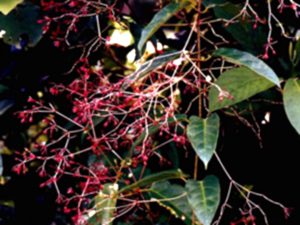
1. Yellow-flowered Patrinia: A perennial herb, 70–130 cm tall. The underground rhizome is slender and elongated, growing horizontally or obliquely, with a distinctive odor. Basal leaves grow in a tuft with long petioles and wither during flowering; stem leaves are opposite; petioles are 1–2 cm long, with upper leaves becoming gradually sessile;the leaf blades are 2–3 pairs of deeply pinnately lobed, 5–15 cm long; the central lobe is the largest, elliptic or ovate, while the lateral lobes are narrowly elliptic to linear, with acuminate tips; the leaf margins are coarsely serrate, and both surfaces are sparsely covered with coarse hairs or glabrous.Cymose panicles are aggregated into sparse, large corymbs, axillary or terminal; the main inflorescence stalk is usually coarsely hairy only on the opposite sides or on one side only; at the base of the inflorescence, there is a pair of linear bracts, very small; flowers are about 3 mm in diameter; the calyx is short, with 5 calyx teeth that are inconspicuous;the corolla is yellow, 5-lobed at the top, with a short corolla tube; there are 4 stamens, nearly as long as the corolla; the ovary is 3-chambered, with 1 chamber developed. The achene is oblong, 3–4 mm long; the margins are slightly flattened, extending from the back toward both sides to form narrow wings. Flowering period: July–September.
2. White-flowered Patrinia: A perennial herb, 50–100 cm tall. The rhizome has a distinctive foul odor; stems and branches are covered with coarse white hairs, which gradually fall off. Basal leaves are clustered; petioles are slightly longer than the leaf blades; leaf blades are broadly ovate or nearly round, with coarse serrations along the margins; cauline leaves are opposite; petioles are 1–3 cm long, with upper leaves becoming nearly sessile;the leaf blades are ovate, rhombo-ovate, or narrowly elliptic, 4–11 cm long and 2–5 cm wide, with apices acuminate to narrowly long-acuminate. The base is cuneate and extended downward; the leaves are pinnately divided into two pairs, and both surfaces are sparsely covered with rough, appressed hairs or nearly glabrous. The inflorescence is a cymose panicle, aggregated into a sparse, large corymb; the bracts are ovate-lanceolate;The calyx is small, with 5 inconspicuous calyx teeth; the corolla is white, approximately 5 m in diameter, with a short tube and 5-lobed apex; there are 4 stamens, which are exserted; the ovary is inferior, and the style is slightly shorter than the stamens. The achene is obovate, with persistent bracts that are adnate; the bracts are nearly circular, with prominent reticulate veins on the membranous surface.
Distribution Area
It is found in most regions of China.
Growth Habits
It prefers slightly moist environments and is tolerant of severe cold. It can be cultivated in most types of soil, but grows best in relatively fertile sandy loam.
Propagation Methods
Propagation is by seed or division.
Cultivation Techniques
1. Seed propagation: Sow seeds in March–April in a 1-meter-wide seedbed using row sowing, covering them with 0.5–1 cm of soil. Keep the soil moist after sowing; seedlings will emerge in about half a month. Once seedlings reach 3–6 cm in height, thin them once; transplant to the field in May or early June.
2. Division: In April–May, dig up mature plants or uproot and transplant young seedlings growing naturally around them. Space rows 30–40 cm apart and plants 25–30 cm apart, planting 2–3 seedlings per hole. Propagation by cuttings is also possible.
3. Field Management: Apply manure 2–3 times during the growing season.