Scutellaria baicalensis, a traditional Chinese medicine. It is the dried root of Scutellaria baicalensis Georgi, a plant in the genus Scutellaria of the Lamiaceae family. It has the effects of clearing heat and drying dampness, purging fire and detoxifying, stopping bleeding, and stabilizing pregnancy.It is primarily used to treat damp-heat syndromes, summer-heat with dampness, chest tightness and nausea, damp-heat-induced epigastric fullness, diarrhea and dysentery, jaundice, cough due to lung heat, high fever with thirst, blood-heat-induced vomiting and nosebleeds, abscesses, swellings, and toxic sores, as well as fetal restlessness.

Scutellaria
Scutellaria baicalensis, a traditional Chinese medicine. It is the dried root of Scutellaria baicalensis Georgi, a plant in the genus Scutellaria of the Lamiaceae family. It has the effects of clearing heat and drying dampness, purging fire and detoxifying, stopping bleeding, and stabilizing pregnancy.It is primarily used to treat damp-heat syndromes, summer-heat with dampness, chest tightness and nausea, damp-heat-induced epigastric fullness, diarrhea and dysentery, jaundice, cough due to lung heat, high fever with thirst, blood-heat-induced vomiting and nosebleeds, abscesses, swellings, and toxic sores, as well as fetal restlessness.
Chinese Name : 黄芩
Latin Name : Scutellariae Radix
Aliases : Fuchang, Huangwen, Duwu, Hongsheng, Jingqin, Yintou, Neixu, Kongchang, Ziqin, Suqin, Tiaojin, Yuanqin, Tujin Tea Root, Camellia Root
Authentic Producing Area : Hebei, Shanxi, Inner Mongolia, Shaanxi
Nature, Flavor & Meridian Tropism : Bitter in taste, cold in nature; enters the Lung, Gallbladder, Spleen, Stomach, Large Intestine, and Small Intestine meridians
Benefits & Efficacy
Benefits
Clears heat and dries dampness; purges fire and detoxifies; stops bleeding; stabilizes pregnancy.
Indications
Damp-heat, summer-heat with dampness, chest tightness and nausea, damp-heat-induced fullness and distension, diarrhea and dysentery, jaundice, lung-heat cough, high fever with restlessness and thirst, blood-heat-induced vomiting and epistaxis, abscesses, swellings, and toxic sores, and fetal restlessness.
Usage and Dosage
Oral use: Decocted, 3–10 g. For clearing heat, it is typically used raw; for stabilizing pregnancy, it is often stir-fried; for clearing heat in the upper jiao, it may be wine-roasted; for stopping bleeding, it may be stir-fried until charred.
Precautions
1. Scutellaria baicalensis is bitter and cold in nature and may damage the stomach; it should not be used by individuals with spleen-stomach deficiency-cold. 2. Vitamin C can break down the glycosides in Scutellaria baicalensis into aglycones and sugars, thereby affecting its therapeutic efficacy; therefore, it should not be used concurrently. 3. Scutellaria should not be used concurrently with digitalis glycosides, as this may lead to digitalis toxicity. 4. Propranolol can significantly inhibit the blood pressure-lowering effect of Scutellaria and should not be used concurrently. 5. Scutellaria injection is extremely incompatible with penicillin and should not be used concurrently.
Chemical Constituents
This product contains baicalin, baicalein, baicalin, baicalein, baicalin, phenylacetone, palmitic acid, oleic acid, proline, benzoic acid, myrosinase, β-sitosterol, and other components.
Pharmacological Actions
Scutellaria baicalensis exhibits antimicrobial, antipyretic, anti-inflammatory, anti-allergic, and detoxifying effects.
Relevant Discussions
1. *Shennong Bencao Jing*: “It treats various types of fever and jaundice, intestinal diarrhea and dysentery, expels excess fluid, relieves blood stasis, and treats malignant sores, ulcerative lesions, and inflammatory abscesses.”
2. *Herbal Materia Medica of Southern Yunnan*: “When directed upward, it clears lung fire; when directed downward, it clears bladder fire. It treats the five types of dysuria in men and sudden uterine bleeding in women; it regulates menstruation and clears heat; it alleviates fetal restlessness caused by heat; it clears fetal heat; and it eliminates excess fire and heat in the Six Meridians.”
3. *Ben Cao Zheng*: “The dried form clears fire in the Upper Jiao, dissipates phlegm, promotes the flow of qi, alleviates wheezing and coughing, stops bleeding, relieves alternating chills and fever, treats wind-heat and damp-heat conditions, and alleviates headaches; it also alleviates epidemic diseases, clears the throat, and treats pulmonary fistulas and mastitis with back abscesses. It is particularly effective at dispelling heat from the muscles and skin, and thus treats rashes, scrofula, sores and ulcers, and red eyes;The ‘Shí’ variety cools heat in the lower jiao; it can eliminate bloody dysentery, heat stagnation in the bladder, the five types of dysuria with burning pain, constipation, and bloody stools or chronic bleeding.”
Applications
Clinical Applications
1. For treating damp-heat and summer-heat syndromes, where damp-heat obstructs the flow of qi, leading to chest tightness, nausea, vomiting, low-grade fever that fails to rise, and a yellow, greasy tongue coating, it is often combined with talc, white cardamom, and akebia, as in the Scutellaria and Talc Decoction (*Treatise on the Differentiation of Warm Diseases*);To treat damp-heat obstruction in the middle jiao, manifesting as epigastric fullness and vomiting, it is combined with Coptis, Dried Ginger, and Pinellia, as in the Pinellia and Coptis Decoction (Shanghan Lun); to treat diarrhea and dysentery caused by damp-heat in the large intestine, it is combined with Coptis and Pueraria root, as in the Pueraria, Scutellaria, and Coptis Decoction (Shanghan Lun); to treat damp-heat jaundice, it may be combined with Yinchen and Zhizi.
2. To treat cough with thick phlegm caused by stagnant lung heat, it may be used alone, such as in Qingjin Pills (*Danxi’s Heart Methods*); to treat lung-heat cough and shortness of breath, it is combined with Bitter Apricot Kernel, Mulberry Bark, and Perilla Seed, such as in Qingfei Decoction (*Revival of Ten Thousand Diseases*);to treat cough with copious phlegm caused by lung heat, it may be combined with Pinellia, as in the Scutellaria and Pinellia Pills (from *Compendium of Pocket-Sized Formulas*).
3. To treat symptoms such as hemoptysis and epistaxis caused by intense fire-toxin forcing blood to flow uncontrollably, it is often combined with Rheum officinale, as in the Rheum Decoction (from *Shengji Zonglu*); to treat other hemorrhagic conditions, it is combined with Sanguisorba officinalis and Sophora japonica flowers to treat bloody stools due to blood heat; or combined with Angelica sinensis to treat metrorrhagia and menorrhagia, as in the Scutellaria and Angelica Pills (from *Gujin Yijian*).
4. To treat abscesses, swellings, and skin infections caused by intense fire-toxin, it is often combined with Coptis, Phellodendron, and Gardenia, such as in the Coptis Detoxifying Decoction (*Secret Essentials from the Outer Pavilion*); to treat hemorrhoids with heat and pain due to stagnant heat-toxin, it is combined with Coptis, Rhubarb, Sophora Flower, and others.
5.To treat fetal restlessness due to blood heat, it can be combined with Sheng Di Huang (raw Rehmannia root), Huang Bai (Phellodendron bark), and other herbs, such as in the Bao Yin Decoction (*Jingyue Quanshu*); to treat fetal restlessness due to qi deficiency with blood heat, it is combined with Bai Zhu (Atractylodes), such as in the Qin Zhu Decoction (*Yixue Rumen*); to treat fetal restlessness due to kidney deficiency with heat, it is combined with Shu Di Huang (prepared Rehmannia root), Xu Duan (Dipsacus root), Ren Shen (Ginseng), and other herbs, such as in the Taishan Pan Shi Powder (*Jingyue Quanshu*).
Related Compatibility
1. Scutellaria baicalensis combined with Coptis chinensis: Both are bitter and cold herbs that clear heat and purge fire. Scutellaria baicalensis excels at clearing lung fire, while Coptis chinensis is effective at purging fire from the heart and stomach and eliminating damp-heat in the middle jiao.When used together, this combination excels at purging pathogenic heat from the upper and middle Jiao, and its effects in clearing heat, drying dampness, purging fire, and detoxifying are significant. It is suitable for conditions such as high fever, headache, red and swollen eyes, swollen gums, and mouth and tongue sores caused by intense heat in the middle and upper Jiao, as well as damp-heat diarrhea or dysentery.
2. Scutellaria baicalensis combined with Paeonia lactiflora: Scutellaria baicalensis clears heat and dries dampness, excelling particularly in clearing lung fire and eliminating damp-heat from the large intestine; Paeonia lactiflora consolidates yin fluids, relieves urgency, and alleviates pain. When used together, these two herbs clear heat to stop dysentery and consolidate yin to relieve pain. This combination is suitable for treating damp-heat dysentery.Additionally, Scutellaria can dispel heat from the blood and clear fetal fire, thereby clearing heat without harming the fetus; White Peony Root nourishes liver yin and harmonizes the blood. When used together, they work synergistically to clear heat without harming the fetus and nourish the body’s vital energy without impeding qi circulation. This combination is suitable for conditions such as rebellious liver qi, spleen-stomach disharmony, and morning sickness with diarrhea or dysentery in pregnant women.
3. Scutellaria baicalensis combined with Asparagus cochinchinensis: Scutellaria baicalensis excels at clearing and purging lung heat; Asparagus cochinchinensis moistens dryness, clears the lungs, nourishes the kidneys, and reduces fire. When used together, these two herbs combine clearing and moistening effects, balancing tonification and purgation, thereby enhancing the ability to clear and purge lung heat. Furthermore, Asparagus cochinchinensis moderates the bitter and drying nature of Scutellaria baicalensis that could otherwise injure yin.This combination is indicated for dry cough with scant phlegm and a dry, hoarse throat caused by lung heat with yin deficiency or lung deficiency with dry heat; for upper-body consumption syndrome (shang xiao) characterized by restlessness, thirst, excessive fluid intake, and frequent urination due to lung-kidney yin deficiency and ascending deficient fire; and for the late stage of lung abscess, where vital energy has been depleted but residual pathogenic factors remain.
4. Scutellaria baicalensis combined with Magnolia officinalis: Scutellaria baicalensis clears heat, dries dampness, purges fire, and detoxifies;Houpo dries dampness, dispels fullness to regulate the spleen, promotes the flow of qi, resolves stagnation, and relieves distension. When these two herbs are combined—one warm, one cold; pungent to open, bitter to descend—they not only clear heat and transform dampness but also regulate qi and relieve distension, thereby eliminating dampness, subduing fire, and harmonizing the flow of qi. This combination is suitable for epigastric and abdominal fullness, distension, and oppression caused by damp-heat in the spleen and stomach, accompanied by a thick, yellow, greasy tongue coating.
5. Scutellaria baicalensis combined with Aquilaria agallocha: Scutellaria baicalensis excels at clearing lung fire and is also effective at eliminating damp-heat from the large intestine; Aquilaria agallocha can invigorate the spleen and stomach, eliminate food stagnation, promote the flow of qi, and relieve pain. When used together, these two herbs can drain damp-heat and regulate the gastrointestinal tract. This combination is suitable for treating damp-heat dysentery with symptoms of tenesmus and a sensation of incomplete evacuation.
6. Scutellaria baicalensis combined with Morus alba bark: Scutellaria baicalensis excels at clearing and purging lung heat; Morus alba bark clears lung heat, resolves phlegm, descends qi, and relieves wheezing. When used together, their ability to clear lung heat is significantly enhanced, jointly achieving the effects of clearing lung heat, relieving wheezing, and suppressing cough. This combination is indicated for wheezing and cough caused by severe lung heat.
7. Scutellaria baicalensis combined with Amomum villosum: Scutellaria baicalensis can clear heat from the uterus without harming the fetus; Amomum villosum can regulate qi and stabilize the pregnancy. When used together, these two herbs not only stabilize the pregnancy but also clear heat and regulate qi. This combination is suitable for fetal restlessness and morning sickness caused by upward surging fetal heat and irregular qi movement.
Medicinal Identification
Raw Scutellaria, Steamed Scutellaria, Boiled Scutellaria, Cold-Infused Scutellaria, Wine-Processed Scutellaria (Roasted Scutellaria),Charred Scutellaria: Scutellaria is a commonly used Chinese herbal medicine. In addition to the raw form, there are various processed forms used in medicine, including steamed Scutellaria, boiled Scutellaria, cold-soaked Scutellaria, wine-processed Scutellaria, and charred Scutellaria; among these, wine-processed Scutellaria is the most commonly used.Raw Scutellaria baicalensis possesses strong properties for clearing heat, purging fire, and detoxifying; it is often used for heat invading the Qi level, damp-heat jaundice, and mastitis or back abscesses. The purpose of steaming or decocting Scutellaria baicalensis is to inactivate enzymes, preserve active ingredients, and soften the herb to facilitate slicing.Wine-processed Scutellaria penetrates the blood division; the alcohol propels the herb upward, making it suitable for treating lung heat in the upper burner and damp-heat in the muscles and skin of the limbs. At the same time, it moderates Scutellaria’s bitter and cold nature to prevent damage to spleen yang, which could lead to abdominal pain. Charred Scutellaria primarily clears heat and stops bleeding; it is used for metrorrhagia, menorrhagia, and other abnormal uterine bleeding caused by uncontrolled blood heat, as well as for hemoptysis and epistaxis.
Related Medicines
Ganlu Disinfection Pills, Lung-Clearing and Fire-Suppressing Pills, Throat-Clearing and Diaphragm-Relieving Pills, Compound Scutellaria Tablets, and Scutellaria-Coptis Tablets.
Related Prescriptions
Scutellaria and Talc Decoction (*Treatise on the Differentiation of Warm Diseases*), Pinellia and Coptis Decoction (*Treatise on Cold Damage*), Pueraria, Scutellaria, and Coptis Decoction (*Treatise on Cold Damage*), Clear Qi and Resolve Phlegm Pills (*Examination of Medical Formulas*), and Cooling the Diaphragm Powder (*Formulas of the Bureau of Medicinal Preparations*).
Medicinal Diet Therapy
1. Coix Seed and Scutellaria Wine
(1) Efficacy: Clears heat and detoxifies; dispels wind and removes dampness. Mainly used to treat beriberi, stiffness and spasms of the limbs, pain caused by wind-toxin, stiffness of the neck and back, and slurred speech.
(2) Ingredients: 50 grams of Coix Seed, 10 grams of Antelope Horn Shavings, 30 grams of Fangfeng, 20 grams of Shengma, 20 grams of Qin Jiao, 20 grams of Scutellaria, 15 grams of Diguipi, 15 grams of Zhike, 20 grams of Qianghuo, 50 grams of Niuxi, 30 grams of Wujiapai, 20 grams of Duhuo,20 g Arctium lappa seeds, 20 g Cinnamomum cassia, 50 g Rehmannia glutinosa (raw), 2.5 liters of white liquor.
(3) Preparation: Rinse all 15 herbs thoroughly, grind them into a fine powder, and place the mixture in a white muslin bag, tying it securely. Place the bag in a clean container, cover with white liquor, and seal the container. Store in a cool, dry place for 7 days, then open, strain to remove the residue, and set aside.
(4) Usage: Drink warm in any amount before each meal.
2. Scutellaria and Pork Lung Soup
(1) Effects: Clears heat and promotes lung function; resolves phlegm and relieves cough; alleviates wheezing.
(2) Ingredients: 15 g of Scutellaria baicalensis (soaked in wine), 6 g of Perilla seeds, 10 g of ginger, 500 g of pork lung, and salt, garlic, scallion segments, soy sauce, and MSG to taste.
(3) Preparation: Wash the pork lung thoroughly, then blanch it in boiling water to remove blood. Cut into chunks and set aside. Wrap the wine-soaked Scutellaria, Perilla seeds, and ginger in a cloth, place them together in a clay pot, and simmer until tender. Add the seasonings to finish.
(4) Usage: Serve as an accompaniment to meals.
3. Scutellaria Lung-Clearing Decoction
(1) Effects: Clears lung heat and relieves stagnation. Can treat acne caused by internal heat.
(2) Ingredients: 9 grams of Scutellaria baicalensis, 6 grams of Angelica sinensis, 6 grams of Carthamus tinctorius, 9 grams of Ligusticum chuanxiong, 9 grams of Paeonia rubra, 9 grams of Rehmannia glutinosa, 9 grams of Pueraria lobata, 9 grams of Pollen, and 1 gram of Mentha haplocalyx.
(3) Preparation: Place all herbs in a pot, add enough water to cover them, bring to a boil over high heat, then reduce to low heat and simmer for about 30 minutes.
(4) Dosage: Take one small bowl twice daily, in the morning and evening, for one week.
Notes
Patients requiring treatment with Chinese herbal medicine should first consult a licensed Traditional Chinese Medicine (TCM) hospital to receive a prescription following a professional TCM differential diagnosis.
Processing & Preparation
Harvesting & Processing
Harvest in spring or autumn; remove stems, leaves, fibrous roots, and soil; sun-dry until half-dry, then knock off the coarse outer bark; dry thoroughly.
Processing Methods
1. Scutellaria: Take the raw herb, remove impurities, boil in water for 10 minutes, remove, let stand until thoroughly softened, slice thinly, and dry; or steam for 30 minutes, remove, slice thinly, and dry (avoid exposure to direct sunlight).
2. Roasted Scutellaria: Place Scutellaria slices in a pan and roast over low heat until yellow; remove and allow to cool.
3. Charred Scutellaria: Place Scutellaria slices in a pan and roast over high heat until dark brown; spray with a small amount of clean water to extinguish all embers; remove and allow to cool completely.
4. Wine-processed Scutellaria: Take Scutellaria slices, mix thoroughly with yellow wine, let them soak until thoroughly moistened, place in a pan, and stir-fry over low heat until deep yellow; remove and let cool.
5. Ginger-processed Scutellaria: Take Scutellaria slices, mix thoroughly with ginger juice, let them soak until thoroughly moistened, place in a pan, and stir-fry over low heat until dry; remove and let cool.
6. Honey-processed Scutellaria: Melt the honey and strain it; reheat until it begins to bubble, then add the Scutellaria slices and stir-fry until they turn a light yellow. Alternatively, spray with water, stir until the water evaporates, then continue stir-frying until yellow and no longer sticky to the touch; remove and air-dry.
Storage Methods
Store in a well-ventilated, dry place away from moisture; for wine-processed Scutellaria baicalensis, store in an airtight container.
Crude Drug Identification
Identification
1. The powder of this product is yellow. Bast fibers occur singly or in bundles of several, spindle-shaped, 60–250 μm long, 9–33 μm in diameter, with thick walls and fine pits. Stone cells are round, square-like, or rectangular, with relatively thick or very thick walls. Cork cells are brownish-yellow and polygonal.Reticulate vessels are common, with a diameter of 24–72 μm. Wood fibers are mostly fragmented, with a diameter of approximately 12 μm and sparse oblique pores. Starch grains are very numerous; single grains are subglobose, 2–10 μm in diameter, with a distinct hilum; compound grains consist of 2–3 subgrains.
2. Take 1 g of the powdered sample, add 30 mL of a mixed solution of ethyl acetate and methanol (3:1), heat and reflux for 30 minutes, allow to cool, filter, evaporate the filtrate to dryness, dissolve the residue in 5 mL of methanol, and use the supernatant as the test solution.Separately, take 1 g of Scutellaria baicalensis reference herbal material and prepare a reference herbal material solution using the same method. Then, take baicalin, baicalein, and wogonoside reference standards and dissolve them in methanol to prepare solutions containing 1 mg, 0.5 mg, and 0.5 mg per mL, respectively, as the reference standard solutions.Perform the test according to the thin-layer chromatography method (General Chapter 0502). Pipette 2 μL each of the test solution and the reference herbal material solution, and 1 μL each of the three reference substance solutions, and apply them separately onto the same polyamide membrane. Use a developing system of toluene-ethyl acetate-methanol-formic acid (10:3:1:2) as the developing agent, pre-saturated for 30 minutes, then developed. The plate was removed, air-dried, and examined under ultraviolet light (365 nm).In the chromatogram of the test sample, spots of the same color appear at positions corresponding to those in the chromatogram of the reference herbal material; three identical dark spots appear at positions corresponding to those in the chromatogram of the reference standards.
Properties of Crude Drugs
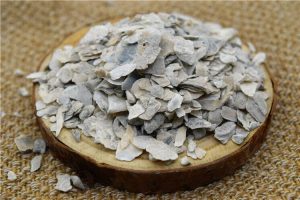
The roots are conical, often twisted, 8–25 cm long, and 1–3 cm in diameter. The surface is brownish-yellow or deep yellow, with sparse, wart-like marks from fine roots; the upper part is relatively rough, with twisted longitudinal wrinkles or irregular reticulate patterns, while the lower part has longitudinal striations and fine wrinkles. The texture is hard and brittle; the roots break easily. The fracture surface is yellow, with a reddish-brown center;The center of old roots is rotten or hollow, dark brown or brownish-black in color, and is known as “Ku Qin” (dried Scutellaria root). It has a faint odor and a bitter taste.
Properties of Processed Slices
1. Scutellaria Root: Thin, nearly circular or irregular slices with a yellow surface and a reddish-brown center; some may have a dark brown or brownish-black, decayed-looking center; the periphery is brownish-yellow or deep yellow. It is hard and brittle. It has a faint odor and a bitter taste.
2. Roasted Scutellaria Root: Resembles Scutellaria Root but has a darker color.
3. Charred Scutellaria: Resembles Scutellaria, but is dark brown and has a burnt charcoal odor.
4. Wine-Infused Scutellaria: Resembles Scutellaria, is brownish-yellow, and has a slight wine aroma.
5. Ginger-Processed Scutellaria: Resembles Scutellaria, with a sour and pungent taste.
6. Honey-Processed Scutellaria: Resembles Scutellaria, with a slightly sweet taste.
Botanical Information
Botanical Classification
Scutellaria baicalensis, a plant of the genus Scutellaria in the Lamiaceae family.
Morphological Characteristics
A perennial herb; the rhizome is thick, fleshy, up to 2 cm in diameter, elongated, and branched. The stem is prostrate at the base and ascending, 30–120 cm tall, with a basal diameter of 2.5–3 mm; it is bluntly quadrangular, finely striated, nearly glabrous or covered with curved to spreading fine soft hairs, green or purplish, and branched from the base.Leaves are stiffly papery, lanceolate to linear-lanceolate, 1.5–4.5 cm long, 0.5–1.2 cm wide, with a blunt apex and a rounded base; entire margins; dark green above, glabrous or sparsely covered with appressed to spreading fine soft hairs;the underside is paler, glabrous or sparsely covered with fine soft hairs along the midvein, and densely covered with sunken glandular dots; there are 4 pairs of lateral veins, which are sunken on the upper surface and prominent on the lower surface relative to the midvein; the petiole is short, 2 mm long, concave on the ventral side and convex on the dorsal side, and covered with fine soft hairs.Inflorescences are terminal on stems and branches, racemose, 7–15 cm long, often aggregating into panicles at the stem apex; pedicels are 3 mm long, both the pedicels and the rachis are covered with fine soft hairs; lower bracts are leaf-like, while upper bracts are much smaller, ovate-lanceolate to lanceolate, 4–11 mm long, nearly glabrous.The calyx is 4 mm long at flowering, with a 1.5 mm high shield; the outer surface is densely covered with fine soft hairs, the calyx margin is sparsely pubescent, and the inner surface is glabrous; at fruiting, the calyx is 5 mm long, with a 4 mm high shield. The corolla is purple, purplish-red to blue, 2.3–3 cm long, densely covered with glandular short soft hairs on the outer surface, and covered with short soft hairs on the inner surface at the sac-like swelling;the corolla tube is distinctly geniculate near the base, with a diameter of 1.5 mm in the middle and widening to 6 mm at the throat; the corolla lobes are bilabiate, with the upper lip helmet-shaped and slightly notched at the apex, and the lower lip’s central lobe triangular-ovate, 7.5 mm wide, while the lateral lobes are fused to the upper lip.There are 4 stamens, slightly protruding; the anterior pair is longer, with half-anthers, and the degenerate half-anthers are inconspicuous; the posterior pair is shorter, with complete anthers, the anther fissures bearing white bristles, and the dorsal surface bearing vesicular hairs; the filaments are flattened, with the anterior pair bearing sparse, small soft hairs on the inner surface below the middle, and the posterior pair bearing such hairs on both sides.The style is slender and elongated, with an acute apex and slightly notched. The disk is annular, 0.75 mm high, slightly enlarged at the front, and extending posteriorly into a very short ovary stalk. The ovary is brown and glabrous. The nutlets are ovoid, 1.5 mm high and 1 mm in diameter, blackish-brown, tuberculate, and bear a fruit umbilicus on the ventral surface near the base. Flowering occurs from July to August, and fruiting from August to September.
Distribution Area
It is distributed in Northeast China, as well as Hebei, Shanxi, Inner Mongolia, Shandong, Henan, Shaanxi, and Gansu.
Growth Habits
It prefers a warm, cool climate and is tolerant of severe cold, drought, and poor soil; the underground parts of mature plants can withstand temperatures as low as -30°C. It is best cultivated in full sun, in deep, fertile, neutral or slightly alkaline loam or sandy loam. It does not tolerate continuous cropping.
Propagation Methods
Propagation is carried out using seeds, cuttings, and root division.
Cultivation Techniques
1. Propagation by Seed
(1) Direct Seeding: Direct seeding is the primary method of propagation. Scutellaria baicalensis grown by direct seeding develops straight roots with few root forks, resulting in superior commercial appearance and quality, while also saving labor. Direct seeding is typically carried out in the spring, generally when the soil temperature at a depth of 5 cm stabilizes between 12°C and 15°C; in northern regions, this usually occurs around early to mid-April.
(2) Seedling Transplanting Method: The seedling transplanting method conserves seeds, extends the growing period, and helps ensure full emergence of seedlings; however, it is relatively labor-intensive. Furthermore, Scutellaria roots transplanted via this method tend to have shorter primary roots and more root forks, resulting in poorer commercial appearance and quality. This method is generally used when seeds are expensive or when direct seeding in dry fields is difficult due to water shortages, making it hard to ensure germination and seedling survival.
2. Propagation by Cuttings
Although propagation by cuttings is possible, it is rarely used in production. The key to successful propagation lies in the timing of planting and the selection of cuttings. The highest survival rate is achieved when cuttings are taken in spring, specifically from May to June. Cuttings should be selected from tender parts of the stem where the tips are semi-lignified; the survival rate can reach over 90%.
3. Rhizome Division
This involves digging up the ungerminated rhizomes of three-year-old Scutellaria baicalensis, cutting off the main root for medicinal use, and then dividing the rhizome into several pieces according to its natural shape. Each piece should have 2–3 bud eyes and can then be planted. Although rhizome division results in rapid growth, the propagation rate is too low, so this method is rarely used in production.
Pest and Disease Control
1. Leaf Blight: Clean the field and garden; at the onset of the disease, spray a 1:1:200 Bordeaux mixture or a 1,000-fold dilution of 50% carbendazim for control.
2. Root Rot: Ensure proper drainage and practice crop rotation; promptly remove and burn diseased plants, and disinfect the soil around the affected area with lime.
3. Scutellaria moth: Control with 90% diazinon.