Sasheng is the name of a traditional Chinese medicine. It refers to the roots of the following plants in the Campanulaceae family: Sasheng (Adenophora stricta Miq.), Apricot-leaf Sasheng (Adenophora hunanensis Nannf.), Wheel-leaf Sasheng (Adenophora tetraphylla (Thunb.) Fisch.),Yunnan Sashen (Adenophora khasiana (Hook.f. et Thoms.) Coll. et Hemsl.), Pao Sashen (Adenophora potaninii Korsh.), and several other species within the same genus. It has the effects of nourishing yin and clearing heat, moistening the lungs and resolving phlegm, and benefiting the stomach and promoting fluid production.It is commonly used for chronic cough due to yin deficiency, consumptive cough with blood-tinged sputum, dry cough with scant sputum, throat obstruction due to deficiency-heat, and thirst caused by fluid depletion.

Sha Shen
Sasheng is the name of a traditional Chinese medicine. It refers to the roots of the following plants in the Campanulaceae family: Sasheng (Adenophora stricta Miq.), Apricot-leaf Sasheng (Adenophora hunanensis Nannf.), Wheel-leaf Sasheng (Adenophora tetraphylla (Thunb.) Fisch.),Yunnan Sashen (Adenophora khasiana (Hook.f. et Thoms.) Coll. et Hemsl.), Pao Sashen (Adenophora potaninii Korsh.), and several other species within the same genus. It has the effects of nourishing yin and clearing heat, moistening the lungs and resolving phlegm, and benefiting the stomach and promoting fluid production.It is commonly used for chronic cough due to yin deficiency, consumptive cough with blood-tinged sputum, dry cough with scant sputum, throat obstruction due to deficiency-heat, and thirst caused by fluid depletion.
Chinese Name : 沙参
Latin Name : Adenophorae Strictae Radix
Aliases : Zhimu, White Saponaria, Bitter Heart, Shimei, Tiger’s Whiskers, White Ginseng, Zhiqu, Wenhu, Wenxi, Goat’s Milk, Southern Saponaria, Bell Ginseng, Soaked Ginseng, Dried Ginseng, Mountain Saponaria, Sand Otter Fruit
Authentic Producing Area : Jiangsu, Anhui, Zhejiang, Henan, Guizhou, Yunnan, Sichuan, etc.
Nature, Flavor & Meridian Tropism : Sweet and slightly bitter in taste; slightly cold in nature; enters the Lung and Stomach meridians
Benefits & Efficacy
Benefits
Nourishes yin and clears heat; moistens the lungs and resolves phlegm; benefits the stomach and generates body fluids.
Indications
Chronic cough due to yin deficiency; consumptive cough with bloody sputum; dry cough with scant sputum; throat obstruction due to deficiency-heat; thirst due to fluid depletion.
Usage and Dosage
Internal use: Decocted as a soup, 10–15 g; fresh product, 15–30 g; or incorporated into pills or powders.
Precautions
Contraindicated for those with wind-cold coughs.
Chemical Constituents
Shan Shen contains β-sitosterol, β-sitosterol-β-D-glucopyranoside, taraxacone, and octacosanoic acid.
Pharmacological Actions
Shan Shen has effects such as regulating immune balance, resolving phlegm, combating fungi, and strengthening the heart.
Relevant Discussions
1. *The Classic of Herbal Medicine*: “Treats blood stasis and startled qi; eliminates cold and fever; tonifies the middle jiao; benefits lung qi; long-term use is beneficial to health.”
2. *The Supplementary Record*: “Treats stomach bi syndrome with pain in the heart and abdomen; resolves heat-pathogen stagnation; relieves headaches; clears pathogenic heat from the skin; stabilizes the five viscera; and tonifies the middle jiao.”
3. *Treatise on the Nature of Medicinal Substances*: “It dispels superficial wind affecting the skin and muscles, treats hernias and prolapse, alleviates constant drowsiness, nourishes liver qi, and disperses wind-pathogen in the five viscera.”
Applications
Clinical Applications
1. For lung-heat cough: Half a liang of Saponaria root, decocted in water and taken orally. (*Simple and Easy Formulas for Health*)
2. For chronic bronchitis, cough, difficult expectoration, and dry mouth: 9g of Southern Saponaria root, 9g of Ophiopogon tuber, 6g of raw licorice, and 9g of Polygonatum rhizome. Decoct in water and take orally. (*Qingdao Handbook of Chinese Herbal Medicine*)
3. For various deficiency syndromes: 1 liang of Saponaria root; take a young chicken, remove its intestines, place the Saponaria root inside the chicken’s abdomen, and simmer in a clay pot until tender; consume the chicken. (*Herbal Materia Medica of Southern Yunnan*)
4. For red or white vaginal discharge caused by emotional distress or deficiency-cold in the lower jiao: Take Saponaria root powder mixed with rice porridge. (*Essential Formulas for Diagnosis and Treatment*)
5. For lack of breast milk after childbirth: Boil 12g each of apricot leaves and Saponaria root with pork and consume the mixture. (*Hunan Materia Medica*)
Notes
Patients requiring treatment with traditional Chinese medicine should first consult a licensed TCM hospital, where a TCM practitioner will conduct a professional diagnosis and prescribe the appropriate herbal formula.
Processing & Preparation
Harvesting & Processing
Harvest 2–3 years after sowing. Dig up the roots in the fall, remove the stems, leaves, and fibrous roots, wash off the soil, and while still fresh, scrape off the outer bark with a bamboo strip, slice, and sun-dry.
Processing Methods
1. Saponaria Root: Take the raw herb, remove impurities and the root crown, wash thoroughly, moisten thoroughly, cut into thick slices, and dry.
2. Honey-coated Saponaria: Take refined honey, dilute it with an appropriate amount of boiling water, add it to the Saponaria slices, mix thoroughly, and let it steep until thoroughly infused. Place the mixture in a pot, heat over low heat, and stir-fry until it turns a yellow-orange color and no longer sticks to the hands. Remove and let cool. Use 25 kg of refined honey for every 100 kg of Saponaria slices.
Storage Methods
Store in a dry container; keep honey-coated sand ginseng tightly sealed and place in a well-ventilated, dry location to prevent insect infestation.
Crude Drug Identification
Properties of Crude Drugs
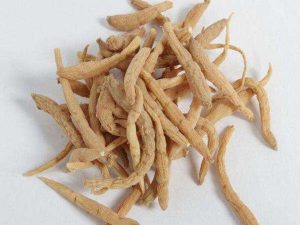
1. Sachin: The root is cylindrical or conical, sometimes curved or twisted, with a few having 2–3 branches; it is 8–27 cm long and 1–4.3 cm in diameter. The surface is yellowish-white or pale brownish-yellow, relatively rough, with irregular, twisted wrinkles; the upper part has fine, dense transverse striations, and the depressions often retain remnants of brownish-black cork.The apical corm (rhizome) is usually single, rarely multiple, 2–7 cm long, with numerous semilunar stem scars around the circumference, giving it a disc-like appearance. The texture is hard and brittle; it breaks easily, with an uneven fracture surface that is off-white, fissured, and relatively spongy. It has a faint odor and a slightly sweet and bitter taste.
2. Apricot-Leaf Scrophularia: The root is conical, with very few branches in the lower part, 9–17 cm long, and 0.7–2 cm in diameter. The surface is grayish-yellow or grayish-brown, without annular rings, and has longitudinal wrinkles. The apical corm is 1.4–8.8 cm long, with disc-like nodes that may be distinct or indistinct. The fracture surface is uneven, off-white, and relatively firm.
3.Wheel-Leaf Scrophularia: The root is cylindrical, with few branches, 5.5–14 cm long, and 0.5–2 cm in diameter. The surface lacks longitudinal wrinkles, and the upper part bears annular rings. The fracture surface is uneven, white, and hollow.
4. Yunnan Scrophularia: The root occasionally branches, 5–25 cm long, and 1–3.5 cm in diameter; the upper part has numerous transverse striations, while the lower part has curved longitudinal striations or deep grooves.The crown is 0.5–4 cm long. The fracture surface is white with numerous fissures.
5. Soaked Saponaria: The root is cylindrical, rarely branched, 8–14 cm long, and 0.9–3 cm in diameter, with annular rings on the surface. The crown is 3–6.5 cm long with densely spaced nodes. The fracture surface is uneven, pale yellowish-white, spongy, and hollow.
Properties of Processed Slices
1. Sand Ginseng: Round or nearly round thick slices; the surface is yellowish-white or nearly white, with numerous irregular fissures forming a mottled pattern. The edges are pale brownish-yellow and shriveled. Light in texture. Odorless, with a slightly sweet taste.
2. Honey-Preserved Sand Ginseng: Resembles Sand Ginseng slices; the surface is orange-yellow or burnt-yellow, occasionally with scorched spots; sweet in taste.
Botanical Information
Botanical Classification
Plants of the Campanulaceae family: Saponaria, Apricot-Leaf Saponaria, Wheel-Leaf Saponaria, Yunnan Saponaria, and Soaked Saponaria.
Morphological Characteristics
1. Scrophularia: A perennial herb with a stem 40–80 cm tall. Unbranched, often covered with short, stiff hairs or long, soft hairs. Basal leaves are heart-shaped, large, and long-petiolate; cauline leaves are sessile, or only the lower leaves have extremely short, winged petioles; leaf blades are elliptical or narrowly ovate, with a wedge-shaped base, 3–11 cm long, and 1.5–5 cm wide.The apex is acute or shortly acuminate, with irregularly serrated margins; both surfaces are sparsely covered with short hairs or long stiff hairs, or nearly glabrous. The inflorescence is usually unbranched, forming a pseudraceme, or may have short branches forming a very narrow panicle; very rarely, it has long branches forming a panicle;The pedicel is less than 5 mm long; the calyx is usually covered with short soft hairs or granular hairs, rarely glabrous; the tube is usually obovate, rarely obovate-conical; the lobes number 5, are narrow and elongated, mostly awl-shaped, rarely linear-lanceolate; the corolla is broadly campanulate, blue or purple, glabrous or bristly on the outside; the lobes number 5 and are triangular-ovate;the disk is short-tubular and glabrous; there are 5 stamens, with filaments expanded into lamellae at the base and slender anthers; the style is usually slightly longer than the corolla, with a 3-lobed stigma; the ovary is inferior and 3-chambered. The capsule is ellipsoid-globose, very rarely ellipsoid, 6–10 mm long.Seeds are numerous, brownish-yellow, slightly flattened, with one ridge, and approximately 1.5 mm long. Flowering and fruiting occur from August to October.
2. Apricot-leaved Scrophularia: This species differs from Scrophularia in that the cauline leaves on the upper part of the stem are sessile or have only a short, wedge-shaped petiole; the leaf base often extends downward in a wedge shape; and the basal leaves have long petioles.The inflorescence branches are stout, almost spreading or arching upward; the calyx lobes are ovate to long-ovate, widest in the middle to lower part, usually more or less overlapping, 1.5–4 mm wide; the disk is often hairy, rarely glabrous; the style is as long as the corolla. Flowering period: July–September.
3. Whorled-leaved Scrophularia: This species differs from the previous three in that its leaves are arranged in 3–6 whorls and are ovate to linear-lanceolate. The inflorescence branches are also often arranged in whorls; the disk is relatively short, 2–4 mm long, with a diameter not exceeding 1 mm; the corolla is minute, nearly tubular, slightly constricted at the mouth, with lobes approximately 2 mm long. Flowering period: July–September.
4.Yunnan Scrophularia: This species differs from the previous three in that the stem is often covered with white, multicellular stiff hairs; the cauline leaves are evenly distributed along the stem; they are usually sessile, with leaf blades ranging from ovate to long-ovate or obovate, sparsely covered with rough hairs on the upper surface and densely covered with stiff hairs on the lower surface, or with stiff hairs only along the veins. The inflorescence is a pseudo-raceme; the disk is short and tubular, not exceeding 1 mm in length; the calyx margin has 1–3 pairs of small teeth.Flowering period: August–October.
5. Poria-type Saponaria: This species differs from each of the previous four in that the stem is usually densely covered with short, backward-pointing stiff hairs; the cauline leaves are sessile, with only very rare instances of a wedge-shaped short petiole; the leaf blades are ovate-elliptic, oblong, narrowly elliptic, or obovate, hairy on both surfaces, with 2 to several coarse teeth along the margin.Inflorescences are usually branched at the base; the disk is hairy; the style is nearly as long as the corolla. Flowering period: July–October; fruiting period: October–November.
Distribution Area
1. Sand Ginseng: Distributed in Jiangsu, Anhui, Zhejiang, Jiangxi, Hunan, and other areas. 2. Apricot-leaved Sand Ginseng: Distributed in Hebei, Shanxi, Shaanxi, Jiangxi, Henan, Hubei, Hunan, Guangdong, Guangxi, Sichuan, Guizhou, and other areas. 3. Whorled-leaved Sand Ginseng: Distributed in Northeast China, North China, East China, Southwest China, and South China. 4. Yunnan Sand Ginseng: Distributed in Sichuan, Yunnan, and Tibet. 5. Soaked Saponaria: Found in Shanxi, Shaanxi, Ningxia, Gansu, Qinghai, Sichuan, and other regions.
Growth Habits
It prefers warm or cool climates and is cold-tolerant. Although it can withstand drought, it requires adequate moisture during the growing season; drought during the seedling stage often causes seedling death. It is best cultivated in deep, fertile, humus-rich, well-drained sandy loam soil.
Propagation Methods
Propagated by seed.
Cultivation Techniques
Sowing can be done in spring or winter. In northern regions, spring sowing takes place in April, while winter sowing is done in November before the ground freezes. Prepare the soil and apply ample base fertilizer—45,000–60,000 kg of compost or manure per hectare.After preparing the soil, create ridges 1 m wide and dig shallow furrows with a row spacing of 40 cm. Scatter the seeds evenly into the furrows, cover with 1–1.5 cm of soil, lightly firm the soil, water, and keep the soil consistently moist. Seeds sown in the spring will germinate in about two weeks, while those sown in the winter will germinate in the following spring.
Pest and Disease Control
1. Diseases include root rot, which can be treated by spraying with a 500-fold dilution of 50% Tebuconazole wettable powder. Brown spot disease can be treated by spraying with a 500-fold dilution of 65% Zinc Dithion wettable powder.
2. Pests include aphids and cutworms.