Wolf Purple Grass, a name in traditional Chinese medicine. It refers to the leaves of Lycopsis orientalis L., a plant in the Boraginaceae family. It is distributed in North China, Northwest China, and other regions. It has detoxifying, anti-inflammatory, and analgesic properties. It is commonly used to treat sores and swellings.

Wolf Purple Grass
Wolf Purple Grass, a name in traditional Chinese medicine. It refers to the leaves of Lycopsis orientalis L., a plant in the Boraginaceae family. It is distributed in North China, Northwest China, and other regions. It has detoxifying, anti-inflammatory, and analgesic properties. It is commonly used to treat sores and swellings.
Chinese Name : 狼紫草
Latin Name : Lycopsis orientalis L.
Aliases : Wild Dry Tobacco
Authentic Producing Area : Northern and Northwestern China
Nature, Flavor & Meridian Tropism : Pungent in taste, warm in nature; enters the Liver meridian
Benefits & Efficacy
Benefits
Detoxifies, reduces inflammation, and relieves pain.
Indications
Sores and swellings.
Usage and Dosage
External use: Apply an appropriate amount of crushed leaves to the affected area.
Precautions
Not yet established.
Relevant Discussions
*Xinhua Bencao Gangyao*: “Leaves: Have anti-inflammatory and analgesic effects. Pound the leaves into a paste and apply to the affected area to treat sores and swellings.”
Applications
Processing & Preparation
Harvesting & Processing
Harvest in summer and sun-dry for later use.
Crude Drug Identification
Properties of Crude Drugs
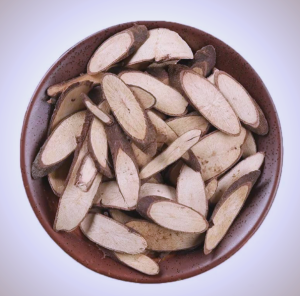
The leaves are mostly broken and curled, herbaceous in texture, blackish-brown or greenish-brown, and covered with white bristles on the surface; intact leaves are ovate-oblong, ovate-lanceolate, or narrowly elliptical, with a pointed or bluntly rounded apex, an asymmetrical base, and irregularly wavy-toothed margins. They have a faint odor and a slightly bitter taste; when chewed, they are initially crisp and then become sticky and moist.
Botanical Information
Botanical Classification
*Lupulinum*, a plant of the Boraginaceae family.
Morphological Characteristics
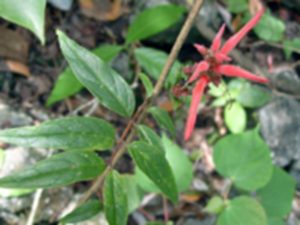
An annual herb. The stem is 10–40 cm tall, often branching from the lower part, and bears spreading, sparse, long, stiff hairs. Basal and lower stem leaves are petiolate, while the remaining leaves are sessile; they are oblanceolate to linear-oblong, 4–14 cm long and 1.2–3 cm wide, sparsely covered with stiff hairs on both surfaces, and have slightly wavy, small teeth along the margins.Inflorescences have a short flowering period and gradually elongate to 25 cm after flowering; bracts are smaller than the leaves, ovate to linear-lanceolate; pedicels are about 2 mm long, elongating to 1.5 cm at fruiting; the calyx is about 7 mm long, 5-lobed to the base, with semi-appressed stiff hairs; lobes are awl-shaped, slightly unequal in length, enlarging at fruiting and spreading in a star-like pattern;The corolla is bluish-purple, sometimes purplish-red, about 7 mm long, glabrous; the tube is slightly geniculate at the base; the lobes are spreading, slightly wider than long; the appendages are verrucose to scaly and densely covered with short hairs; the stamens are attached below the middle of the corolla tube; the filaments are extremely short; the anthers are about 1 mm long; the style is about 2.5 mm long; the stigma is globose and 2-lobed.The nutlet is reniform, pale brown, 3–3.5 mm long, about 2 mm wide, with a reticulate surface and small wart-like dots; the attachment surface is cup-shaped, with an entire margin. The seed is brown; the cotyledons are narrowly ovate and fleshy; the radicle is superior.
Distribution Area
It is distributed in North China, Northwest China, and other regions.